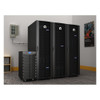
Vertiv AS5A0NCUGNNXLKB 5KVA Lithium-Ion Scalable UPS
Overview
The Vertiv AS5A0NCUGNNXLKB is a 5KVA lithium-ion UPS with N+1 redundancy scaling to 15KVA — built for data centers, edge deployments, and mission-critical infrastructure where battery longevity, thermal tolerance, and low total cost of ownership are the deciding factors over the life of the installation. If you're evaluating this against traditional VRLA-based UPS systems, the lithium chemistry alone changes the calculus on replacement cycles, footprint per kilowatt-hour, and performance in warm environments.
Explore the full Vertiv power protection catalog or browse the broader uninterruptible power supply category to compare capacity tiers and form factors.
Key Features
- LiFePO₄ Lithium-Ion Chemistry: Lithium Iron Phosphate is the safest lithium variant — lower thermal runaway risk than NMC or NCA chemistries. For deployments in enclosed server rooms or edge cabinets with limited ventilation, LiFePO₄ is the specification to require, not just prefer.
- Up to 10-Year Service Life: VRLA batteries typically cycle out every 3–5 years. A 10-year design life on the AS5A0NCUGNNXLKB means you're potentially cutting battery replacement events in half over a 10-year ownership window — a real labor and logistics cost reduction in multi-site deployments.
- Scalable from 5KVA to 15KVA N+1: Start at 5KVA and scale to a 15KVA N+1 configuration as load grows — without replacing the base unit. For IT architects planning phased infrastructure buildouts, this avoids the over-provisioning trap of buying capacity you won't use for 3 years.
- Sub-4.5-Hour Recharge Time: The AS5A0NCUGNNXLKB recharges in under 4.5 hours. After a sustained outage, that turnaround matters: you're back to full protection within a half-shift rather than waiting 12–24 hours as with some VRLA designs.
- Better Performance at Higher Temperatures: Lithium-Ion chemistry maintains capacity at elevated ambient temperatures where VRLA batteries derate significantly. For edge deployments — telecom closets, manufacturing floors, outdoor cabinets — this is a meaningful operational advantage without requiring supplemental cooling.
- Approximately 46 lbs per Battery String: At roughly 46 lbs per string, the weight profile is substantially lighter than equivalent-capacity VRLA installations. This matters for floor load calculations in older facilities and for the physical logistics of replacing or adding strings without specialized lift equipment.
- Advanced BMS with Cell-Level Monitoring: The battery management system monitors at the cell level — not just at the string or module level. Cell-level visibility means degradation is caught before it becomes a capacity shortfall, and service events are predictive rather than reactive.
- Minimal Maintenance Profile: Fewer scheduled maintenance interventions compared to VRLA reduce operational overhead — particularly relevant for unmanned edge sites where sending a technician on-site has a real cost per visit.
- 5-Year Warranty on UPS and Batteries: The manufacturer warranty covers both the UPS unit and the battery strings for 5 years. In a category where battery warranties are often decoupled and shorter than the unit warranty, a unified 5-year term simplifies procurement and support planning.
- Lower Total Cost of Ownership: Fewer replacements, less maintenance labor, longer intervals between service events, and better performance under real-world thermal conditions combine to reduce lifecycle cost compared to VRLA alternatives of equivalent capacity.
Integration and Compatibility
The AS5A0NCUGNNXLKB is designed for integration into data center and edge infrastructure environments requiring scalable, redundant power protection. The N+1 architecture supports deployment alongside intelligent rack PDUs for downstream load monitoring. For enterprises planning full power chain management, pair with network-connected monitoring solutions to expose battery health and runtime estimates to your DCIM or network operations platform. The cell-level BMS telemetry supports predictive maintenance workflows — consult your power infrastructure integration documentation for SNMP and management card compatibility details specific to your NMS environment.
Frequently Asked Questions
Q: What is the warranty on the Vertiv AS5A0NCUGNNXLKB?
A: The AS5A0NCUGNNXLKB carries a 5-year manufacturer warranty covering both the UPS unit and the battery strings — an unusually unified coverage term for this product class.
Q: How long does the AS5A0NCUGNNXLKB take to recharge after a full discharge?
A: Recharge time is under 4.5 hours, meaning you can return to full runtime protection within a half-shift following a sustained outage — significantly faster than many VRLA-based alternatives.
Q: How much does the AS5A0NCUGNNXLKB weigh per battery string?
A: Each battery string weighs approximately 46 lbs — considerably lighter than equivalent-capacity VRLA strings, which simplifies installation and reduces floor load concerns in retrofit deployments.
Q: Can the AS5A0NCUGNNXLKB be scaled up after initial installation?
A: Yes. The system starts at 5KVA and can be scaled to a 15KVA N+1 configuration, allowing phased capacity expansion without replacing the base unit as load requirements grow.
Q: Is the AS5A0NCUGNNXLKB suitable for deployments in warm or high-temperature environments?
A: The LiFePO₄ lithium-ion chemistry performs better at higher ambient temperatures than VRLA batteries, which derate significantly as temperature rises. This makes it well-suited for edge deployments in telecom closets, manufacturing environments, or locations with limited climate control.
Q: What makes the LiFePO₄ chemistry in the AS5A0NCUGNNXLKB safer than other lithium chemistries?
A: Lithium Iron Phosphate (LiFePO₄) has a significantly lower thermal runaway risk compared to NMC or NCA lithium chemistries. Combined with the advanced BMS providing cell-level monitoring, the AS5A0NCUGNNXLKB is designed for deployment in enclosed or space-constrained environments where thermal safety is a primary concern.
The detail I keep coming back to on the AS5A0NCUGNNXLKB is the cell-level BMS — not the headline scalability number. Cell-level monitoring means you're catching individual cell degradation before it pulls down string capacity, which is the failure mode that bites you at 3am when you assumed the battery was fine because the module-level indicator read green. That's the spec that changes how you think about scheduled maintenance intervals at unmanned sites.
Technical Highlights:
- LiFePO₄ Chemistry: Lower thermal runaway risk than NMC or NCA lithium — the right call for server rooms and enclosed edge cabinets where you can't afford a thermal event regardless of how unlikely it statistically is.
- Sub-4.5-Hour Recharge: Full protection restored within a half-shift after a sustained discharge. At sites running two-shift operations, that means you're covered before the next crew starts — not waiting a full day for capacity to return.
- ~46 lbs per Battery String: Comparable VRLA installations can run 2–3× heavier per unit of capacity. At 46 lbs, you can add strings without a floor load study in most commercial builds, and a two-person team can handle a string swap without rigging equipment.
Deployment Considerations:
- The N+1 scalability to 15KVA is most valuable when you plan the physical cabinet and power distribution layout for the expanded configuration from day one — retrofitting bypass and distribution wiring after the fact in a live rack environment costs more than doing it right initially.
- The 10-year design life is a design target, not a guarantee — actual longevity depends on depth-of-discharge cycle frequency and ambient temperature management. The BMS helps, but sites with frequent deep discharges (daily generator test cuts, frequent utility instability) should document cycle counts from commissioning.
This unit fits cleanly into phased data center buildouts and distributed edge deployments — specifically the kind of multi-site enterprise rollout where standardizing on a single scalable platform reduces the spare-parts and training overhead that comes with running multiple UPS generations across locations.