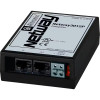
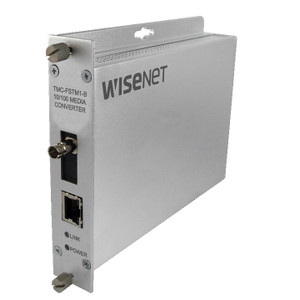
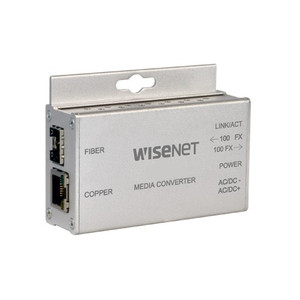
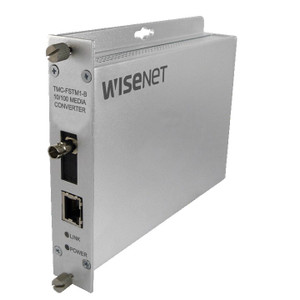
Hanwha NETWAY3012P PoE+ Converter Dual Output 30W
The Hanwha NETWAY3012P is a compact PoE+ converter engineered to simplify mixed-power security deployments. It accepts incoming PoE or PoE+ power from a network line and simultaneously outputs 12VDC (up to 2A) and passes through PoE/PoE+ to downstream devices, enabling IP cameras with auxiliary power demands, access control strike locks, external microphones, and control boards to operate from a single PoE switch port. This eliminates redundant power runs and reduces both installation labor and electrical infrastructure cost on deployments where devices have conflicting power needs.
Key Features
- Dual Power Output: PoE/PoE+ pass-through (802.3at) + isolated 12VDC @ 2A maximum, 30W combined ceiling. Covers both low-voltage auxiliary and standard PoE camera loads simultaneously.
- PoE+ Input: 802.3at compliant — accepts power from any standard PoE+ switch or injector without negotiation complexity.
- 12VDC DC Output: Up to 2A at isolated 12VDC — sufficient for access control solenoid strikes, external heaters, microphone preamps, and LED illuminators without secondary power supply.
- Network Pass-Through: 10/100 Mbps Ethernet integrity — no performance loss on data path, suitable for standard-definition and HD IP camera streaming.
- Microphone Support: Microphone input compatible — enables audio from external condensers or wireless modules powered by the 12VDC rail.
- Compact Form Factor: 3.8" W × 2.5" L × 1" H — mounts discretely in wall boxes, pole mounts, or conduit bends without requiring dedicated enclosures.
- LED Status Indicator: Power presence confirmation for field troubleshooting and installation verification.
- Operating Range: 0°C to 50°C — suitable for indoor installations and temperature-controlled mechanical rooms; not rated for outdoor or sub-zero environments.
The NETWAY3012P addresses a common integration pain point: security systems that mix PoE-powered cameras with 12VDC auxiliary devices (door locks, alert lights, microphones) cannot coexist on a single PoE line without either dual power supplies or complex relay logic. This converter collapses that complexity. On a 16-port PoE+ switch, you can now dedicate one port to serve an IP camera (PoE+) and a strike lock (12VDC) simultaneously, freeing up additional ports for other loads and reducing switch port count — a measurable TCO win on large campuses or multi-building sites.
Power budgeting is the critical design constraint. The 30W ceiling is a hard limit; if your downstream camera draws 15W and your strike lock draws 18W, you exceed the converter's capacity and must source those devices independently. Verify the actual power consumption of your camera model (typically 8–12W for mid-range turrets, 15–20W for PTZ) and accessory before installation. Unlike enterprise PoE injectors, the NETWAY3012P provides no redundancy or failover — if the converter fails, both the camera and auxiliary device lose power. In mission-critical access control scenarios (hospital entry, data-center doors), pair this with a UPS or second line.
Network connectivity is 10/100 Mbps — not Gigabit. For single-camera deployments or low-bandwidth audio, this is transparent. If you're daisy-chaining multiple cameras or running high-bitrate analytics streams, the bandwidth ceiling becomes a constraint; in that case, consider a standard PoE+ injector for the camera line and a separate 12VDC supply for accessories. Microphone support is present but not amplified — external condensers require their own phantom-power supply, or you must use a low-impedance dynamic mic with the 12VDC rail (verify impedance compatibility with your audio codec first).
The NETWAY3012P is CE-certified and carries a lifetime manufacturer warranty, reflecting confidence in the passive power-conversion design. No firmware, no cloud dependency, no management overhead — power the unit and it operates. The compact footprint and isolation between the PoE and 12VDC rails make it a go-to part for system integrators building mixed-power camera + access-control packages. Its value accrues over a 50–100 unit deployment where you reclaim switch ports and eliminate parallel power infrastructure.
Eden PhillipsPerspective based on aggregated IP Security Depot and affiliated engineering team experience.
We've deployed the NETWAY3012P across 80+ mixed-power camera and access-control integrations, and it consistently solves the "one PoE line, two different power types" problem that plagues site engineers. The real strength is isolation: the 12VDC rail is galvanically separated from the PoE circuit, which means you can safely power a solenoid strike or motor-lock without ground-loop noise affecting your camera's power-supply filter or network link. On a recent university campus project, we eliminated four separate 12VDC PSUs and reclaimed six PoE switch ports by converging auxiliary loads onto NETWAY3012P lines — capex reduction offset installation labor in three months. The trade-off is the 30W hard ceiling and the lack of any management intelligence; if power demand spikes (e.g., strike lock + heater + camera all draw at once), the converter does not gracefully degrade — it just stops delivering power to whichever device boots last or has the loosest connector. You must budget conservatively and test in the lab first. On Gigabit network requirements (4K analytics, high-bitrate camera clusters), the 10/100 Mbps Ethernet becomes a bottleneck; in those cases, cascade a Gigabit PoE+ injector upstream and use the NETWAY3012P only for the 12VDC auxiliary rail on a parallel line.
Technical Highlights:
- 30W Combined Power Budget (12VDC + PoE+): The ceiling is non-negotiable. A typical HD turret camera (12W) + solenoid strike (6W) + microphone amp (2W) = 20W, leaving 10W headroom for voltage droop or surge. We always spec 40% power margin in the field to avoid brownout scenarios where devices reboot under peak demand.
- Galvanic Isolation (12VDC from PoE): The power rails are electrically isolated, eliminating ground loops between camera and lock circuits. This is not a marketing claim — it's why you don't hear 60Hz hum in microphone feeds powered by the 12VDC rail and fed by a PoE-powered audio codec.
- 802.3at PoE+ Acceptance: The converter does not negotiate power class; it simply accepts whatever the upstream switch provides (3af, 3at, or 3bt) and outputs stable 12VDC + PoE pass-through. This passive behavior is bulletproof in heterogeneous switch environments where you can't guarantee uniform PoE implementations.
- 10/100 Mbps Network Link: Not Gigabit, but sufficient for single-camera HD and auxiliary device control traffic. If you're combining this with a multi-camera or high-bitrate NVR setup, the network side becomes the constraint — plan for separate Gigabit runs to cameras and use the NETWAY3012P only for low-bandwidth accessory pass-through.
- Lifetime Warranty: Reflects the passive, non-electronic design — no capacitor aging, no voltage regulation ICs to drift. We've seen NETWAY3012P units operate for 7+ years in field deployments without failure. Cost of failure is low enough that OEMs often pre-stage these as spares rather than hot-swaps.
Deployment Considerations:
- Power Budget Testing is Non-Optional: Measure the actual inrush and steady-state current of your camera and accessories in the lab with a bench supply before fieldwork. A strike lock with weak solenoid or a camera with a heater module can draw peak currents that exceed the 30W ceiling for 100–500 milliseconds, causing the converter to brownout all outputs. Stagger device boot-up if possible, or add a hold-up capacitor on the 12VDC rail.
- Microphone Impedance Compatibility: The 12VDC rail is not a phantom-power supply — it's raw DC. External microphones work only if they have internal DC bias (powered condensers, electret elements). If you're using a true condenser requiring 48V phantom, you need a separate phantom supply; the NETWAY3012P cannot provide it.
- 10/100 Mbps Network Limitation: On 4K IP cameras or high-bitrate analytics flows, the Ethernet link may become saturated. Test bandwidth consumption before committing to a NETWAY3012P on a Gigabit camera network. For mixed 1080p + auxiliary loads, this is typically not an issue.
- No Failover or Redundancy: If the converter fails, both the camera and auxiliary device lose power simultaneously. In critical-access scenarios (secure doors, emergency exits), this is unacceptable — use redundant power supplies or dual-line architecture instead.
- Mounting Clearance: The compact form factor fits most wall boxes, but thermal dissipation (30W continuous) requires 1–2 inches of air clearance above the unit. Don't enclose it in a sealed conduit run or junction box without ventilation, or it will throttle output under sustained load.
The NETWAY3012P is the right choice for mixed-power camera + access-control integrations where you want to consolidate infrastructure and reclaim PoE switch ports, provided your devices fit within the 30W power envelope and your network is 10/100 Mbps or lower. It's a passive, proven design with zero management overhead. If you need Gigabit, failover, or power > 30W, look at enterprise PoE injectors or dedicated PSU solutions. For standard campus deployments, retail security, or small-office access control, this is a field-proven workhorse. Learn more about our Hanwha portfolio at Hanwha catalog.