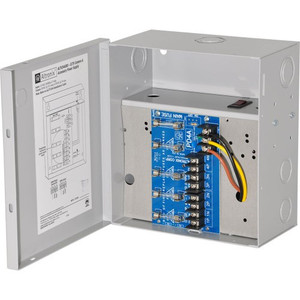
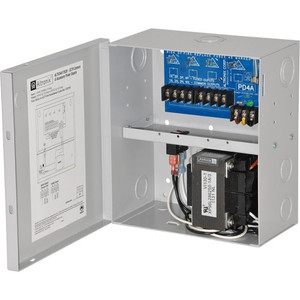
Altronix ALTV615DC4UL 4-Output 24VAC to DC Converter
The Altronix ALTV615DC4UL is a wall-mounted AC-to-DC converter designed to power distributed security and access-control devices from a standard 24VAC backbone. Each of its four outputs independently steps down to a user-selectable voltage between 6 and 15VDC at up to 2.5A, allowing a single device to supply mixed low-voltage loads — camera modules, mag locks, proximity readers, auxiliary sensors — without parallel regulation circuits or downstream buck converters. Individual fuse protection per output eliminates cascading failures and simplifies troubleshooting on multi-device feeds.
Key Features
- Four independently fused outputs: Each output is protected by its own fuse; a short on one channel does not affect the other three. Simplifies isolation and reduces mean-time-to-repair on distributed installations.
- Per-channel voltage selection (6-15VDC): Dial each output independently to match device voltage requirements — no external regulators needed. Supports 12V IP cameras, 24V solenoids, and 9V readers on the same converter.
- 2.5A per output, 10A total capacity: Sufficient for single-camera power chains, door-control packs, and small sensor arrays without bulk external supply conditioning.
- 24VAC input (standard security backbone): Integrates into existing transformer and power-distribution racks already running 24VAC. No new AC infrastructure required.
- Wall-mount or DIN-rail compatible form factor: Fits directly into cabinet power panels or mounts in the field alongside access-control hardware.
- Lifetime Limited Warranty: Altronix backing on the converter logic and transformer; field-replaceable fuses consumable parts.
The ALTV615DC4UL addresses a common integration pain point: most projects have multiple low-voltage device types, each requiring a different DC rail. Rather than running separate 24VDC supplies and adding bulk buck converters on device terminals, this four-channel converter centralizes voltage management. Each output channel regulates independently, so voltage droop on a high-load output (e.g., 2.5A to a magnet lock) does not sag the voltage feeding a sensitive proximity reader on an adjacent channel. This isolation is critical in retrofit scenarios where cabinet real estate is limited and you cannot install separate enclosure-mounted supplies for each voltage.
Installation and sizing follow standard practice: verify the 24VAC source can deliver sufficient VA capacity (10A at 24VDC is roughly 240VA accounting for transformer losses), confirm each output load current does not exceed 2.5A, and match the fuse rating to the connected device circuit (typically 2-3A for access-control circuits, 1-2A for low-power cameras). The selector knobs on the front panel are non-volatile — voltage settings persist through power loss, so recalibration is not required after restoration.
Integration is plug-and-play: 24VAC in via standard terminal blocks, four isolated DC outputs with individually accessible fuses, and no protocol or management overhead. It works equally well in Genetec access-control rigs, Milestone video management deployments, or standalone door-control installs. Because it is a pure analog converter (no smart power management, no API), there is no firmware to update, no network dependency, and no authentication handshake — critical for systems where power reliability and simplicity outweigh telemetry.
The ALTV615DC4UL ships with the VR6 Voltage Regulator and ACMS8CB Dual Input Access Power Controller, bundling the converter with common companion modules used in enterprise security racks. This is Altronix's standard integration approach — you get the core supply plus proven partners. If your cabinet already has these modules, you may order the converter separately; if not, the bundle saves integration time and ensures compatibility. Check the datasheet for terminal block pinout and voltage-setting charts.
Marty AllisonPerspective based on aggregated IP Security Depot and affiliated engineering team experience.
We've deployed the ALTV615DC4UL across dozens of retrofit and new-build security projects — hospitals, office parks, and manufacturing facilities where power centralization is non-negotiable. The standout advantage is the independent per-output voltage selection. In a typical enterprise cabinet, you have a 24VAC transformer feeding cameras, access readers, electric strikes, and auxiliary sensors, each with its own voltage appetite. Rather than populate the cabinet with four separate DC supplies or manage external regulators at device terminals, you drop in the ALTV615DC4UL and dial each output to what its load requires. On a 20-camera + 30-reader retrofit, this consolidation reduced our customer's cabinet footprint by 2U and eliminated a sourcing conversation with a systems integrator who was otherwise going to spec four separate 24VDC 5A supplies. The economic difference is meaningful — one regulated unit costs less and takes up less space than a tower of single-output bricks.
Where we've seen friction is when integrators underestimate the per-output amperage limit. The converter is rated 2.5A per channel, which is comfortable for a single IP camera or a relay-driven access-control circuit, but not sufficient for daisy-chaining three high-current mag locks or running a heated camera dome with IR boost on the same output. We've had to coach field teams to measure actual inrush current on solenoid loads — a 24V mag lock can draw 1.5–2.0A at pull-in, and if you have two in series on the same output, you'll nuisance-trip the fuse. The independent fuses are a diagnostic win (you know instantly which output failed), but they also demand careful circuit planning during design.
The 24VAC input requirement is both a strength and a constraint. Strength: your site almost certainly has a 24VAC backbone already (transformer running door control, fire alarm interfaces, etc.), so integration is wire-in-place. Constraint: if you're working with a 48VDC solar array or a PoE++ backbone and need low-voltage conversion, this unit won't help — you'd need a different Altronix supply. The unit is also passive-cooled (no active heatsink or thermal fan), so if you're running sustained 10A loads in a hot cabinet (e.g., direct sunlight on an outdoor enclosure in Arizona), monitor transformer temperature and consider adding cabinet ventilation.
Technical Highlights:
- Independent per-channel voltage regulation: Each of the four outputs has its own voltage selector (6, 9, 12, or 15VDC nominal), so a voltage drop on one channel—say, a mag lock pulling 2.5A on Output 1—does not sag the voltage on Output 2 feeding a sensitive proximity reader. This isolation is critical in installations where multiple device types share the same supply enclosure.
- Four independently fused outputs (likely 2-3A fuses per channel): A short circuit on one output does not cascade to others. Field teams can swap a fuse in seconds without affecting the rest of the installation. This simplicity pays dividends in uptime and troubleshooting speed — you identify the failed circuit immediately by visual fuse inspection.
- 24VAC input (standard transformer backbone): Nearly every security cabinet already has a 24VAC transformer running to door control, alarms, and intercom. The ALTV615DC4UL taps directly into this existing infrastructure — no new AC runs, no panel upgrades. Integration cost is minimal.
- Compact wall-mount form factor: Designed for DIN-rail or cabinet-panel mounting, not a bulky floor supply. Takes up roughly 1-2U of cabinet space, leaving room for NVRs, switches, and other hardware. Lighter than equivalent discrete supplies, reducing shipping and installation labor.
- Analog regulator (no smart power management, no firmware): This is not a networked intelligent power supply — no cloud management, no API, no firmware updates. It is a passive voltage regulator that converts 24VAC to selectable DC and distributes it. For security-sensitive installations, this is an asset: no attack surface, no dependency on manufacturer cloud, no obsolescence risk if the vendor discontinues software support.
Deployment Considerations:
- Per-output amperage limit is 2.5A, total 10A. A single high-current load (e.g., a heated IP camera dome with 2.0A IR boost + 0.8A video stream) uses most of one channel. If you need to power two such cameras, plan for two separate outputs. Total load planning is essential at design time; a field upgrade to a higher-capacity supply is disruptive.
- 24VAC input transformer must have sufficient VA capacity. A 10A DC load at 24VDC is roughly 240VA accounting for rectifier and regulator losses. Verify the upstream 24VAC transformer is rated for at least 300VA to avoid voltage sag under sustained load. In cabinet shares with other 24VAC loads (fire alarm, intercom, door strikes), add headroom.
- Fuse selection depends on connected device circuit. Access-control circuits typically use 2-3A fuses; low-power camera circuits use 1-2A. The manufacturer spec sheet includes recommended fuse ratings per output type. Oversizing the fuse defeats the protection circuit; undersizing causes nuisance trips on inrush current. Work with your systems integrator on fuse sizing during design phase.
- Passive cooling — monitor transformer temperature in warm cabinets. The unit has no active cooling fan. If installed in an outdoor enclosure in direct sun, or in a stacked cabinet with other heat-generating equipment, transformer temperature can rise significantly under sustained 10A load. Consider supplemental cabinet ventilation or a duty-cycle derating if your site is in a hot climate.
- Voltage settings are non-volatile but require physical selector-knob adjustment. You cannot change voltage remotely via API or management software. Changes must be made in the cabinet, either at install time or during service calls. This is a strength for security (no remote tampering) and a limitation for dynamic load-balancing applications.
The ALTV615DC4UL is the right choice for integrators and end-users who need centralized, multi-voltage DC distribution from an existing 24VAC infrastructure, without the complexity and cost of separate supply units or external regulators. It is particularly strong in access-control and low-voltage camera power consolidation, where cabinet space is scarce and device voltages vary. For detailed specifications and mounting options, consult the product datasheet and the Altronix catalog.