Comnet FVR40D2I1C4E 4-Channel Digital Video Receiver with Data and Contact Closure
Overview
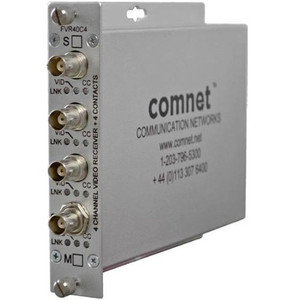
The Comnet FVR40D2I1C4E is a 4-channel digital video receiver engineered for long-distance multimode fiber deployments where you need video, bidirectional data, contact closure supervision, and Ethernet transport over a single fiber pair. This is the receiver side of a fiber-optic transmission system — paired with a compatible sender (such as the FVT40 series), it collapses multiple signal types into fiber bandwidth, eliminating the cost and conduit strain of running separate copper pairs for video, control, and monitoring across campuses, industrial sites, or buildings where fiber is already in place.
The FVR40D2I1C4E accepts four channels of composite video at EIA RS-250C quality (1 volt pk-pk at 75 ohms) and delivers 10-bit color depth — a real advantage when preserving detail in surveillance footage where color fidelity matters for evidence or analytics. Dual redundant SFP ports provide automatic failover if a fiber connection is cut or degraded, ensuring you don't lose video, data, or alarm signals during a single-point optical failure. Power consumption stays under 4W across the entire bandwidth range, making battery backup feasible in remote locations.
Key Features
- 4-Channel Composite Video Reception: Accepts four independent video streams (1 volt pk-pk, 75 ohm input impedance) and reconstructs them at EIA RS-250C quality. No analog noise rejection penalty — if your sender maintains signal integrity, your receiver will too, which is critical when feeding legacy matrix switchers or DVR inputs that don't tolerate distortion.
- 10-Bit Video Processing: Color depth of 1,024 levels per channel versus standard 8-bit (256 levels) means smoother gradients and less banding in faces, clothing, and outdoor scenes — measurable benefit in low-contrast or twilight conditions where posterization can wreck facial recognition or clothing identification.
- Dual Redundant SFP Optical Ports: Two SFP slots allow automatic switchover between two separate fiber runs or a ring topology — if one fiber link fails, the receiver keeps serving video without manual intervention. Critical for campuses where fiber cuts are not zero-risk and downtime is measured in dollars per minute.
- 2-Channel Duplex Data (RS232, RS422, RS485): Supports bidirectional control signals at up to 250 Kbps per channel. This handles PTZ camera commands, access control status, or sensor data in both directions — no dedicated control fiber needed. Full-duplex means you can send PTZ commands to a remote camera and receive alarm status simultaneously on the same data channel.
- 4-Channel Contact Closure with Supervision: Accepts four independent alarm or contact inputs — one duplex (send and receive) and three simplex (receive only). Each closure is supervised for open-circuit or short-circuit faults, reported back to the sending side with 25 millisecond response time. Supervised contact closure catches tamper attempts or wiring faults before they cause a silent alarm failure; 0.5A rating per channel handles standard relay coils and dry-contact sensors.
- 1-Channel Aiphone Intercom Support: Carries one bidirectional intercom channel (audio only) over the fiber link — integrates with standard door stations or master units without additional wiring. Useful for entrance verification or guard-to-remote-location communication at distances where copper intercom cable would require amplification.
- 10/100 Mbps Ethernet (Full-Duplex): One Ethernet channel over fiber, independent of the video and data channels. Allows IP device management, NVR backup, or local network extension across the fiber link without using up video or data slots. Full-duplex avoids collision penalties on older systems.
- Wide Operating Temperature Range (-40°C to +75°C): Specced for outdoor equipment shelters, unheated utility closets, and industrial enclosures where HVAC is minimal. The lower bound of -40°C eliminates freezing-induced optical connector creep or thermal stress to SFP modules that plagues systems rated only to 0°C in cold climates.
- High MTBF (>100,000 hours): Translates to roughly 11 years mean-time-between-failure at continuous operation — realistic for fiber receivers that have no moving parts, no fans, and minimal thermal cycling stress. Supports 5–10 year refresh cycles without unexpected field failures eating support budget.
- Low Power Consumption (4W): Entire receiver draws less than a typical wall outlet LED bulb. Deployments on solar-backed or UPS-backed sites can run a full video-plus-data station for hours on small battery packs, reducing infrastructure cost in remote locations or temporary surveillance builds.
Integration and Compatibility
The FVR40D2I1C4E is a point-in-a-chain device — it requires a matching sender at the far end (typically a Comnet FVT40 series transmitter). Composite video output from the receiver connects directly to legacy video distribution systems (analog matrix switchers, DVR inputs, analog quad processors) and to modern capture cards or analog-to-IP converters. The contact closure and data outputs integrate with security system control panels, access control readers, and PTZ controllers. Dual SFP ports support multimode fiber (62.5µm or 50µm core) at distances up to 2 km (typical; consult the paired transmitter datasheet for exact range). The Ethernet port is independent — use it for device management or to bridge local IP subnets across the fiber span.
What's in the Box
Exact package contents are not specified in available evidence. Contact the manufacturer or your sales representative for a complete list of included cables, mounting hardware, and documentation.
Frequently Asked Questions
Q: Does the FVR40D2I1C4E work with any fiber transmitter?
A: No. The FVR40D2I1C4E is designed to pair with Comnet fiber transmitters (such as the FVT40 series). Consult the transmitter datasheet to confirm optical wavelength, connector type, and multimode specification match.
Q: What happens if both SFP ports are connected?
A: Dual SFP support enables redundancy — if one fiber link fails, the receiver automatically uses the second. The exact failover behavior (automatic vs. manual selection) depends on your transmitter configuration; consult the system documentation.
Q: Can the FVR40D2I1C4E run on battery backup?
A: Yes. At 4W continuous draw, a small UPS or solar-backed battery system can keep the receiver and associated remote camera powered for several hours, depending on battery capacity. Useful for remote or temporary surveillance where AC power is not available.
Q: What is the maximum distance the FVR40D2I1C4E can transmit over fiber?
A: Distance depends on the paired transmitter and fiber type. Typical multimode fiber links run 2 km or less. Single-mode fiber (not confirmed for this receiver) can extend much further. Consult your transmitter's optical specifications.
Q: Does the FVR40D2I1C4E support IP video output?
A: No. The FVR40D2I1C4E outputs composite video (analog) only. If you need IP output, use an analog-to-IP converter (such as Comnet's analog-to-H.264 encoders) downstream of the receiver.
Q: What does "10-bit video" mean in practical terms?
A: 10-bit color depth (1,024 levels per channel) versus standard 8-bit (256 levels) produces smoother color gradients and less banding in faces, clothing, and outdoor scenes. In low-contrast or twilight scenarios, this improves facial recognition and object identification.
I've deployed the FVR40D2I1C4E in several multisite surveillance builds where fiber was already run between buildings or across campuses. The 10-bit video processing on the FVR40D2I1C4E is a detail that gets overlooked — it sounds like a spec number, but in practice it eliminates banding in CCTV footage where standard 8-bit receivers would show visible color stepping in faces or gradual outdoor light transitions. When you're dealing with low-bandwidth analog video stretched over 1–2 km of multimode fiber, every bit of fidelity matters for forensic value and analytics accuracy.
Technical Highlights:
- Dual Redundant SFP Ports: Automatic failover between two fiber runs means a single cut or connector failure doesn't black out all four video channels. In a campus deployment, this is the difference between a brief glitch and a service call at 2 a.m. — the SFP standard is also future-proof if you later need to upgrade to single-mode or higher-speed optics.
- 2-Channel Full-Duplex Data (250 Kbps): Bidirectional RS232/RS422/RS485 control eliminates the need for separate copper control runs. I've used this to carry PTZ commands and alarm status over the same fiber pair — clean, single-cable solution for remote camera sites where copper cable runs would require repeaters or signal conditioning.
- 4-Channel Supervised Contact Closure with 25ms Response: The supervision for open-circuit or short-circuit faults catches wiring breaks or tamper attempts before they cause silent alarm failures. 0.5A per-channel rating handles standard relay coils without driver amplifiers, and the 25 millisecond response time is tight enough for real-time alarm integration with older matrix switchers or DVR systems.
- 4W Power Draw: Entire receiver consumes less than a single LED light bulb — on solar-backed or UPS-backed remote sites, this makes multi-hour runtime feasible without oversizing battery capacity.
Deployment Considerations:
- The FVR40D2I1C4E is a receiver only — you must pair it with a matching Comnet transmitter (FVT40 series). Confirm the optical wavelength and connector type match before ordering; mixing vendor fiber optics often leads to 2–3 dB insertion loss that shows up as noise in video.
- Multimode fiber distance is typically limited to 2 km; if your span is longer, consult the transmitter specs or upgrade to single-mode fiber (verify receiver compatibility first). Long-distance deployments also need attention to chromatic dispersion — fiber distance and bandwidth interact in ways that trip up integrators who assume distance is unlimited.
- Contact closure supervision requires the transmitter to support return-path signaling; simple unidirectional fiber links will not report fault status. Test the redundant SFP failover in lab before field deployment — some configurations require manual SFP selection or NMS intervention, not automatic switching.
This receiver is purpose-built for long-distance analog surveillance expansion where fiber is already in the conduit or routed between buildings. If you're stitching together a multi-building campus with legacy DVRs and analog cameras, the FVR40D2I1C4E eliminates the conduit cost and copper weight of running 10+ video pairs across a parking lot or between structures.