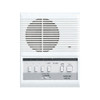
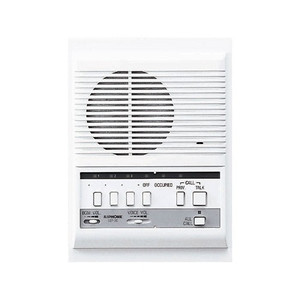
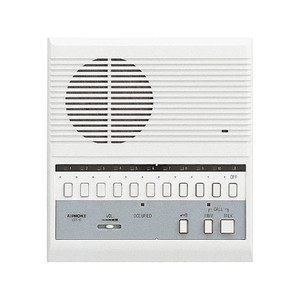
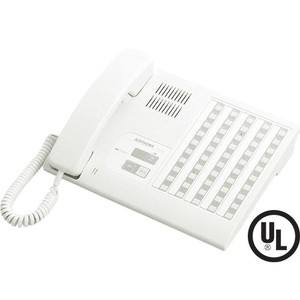
Aiphone LEF-3L 4-Station Master Intercom with Selective Door Release
The Aiphone LEF-3L is a 12V DC master intercom station designed for small-to-mid-range commercial access control and voice communication systems. As a central hub, it handles up to 4 stations (expandable with optional sub-stations) over standard twisted-pair wiring, and includes a normally-open or normally-closed relay contact rated for door strike activation or other access control circuits. If you're building a multi-door entry system for a small office, warehouse, or medical facility where voice verification and controlled release are both required, the LEF-3L serves as the command point.
Key Features
- 4-Station Capacity: Connect up to 4 station units to a single LEF-3L master — enough for a small suite or facility entrance. Additional sub-stations are possible with looped or homerun wiring, giving you layout flexibility without a separate PBX.
- Dual-Path Audio (800mW reception, 500mW transmission @ 20Ω): Full-duplex talk channel with clear audio levels suitable for voice identification across typical building interiors. The 800mW receive amplification ensures the master station operator hears all incoming callers without distortion, critical when making access-grant decisions.
- Selective Door Release Relay (RY-PA): 1A contact rated up to 110V AC or 24V DC — sufficient to drive most electromagnetic door strikes or supplementary solenoid circuits. Configurable as normally-open (default) or normally-closed, allowing flexible logic in your access workflow (e.g., buzz-to-unlock or buzz-to-hold patterns).
- Extended Wiring Distance: Reaches 650 feet with standard 22AWG cable, 1600 feet with 18AWG — reduces the need for line-conditioning or repeater equipment in larger facilities. Plan your station locations accordingly: thicker wire (18AWG) is heavier to run but extends range significantly.
- Low Power Consumption (300mA @ 12V DC): Draws just 3.6W at steady-state, minimizing your DC power supply footprint. Use Aiphone PS-1208UL or PS-1225UL depending on system load; the PS-1225UL is recommended if you're using BG-10C battery backup, a practical choice for life-safety-sensitive doors.
- Compact Desktop Form Factor (7-1/16" H × 5-5/8" W × 2-1/8" D): Fits standard desk or wall-mount enclosures without consuming precious counter space. The small footprint doesn't sacrifice call-queue visibility — built-in LED indicates when a talkpath is active, so you know when the line is in use.
Integration & Compatibility
The LEF-3L operates on a 5-common-wire (E, R, Y, +, −) plus 1-per-station individual loop. This wiring topology is proprietary to Aiphone's compact intercom systems but is straightforward to install in new construction or retrofit. If you're upgrading from an older analog intercom, verify your existing cable can handle the station count and distance before reusing runs. The relay contact is dry (isolated), so it integrates cleanly with any access control circuit — door controllers, magnetic locks, or supplementary buzzer circuits. No voltage isolation required; just verify load and switching frequency.
The LEF-3L is intermixable with other Aiphone LEF-series sub-stations, meaning you can deploy a mix of handset, speaker-phone, or combination units on the same system without conflicts.
Power and Wiring Considerations
Power the LEF-3L through a dedicated 12V DC supply (PS-1208UL for baseline systems, PS-1225UL for redundancy). Plan your wire gauge based on distance: 22AWG is acceptable for short runs (under 200 feet) or single-station add-ons, but 18AWG is strongly recommended for multi-station installs or runs approaching the 1600-foot limit to avoid voltage sag. Sag directly affects audio clarity and relay switching reliability. If your facility is already wired with shielded twisted-pair (common in older buildings), verify the shield is terminated at the power supply ground only, not at both ends, to prevent ground loops that degrade voice quality.
What's in the Box
The LEF-3L arrives as a standalone master unit. Mounting hardware, wiring terminals, and relay configuration documentation are included. You will need to source your 12V DC power supply separately (PS-1208UL or PS-1225UL) and any sub-station units or optional door-release modules (RY-PA relay output) based on your system design.
Frequently Asked Questions
Q: Can I use the LEF-3L in a building taller than 4 stories?
A: Yes. Station capacity (up to 4) and wiring distance (up to 1600 feet with 18AWG) are the physical limits, not building height. Vertical runs are fine; just ensure your power supply voltage doesn't sag excessively over the total wire length.
Q: What relay outputs are available on the LEF-3L?
A: One RY-PA relay contact, 1A max, 110V AC or 24V DC. It is normally-open or normally-closed, your choice. If you need multiple independent relay circuits (e.g., multiple doors), you will need to add sub-station relay modules.
Q: Does the LEF-3L work with wireless door locks?
A: The LEF-3L itself is hardwired, and its relay is a dry contact — it cannot emit radio signals. However, you can wire its relay output to a wireless gateway or control module that your door locks understand (Z-Wave, Zigbee, proprietary RF). Verify the gateway's power and switching requirements against the 1A, 110V AC / 24V DC relay spec.
Q: What power supply should I buy?
A: For a single LEF-3L master and up to 4 sub-stations, the PS-1208UL (8A, 12V DC) is standard. Use PS-1225UL (25A, 12V DC) if you're adding the BG-10C battery backup unit or if you anticipate expanding to more sub-stations later.
Q: Is the LEF-3L NDAA Section 889 compliant?
A: No compliance statement is available in the manufacturer evidence. If NDAA eligibility is a procurement requirement, contact the manufacturer or your reseller directly.
Q: What's the warranty on the LEF-3L?
A: Warranty details are not provided in the available documentation. Refer to the manufacturer's warranty statement or your point of purchase for specifics.
I've installed the LEF-3L in a handful of small commercial facilities, and it remains a workhorse for voice-plus-release access control when you need simplicity and no moving parts. The key insight is that the LEF-3L is fundamentally a call controller with a bonus relay output — it's not a full access control panel. That means it shines in environments where an operator (receptionist, security desk, warehouse office) needs to authenticate a caller voice-to-voice, then grant access with a button press. The 1A relay contact on the LEF-3L is your only switching point, so you're limited to one independent circuit per master unit.
Technical Highlights:
- 800mW reception (20Ω load): This is a real-world number that matters. It's enough to overcome ambient noise in a typical office environment, but in a noisy warehouse or with more than one person talking nearby, the operator may miss callers. If you're integrating the LEF-3L into a high-noise environment, consider a speaker-phone variant or add local amplification.
- RY-PA relay: 1A, 110V AC or 24V DC: Standard electromagnetic door strike and solenoid-latch circuits draw 0.3–0.8A at 12V or 24V, so you're safe. The 110V AC rating is useful if you're retrofitting into an older building with AC-powered door control. Watch the ambient temperature, though — relay contacts degrade faster at elevated temperatures, so verify thermal conditions in your install location.
- 1600' wiring reach (18AWG) @ 12V DC: This is achievable, but voltage sag over distance is real. A 500-foot run in 18AWG can lose 0.3–0.5V depending on station load. Plan your supply voltage accordingly — aim for 13.2V or 13.5V at the master to compensate for drop across the wire run.
Deployment Considerations:
- The LEF-3L is master-only; you must purchase sub-stations separately (different model numbers for handset, speaker, or combination units). Budget accordingly and verify sub-station availability before committing to the LEF-3L as your hub.
- The 5-common-wire topology means every station shares the same return path. If one station has a short or damage, it can kill the entire system. Test all cabling before final installation, and consider running spare pairs if your conduit allows it — future troubleshooting will be faster.
Deploy the LEF-3L in small-to-mid reception areas, medical offices, or light-industrial facilities where voice authentication is acceptable and door releases are infrequent (not high-traffic loading docks). If you need multi-door independent control or IP-based remote access, you'll want a proper access control panel, not an intercom with a relay bonus feature.