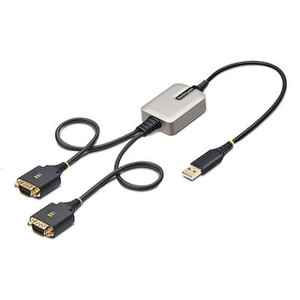
StarTech I23-SERIAL-ETHERNET 2-Port RS-232 to Ethernet Device Server
Overview
The StarTech I23-SERIAL-ETHERNET is a two-port RS-232 serial to Ethernet adapter that bridges legacy serial devices onto a modern IP network — without replacing hardware that still works. If you're managing PLC controllers, environmental sensors, access control panels, or serial-based security appliances that have no native Ethernet interface, this device server lets you reach them over TCP/IP rather than running dedicated serial cable runs across a facility. The I23-SERIAL-ETHERNET connects to your network via a single 10/100 Mbps Ethernet port, exposes two independent DB-9 RS-232 serial ports, and supports baud rates up to 921.6 Kbps — fast enough for virtually any real-world serial device you'll encounter in the field. It also ships with both wall and DIN rail mounting options, which matters when you're fitting it into a control cabinet or IDF closet rather than leaving it on a bench.
Key Features
- Two Independent RS-232 Ports (DB-9): Each port operates independently, so you can connect two different serial devices — a PTZ camera controller and an access panel, for example — through a single device server and a single network drop. That cuts IP addressing overhead and reduces rack or cabinet clutter compared to deploying two single-port adapters.
- 921.6 Kbps Maximum Baud Rate: Most legacy serial devices top out at 115.2 Kbps. The I23-SERIAL-ETHERNET's 921.6 Kbps ceiling gives you headroom for high-throughput serial applications — industrial sensors and some medical devices excepted — and ensures the adapter won't be the bottleneck in your data path.
- Telnet RFC2217, TCP Server, TCP Client, and UDP Protocol Support: RFC2217 is the critical one for VMS and SCADA integrations — it lets software treat the remote serial port as if it were a local COM port, which is exactly how most serial PTZ drivers and device management tools expect to communicate. TCP Client mode lets the device server initiate the connection outbound, which simplifies firewall rules in environments where inbound connections are restricted. UDP support serves low-latency broadcast scenarios.
- 10/100 Mbps Ethernet with RJ-45 and Terminal Block Connectors: The combination of RJ-45 and terminal block connectivity means you can terminate to a standard patch panel or hard-wire into a terminal strip in a control enclosure — useful in industrial settings where vibration or repeated handling would loosen a plug-style connector over time.
- ESD Protection: ±15kV Air, ±8kV Contact: Serial ports in industrial and outdoor-adjacent environments are ESD exposure points. The ±15kV air discharge and ±8kV contact discharge ratings on the I23-SERIAL-ETHERNET's serial interfaces protect against the kind of static events that kill unprotected adapters in manufacturing floors, loading docks, and HVAC rooms.
- Steel Enclosure with Wall and DIN Rail Mounting: The steel housing is a meaningful upgrade over plastic-shell adapters in environments where the device gets handled during maintenance or sits in a shared control cabinet with other gear. DIN rail compatibility means it fits standard electrical enclosures without custom brackets; wall-mount hardware covers junction boxes and wall-mounted panels.
- Wide Input Voltage Range: 100–240V AC, 5V DC / 3A Output: The universal AC input means no step-down transformer when deploying in international facilities or in mixed-voltage plant environments. The included power supply delivers 5V DC at up to 3A — the device server itself draws a maximum of 15W, leaving margin if the supply is also powering ancillary equipment via the terminal block.
- Operating Temperature 0°C to 60°C (32°F to 140°F): Standard commercial-grade temperature range. Adequate for conditioned control rooms, IDF closets, and most indoor industrial spaces. Not rated for unheated outdoor enclosures or environments that see freezing temperatures — plan accordingly for cold-climate deployments.
- Humidity Tolerance 5–95% RH (Non-Condensing): Covers humid manufacturing and warehouse environments. Non-condensing is the key qualifier — direct condensation events (rapid temperature swings in uncontrolled spaces) require additional enclosure protection.
Integration and Compatibility
The I23-SERIAL-ETHERNET (often searched as I23 SERIAL ETHERNET) is protocol-agnostic at the serial level — it passes RS-232 data transparently, so compatibility depends on your application software's ability to handle network-attached COM ports or direct TCP/UDP socket communication. RFC2217 Telnet support is the most broadly compatible path for VMS serial PTZ integrations and SCADA systems that use virtual COM port drivers. TCP Server mode works well for custom middleware and device management applications that connect directly to a known IP and port. For serial to Ethernet converters in security and automation applications, verify that your VMS or controller software supports RFC2217 or raw TCP socket serial communication before specifying this unit. Pair it with a managed PoE switch if you need to centralize network management for the segment where this device server sits. For broader context on integrating legacy serial devices into IP infrastructure, review our network integration guide. The StarTech networking and connectivity product line includes complementary adapters and serial converters for mixed-protocol environments. If you're building out a complete serial device management layer, consider pairing this with compatible serial device servers from the same family for consistent management interfaces across sites.
Frequently Asked Questions
Q: What serial protocols does the I23-SERIAL-ETHERNET support?
A: The I23-SERIAL-ETHERNET supports RS-232 serial interfaces via DB-9 connectors. Network protocol support includes Telnet RFC2217, TCP Server, TCP Client, and UDP — giving software multiple options for communicating with connected serial devices over IP.
Q: Can the I23-SERIAL-ETHERNET be mounted in a standard electrical control cabinet?
A: Yes. It supports both DIN rail and wall mounting. DIN rail compatibility means it fits standard 35mm rail inside most industrial control enclosures without any additional hardware fabrication.
Q: What is the maximum baud rate supported?
A: The I23-SERIAL-ETHERNET supports baud rates up to 921.6 Kbps per port — well above the 115.2 Kbps ceiling of most legacy serial devices, so the adapter will not be the throughput constraint in typical deployments.
Q: What power supply does the I23-SERIAL-ETHERNET require?
A: It accepts 100–240V AC input and converts to 5V DC internally. Maximum power consumption is 15W. The universal AC input range makes it usable in international facilities without a separate voltage converter.
Q: What is the warranty on the I23-SERIAL-ETHERNET?
A: StarTech covers the I23-SERIAL-ETHERNET with a 2-year manufacturer warranty.
Q: Is the I23-SERIAL-ETHERNET suitable for outdoor or unheated enclosure deployment?
A: The operating temperature range is 0°C to 60°C (32°F to 140°F), which covers conditioned indoor and climate-controlled industrial spaces. It is not rated for environments that drop below freezing — outdoor or unheated enclosure deployments in cold climates will require an externally heated cabinet.
The spec that matters most on the I23-SERIAL-ETHERNET isn't the baud rate ceiling — it's the RFC2217 Telnet support. That protocol is what lets your VMS or SCADA platform address these serial ports as if they were local COM ports, which is the integration path almost every serial PTZ driver and legacy device management tool is built around. Without RFC2217, you're writing custom socket code or relying on virtual COM port drivers that add another maintenance layer. With it, the I23-SERIAL-ETHERNET slots into existing software infrastructure with minimal configuration.
Technical Highlights:
- ESD Protection ±15kV Air / ±8kV Contact: Serial ports in panel rooms, loading docks, and manufacturing spaces are genuine ESD exposure points. These ratings are meaningful protection — unprotected adapters in those environments have a short service life.
- Dual DB-9 RS-232 Ports: Two independent serial channels on one IP address and one network drop. In a control cabinet with a PTZ controller and an access panel both needing network reachability, that's one device server instead of two, one IP address to manage, one power connection.
- Steel Enclosure + DIN Rail Mount: The steel shell and DIN rail compatibility are what separate this from consumer-grade serial adapters. It sits correctly in a standard 35mm rail enclosure, doesn't flex under cable tension, and won't crack if someone bumps it during maintenance.
Deployment Considerations:
- RFC2217 mode requires that your host software or VMS supports network COM port emulation — confirm this before deployment. Not all serial PTZ drivers handle RFC2217 natively; some require a virtual COM port driver installed on the server side.
- The 0°C lower operating limit is the hard boundary for this unit. Unheated exterior enclosures in northern climates will breach that threshold — either use a heated enclosure or specify a device server with an extended temperature rating for those sites.
The I23-SERIAL-ETHERNET is the right pick for integrators retrofitting serial-based access control hardware, PTZ dome controllers, or environmental monitoring sensors into IP-managed infrastructure — specifically where the installation point is a conditioned control room or IDF closet, and where RFC2217 compatibility with existing software is already confirmed.