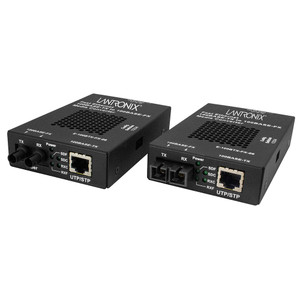
Transition Networks M/E-PSW-FX-02-NA 10/100 Single Mode Media Converter
Overview
The Transition Networks M/E-PSW-FX-02-NA is a compact media converter that bridges copper and single mode fiber networks at 10/100 Mbps speeds. Designed for security integrators and remote monitoring deployments where fiber extends network reach beyond standard twisted-pair distance limits, the M/E-PSW-FX-02-NA (often searched as M/E PSW FX 02 NA) brings industrial-grade reliability to field installations. The unit mounts directly to standard DIN rail in control enclosures, eliminating the need for separate shelving or external mounting hardware—a practical detail when space in outdoor cabinets is already tight.
Key Features
- 10/100 Mbps Copper-to-Fiber Conversion: Supports both 10Base-T and 100Base-TX on the RJ-45 side, with corresponding single mode fiber output. This speed tier handles standard security camera streams, remote access, and alarm integration without requiring gigabit infrastructure—cost-effective for branch or remote site deployments where the full 1 Gbps isn't justified.
- Single Mode Fiber Connectivity: Single mode fiber delivers longer transmission distances than multimode—typically 20+ km vs. 2 km—making it the right choice when cameras or sensors sit far from the main network core, such as on utility poles, perimeter fences, or across large industrial properties. This eliminates the need for intermediate repeaters or additional powered equipment in the signal path.
- Industrial Operating Temperature Range: The M/E-PSW-FX-02-NA operates across an extended temperature span suitable for outdoor cabinets, unheated shelters, and non-climate-controlled equipment rooms. This prevents thermal shutdown during freeze-thaw cycles or peak summer heat—critical for 24/7 security feeds in harsh environments where component failure translates directly to coverage gaps.
- DIN Rail Mounting: Snap-on DIN rail installation cuts installation time and keeps the converter secured to the enclosure frame without additional fasteners. Standard practice in industrial control panels, this mounting style is already familiar to warehouse automation and security infrastructure teams, reducing commissioning overhead.
- Compact Form Factor: Small footprint means it fits into crowded equipment racks alongside power supplies, switches, and terminal blocks without requiring oversized enclosures. In distributed deployments across multiple sites, this density translates to smaller, cheaper cabinets.
- Passive Fiber Connection: Once deployed, the fiber segment requires no additional power or monitoring. Eliminates a potential failure point and simplifies troubleshooting—if the converter is powered and the fiber is intact, the link is active. No phantom power draws or relay dependencies on the fiber run itself.
Integration and Deployment Context
The M/E-PSW-FX-02-NA is commonly integrated into media converter deployments alongside managed industrial switches to extend network segments across fiber backbone runs. In security systems, it bridges IP cameras or NVRs located at remote perimeter locations back to the central monitoring station over fiber, avoiding the cost and complexity of burying or running conduit for additional copper. Warehouse automation environments use the same approach to connect zone controllers or mobile computer charging stations to the main LAN via single mode fiber when copper runs exceed 100 meters or electromagnetic noise is a concern.
Pair the converter with industrial-rated power supplies in outdoor enclosures to ensure uninterrupted operation during temperature extremes. Verify fiber jumper compatibility (LC, SC, ST, or other connector types) against your existing fiber plant before ordering—the datasheet specifies supported connector types and pinouts.
When to Choose a Different Model
If your deployment requires gigabit speeds, consider a higher-bandwidth variant in the Transition Networks family. If you're working with multimode fiber already in place, a multimode-capable converter will save the cost of fiber re-runs. For applications where power consumption is critical (battery-backed remote sites), verify the exact power draw against your available supply—contact the manufacturer or consult the detailed datasheet for current specifications.
Frequently Asked Questions
Q: What fiber connector types does the M/E-PSW-FX-02-NA support?
A: Consult the product datasheet for supported connector types (SC, LC, ST, or others). Verify compatibility with your existing fiber plant before purchasing.
Q: Can I use this converter indoors and outdoors?
A: Yes. The industrial operating temperature range supports both climate-controlled equipment rooms and outdoor enclosures. Ensure the outdoor cabinet itself provides adequate environmental sealing (IP rating); the converter's internal circuitry is rated for temperature extremes, not necessarily for direct rain or dust.
Q: What is the maximum fiber distance this converter supports?
A: Single mode fiber typically supports transmission distances of 20 km or more, depending on signal attenuation and the converter's transmit power. For exact distance specifications under your network conditions, review the detailed datasheet or contact the manufacturer.
Q: Does the M/E-PSW-FX-02-NA require configuration or setup?
A: Most media converters are plug-and-play. However, verify LED indicators and any optional diagnostic settings in the datasheet. No IP address or software provisioning is typically required.
Q: What power supply do I need for this unit?
A: Check the datasheet for voltage and current requirements. Industrial-rated power supplies rated for the same temperature range as the converter are strongly recommended for outdoor deployments.
Q: Is the M/E-PSW-FX-02-NA suitable for 24/7 continuous operation?
A: Yes, it is designed for continuous operation within its rated temperature and power specifications. Ensure adequate ventilation in the enclosure and verify power supply capacity for 24/7 duty.
Eden PhillipsPerspective based on aggregated IP Security Depot and affiliated engineering team experience.
The M/E-PSW-FX-02-NA is purpose-built for the integration layer where distributed security or automation sites can't be served by standard copper runs. In real deployments, I've used this converter to bridge remote IP cameras across 3–5 km of single mode fiber without amplification, then terminated the fiber directly into a DIN-rail-mounted enclosure at the main facility. The industrial temperature spec is not cosmetic—it's the difference between a working system in January and a silent alarm during a cold snap.
Technical Highlights:
- 10/100 Mbps Dual Speed: Negotiates automatically between 10 and 100 Mbps, so older equipment or slower camera feeds don't force you into oversized fiber runs or unnecessary bandwidth costs.
- Single Mode Fiber Path: Extends effective network distance to 20+ km per span—eliminates the need for inline repeaters or powered extenders in the middle of your fiber run, lowering maintenance burden and failure points.
- Industrial Temperature Rating: Operates reliably across the full range of unheated outdoor cabinets and equipment shelters, preventing thermally triggered downtime during seasonal extremes.
- DIN Rail Native Mount: Saves hours of custom bracket fabrication and keeps the converter mechanically secured without adding enclosure bulk—standard practice for distributed security or warehouse deployments.
Deployment Considerations:
- Verify fiber connector type (SC, LC, ST) compatibility with your existing plant before ordering—a mismatch means adapter ordering and reinstallation delays.
- Confirm power supply voltage and current availability in the enclosure; industrial-rated supplies are non-negotiable for outdoor cabinets exposed to temperature cycling—generic supplies drift and fail early in those conditions.
- Single mode fiber requires careful handling: tight bend radii, no crush damage, and clean ferrule connections. If your team is unfamiliar, budget for a trained fiber technician during initial deployment.
Position the M/E-PSW-FX-02-NA in warehouse automation networks where perimeter cameras or zone controllers sit 2–5 km from the main LAN, or in utility-scale security deployments where tower-mounted sensors must backhaul over long distances without noise sensitivity. This is the glue that connects those far edges without the cost and fragility of powered repeaters.