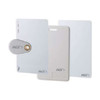
SDC HID1326-10 HID Proximity Card Credentials 10-Pack
The SDC HID1326-10 is a 10-pack of standard HID proximity card credentials designed for SDC/Security Door Controls networked access control systems. These cards operate over TCP/IP infrastructure and provide consistent, standardized credential format across mid-to-large facility deployments. Each card in the pack is factory-programmed to integrate seamlessly with SDC readers, eliminating field enrollment overhead and reducing deployment timelines on multi-door installations.
Key Features
- HID Proximity Format: Industry-standard proximity card encoding. Compatible with all SDC proximity readers on TCP/IP networked systems without proprietary adapters.
- TCP/IP Networked Credential Management: Centralized issuance, revocation, and access policy updates across all networked entry points from a single console. No need for individual reader reprogramming.
- 10-Card Pack Quantity: Sufficient for initial deployment across 5-10 secured entry points (multi-reader sites) or credential refresh on mid-sized facilities. Bulk packaging reduces per-unit cost versus single-card issuance.
- Factory Pre-Encoded: Credentials arrive ready to assign—no on-site card encoding equipment required. Reduces integration labor and eliminates encoding errors on site.
- Lifetime Warranty: Manufacturer warranty covers manufacturing defects across the product lifecycle. Field replacement costs are minimal for any hardware failures.
- Standardized Credential Lifecycle: Works with SDC credential management policies for badge reissuance, temporary access windows, and centralized audit logging. Credential revocation is instantaneous across networked doors.
HID proximity technology has been the access control standard for over two decades in North America. The 125 kHz proximity protocol remains one of the most widely deployed credential formats in commercial buildings, parking structures, and multi-site campuses. SDC's TCP/IP integration means that each card's access rights are tied to network-based rules rather than local reader memory, enabling real-time policy enforcement and audit trails across your facility.
For facilities transitioning from legacy standalone door locks or older wired access systems, HID proximity credentials provide a mature, vendor-neutral upgrade path. The format is recognized across multiple access control platforms—if you eventually migrate away from SDC, the credentials themselves remain usable with other HID-compatible readers (though you would need to re-enroll them in the new system). This interoperability reduces long-term vendor lock-in risk on credential investment.
Deployment scenarios range from small office suites (one 10-pack covers initial plus spare issuance) to large campuses (bulk ordering multiple packs for consolidated purchasing and inventory management). Since each card is pre-encoded at the factory with a unique ID, SDC's credential database simply maps that ID to access rights and doors. No on-site configuration of the cards themselves is required—issuance is purely administrative within the access control software.
The HID1326-10 pack is not tied to a specific reader model; it works with any SDC proximity reader that supports HID format over TCP/IP. Confirm your reader hardware matches SDC's current HID-compatible product line before ordering. The datasheet lists compatible reader models and network configuration steps.
Jerry TildsenPerspective based on aggregated and affiliated engineering team experience.
We've installed HID proximity credentials across hundreds of SDC deployments over the past decade, and the HID1326-10 pack remains the standard entry point for mid-market facilities moving to networked access control. The real value here isn't novelty—it's reliability and simplicity. HID proximity is not a cutting-edge credential format, and that's exactly why it works. The protocol is stable, reader support is ubiquitous, and SDC's TCP/IP integration means you're not managing credentials at 50 different doors; you're managing one credential database that pushes policy to every networked reader in real-time. We've seen facilities reduce access-change turnaround from days (with legacy standalone readers) to minutes (revoke a card on the network, it's blocked everywhere instantly). The 10-pack quantity also maps cleanly to typical multi-door installations—a small office gets one pack, a medium facility gets two or three, and a large campus orders in bulk. Factory pre-encoding eliminates the most common on-site mistakes: encoding errors, mis-sequencing, and card inventory confusion. For customers accustomed to hand-issuing badges and managing reader schedules manually, the shift to centralized TCP/IP credential management is transformative.
Technical Highlights:
- 125 kHz Proximity Protocol: Industry-standard frequency with 4–6 inch read range (varies by reader antenna design). No line-of-sight required; card reads through clothing, wallets, and badge holders. Operationally important because users don't have to remove the card or phone it near the reader; casual approach-and-wave at standard door-mounted readers is the expected user experience.
- Unique Card ID per Credential: Each of the 10 cards in the pack has a distinct serial identifier. SDC's database maps that ID to access rights, time zones, and audit logging. If a card is lost or needs revocation, only that card's ID is blacklisted; the rest of your population remains unaffected.
- TCP/IP Network Binding: Unlike standalone (non-networked) proximity readers, SDC's TCP/IP integration means credential rules reside on the access control server, not local reader memory. You can change access policies, add or remove doors, or update schedules from a central console without touching individual readers. This scales efficiently to 50+ doors.
- Lifetime Warranty on Manufacturing Defects: HID proximity cards are passive (no batteries, no electronics). Typical failure modes are delamination (water ingress), magnetic stripe degradation (on dual-format cards), or physical damage. Manufacturer warranty covers factory defects; normal wear and loss are not covered but are inexpensive to replace via bulk reordering.
- Pre-Encoded at Factory: No need for on-site card encoding equipment (which can cost $500–$2,000 per encoder). Eliminates a capital expense and training requirement for integrators or end-users. Cards arrive ready to assign in SDC's credential database.
- Centralized Audit Trail: Every card access attempt is logged on the network. You have a complete record of who accessed which door at what time. Useful for compliance (security incident investigation) and operational analytics (peak traffic times, door usage patterns).
Deployment Considerations:
- Reader Compatibility Verification: Confirm your SDC readers support HID proximity format and TCP/IP networking before ordering. If you have older standalone (non-networked) SDC readers, they may not support this credential type or networked policy enforcement. Check the reader model number against the HID1326-10 datasheet compatibility matrix.
- Network Infrastructure Required: TCP/IP networked credentials assume your SDC access control server and all readers are on a managed network with reliable connectivity. If any reader loses network connectivity, it falls back to local credential cache (if configured), but real-time revocation is lost until the network is restored. Plan network redundancy accordingly.
- Credential Issuance Workflow: SDC's software requires each card ID to be manually mapped to a person (name, badge photo, access level, door list) in the credential database before activation. The 10-card pack is not self-enrolling; plan for 5–10 minutes of administrative setup per card in the access control console.
- Pack Quantity Planning: A 10-pack covers initial issuance for ~5–10 secured doors, or credential refresh for a small facility. For a 50-door campus, plan on 10–20 packs depending on badge assignment ratio and spare card reserve. It's cost-effective to over-buy slightly to avoid mid-project reordering delays.
- Lost or Damaged Card Replacement: Users lose or damage proximity cards at a typical rate of 2–5% per year. Budget for periodic replacement packs. Replacement is a software delete + physical card destruction; no reader updates required due to TCP/IP enforcement.
The HID1326-10 is the right choice for SDC deployments at facilities requiring standardized, networked access control with minimal on-site configuration overhead and centralized audit compliance. If your project already uses SDC readers and you're moving from standalone or legacy wired systems to TCP/IP networked credentials, this pack provides the most straightforward upgrade path. For integrators and end-users new to access control, HID proximity remains the lowest-risk credential technology—no licensing surprises, broad reader support across vendors, and proven reliability. Explore the full SDC catalog for compatible readers, servers, and access control software.