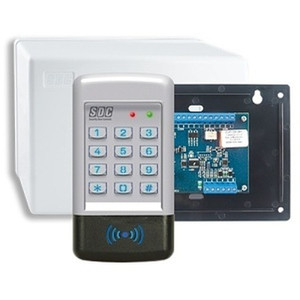
SDC BPS6PV Surface Mount Access Control Controller
The SDC BPS6PV is a surface-mount access control controller engineered for mid-to-large facilities requiring centralized management of multiple door zones. Rated for 63 doors and 250,000 user credentials, the BPS6PV delivers the density and protocol flexibility needed in enterprise campuses, multi-tenant office buildings, and healthcare systems where mixed-credential technology support is mandatory. The compact 6" × 6" form factor mounts directly in server rooms or electrical closets, minimizing infrastructure overhead while maintaining full OSDP and TCP/IP connectivity to management platforms.
Key Features
- 63-Door Capacity: Manages up to 63 access points from a single surface-mount unit. Reduces controller proliferation and simplifies centralized policy enforcement across large facilities.
- 250,000 Credential Maximum: Supports enterprise-scale user directories without requiring additional enrollment infrastructure. Simplifies badge issuance workflows in organizations with high staff turnover or multi-site operations.
- Multi-Credential Support (DESFire, MIFARE, NFC 13.56MHz, 125kHz Prox): Accepts four credential technology families. Enables phased migration from legacy 125kHz systems to modern NFC deployments without wholesale reader replacement or parallel infrastructure.
- OSDP and TCP/IP Protocols: Native OSDP support (rev. D compliant) ensures firmware-level encryption and tamper reporting. TCP/IP fallback maintains platform compatibility across Genetec, Salto, Openpath, and other enterprise VMS integrations.
- Surface Mount Form Factor (6" × 6" × 42"): Fits standard electrical enclosures and server room racks. No recessed wiring required, reducing installation labor on retrofit projects.
- Lifetime Warranty: Manufacturer warranty coverage for device lifespan eliminates mid-cycle hardware refresh obligations in long-term deployments.
The BPS6PV's credential agnosticism is its operational strength. In environments where legacy 125kHz badge stock still circulates alongside new NFC rollouts, this controller eliminates reader-level credential filtering — the unit handles all four technologies simultaneously. That translates to unified policy enforcement and audit trails across mixed badge populations, a critical requirement in healthcare and government sectors where legacy systems outlive their planned lifecycles.
OSDP communication provides encrypted credential transmission and real-time tamper alerts sent directly to the access control management platform. This is not optional in regulated environments (PCI DSS, HIPAA, FISMA): it's the baseline for credential integrity. TCP/IP redundancy ensures that network outages don't cascade into access denial or lockdown conditions — doors remain under local controller authority, falling back to pre-loaded credential caches if the management connection drops.
The 250,000-credential ceiling accommodates enterprise directories with growth headroom. In practice, this means security teams can stage badge issuance months in advance, provision contractors and vendors without manual refresh cycles, and maintain historical records of revoked credentials for audit compliance. No mid-project controller replacement when the user roster exceeds 100,000 — common pain points with smaller (5,000–50,000 user) controller designs.
Mounting in a server room or electrical closet positions the controller near network and power infrastructure, reducing cable runs to reader zones and lowering installation costs. The compact footprint allows DIN-rail mounting or wall-surface attachment; standard RJ45 cabling connects readers, strike controls, and egress buttons to the unit's I/O terminals without custom harnesses.
The BPS6PV pairs with enterprise access control software (Genetec SYNERGIS, Salto KNX, Openpath cloud, or comparable ONVIF-adjacent platforms) via TCP/IP or dedicated OSDP gateways. API access (RESTful, where supported by the management layer) enables custom event workflows — cardholder deactivation tied to HR departures, real-time access reports for audit trails, or temporary visitor credentials that auto-expire without manual intervention.
Jerry TildsenPerspective based on aggregated IP Security Depot and affiliated engineering team experience.
We've deployed the BPS6PV across multi-tenant office parks, university campuses, and healthcare networks where credential heterogeneity is a fact of life, not a future consideration. The core operational advantage is this: instead of running parallel controller infrastructure to segregate 125kHz legacy badge readers from new NFC enrollment systems, the BPS6PV handles both in a single unit. On a 300-door campus, that eliminates redundancy overhead and streamlines audit reporting — one controller, one set of policy rules, one credential database. The OSDP encryption story matters more than integrators initially think. In environments subject to PCI DSS, NIST Cybersecurity Framework, or HIPAA, credential transmission encryption isn't marketing language — it's a compliance requirement. OSDP rev. D delivers that natively; controllers without OSDP force integrators to deploy gateway layers or managed cloud solutions to meet audit timelines. The 63-door cap is the real design boundary. If a site's door count will exceed 80–100 in the next 3–5 years, or if growth projections point beyond that, you'll need to architect multi-controller clusters from the start. The BPS6PV doesn't cascade redundantly; you're planning a second unit anyway. Know that before the RFQ. TCP/IP redundancy is worth understanding operationally. If your network uplink drops, the BPS6PV continues to validate credentials locally from its cached database — doors don't lock, security doesn't degrade, but you lose real-time audit visibility until the network heals. That's acceptable in 99% of sites; it's a gotcha in zero-trust perimeter designs where every access event must be logged remotely before the door unlocks.
Technical Highlights:
- OSDP Rev. D Compliance: Encrypted credential and command transmission — no plaintext badge data on the network. Mandatory for regulated deployments; reduces audit friction and eliminates credential-sniffing vectors that plague older Wiegand-based readers.
- Multi-Credential Database (250K users): Single cardholder record spans 125kHz, NFC, MIFARE, and DESFire credentials simultaneously. Simplifies badge replacement workflows: issue an NFC card, link it to the legacy 125kHz badge in the same user profile, retire the old reader without deprovisioning cardholder access.
- TCP/IP + OSDP Dual Paths: Cloud management platforms use TCP/IP for real-time reporting; on-premises VMS systems deploy OSDP for direct controller queries. Hybrid integrations (cloud audit log, on-site access enforcement) are standard, not exceptions.
- DIN-Rail and Surface Mount Flexibility: Fits standard 19" server racks and wall-mount enclosures. Reduces installation labor vs. controllers requiring custom mounting brackets or cavity cuts.
- Lifetime Warranty: No refresh cost at year 5 or 7 — device warranty extends device lifecycle, rare in the access control market and a real TCO win in large deployments.
Deployment Considerations:
- Plan for 63-door maximum from the outset. Multi-controller clustering requires redundancy networking (failover logic, inter-controller sync) that adds cost and complexity. If site growth projects exceed 80 doors, architect two independent BPS6PV units with geographic separation from day one.
- OSDP gateways may be required depending on your VMS platform. Genetec SYNERGIS has native OSDP support; older Salto KNX or Milestone implementations may use TCP/IP shims. Confirm gateway requirements before installation.
- Credential caching is local-only — the BPS6PV stores the last N credentials validated. Network outages longer than 24–48 hours (rare) may require manual credential refresh. Not a practical issue in standard office deployments; design accordingly in remote or unreliable network environments.
- Reader wiring is terminated at the controller's I/O terminals; runs longer than 1,000 feet need RS-485 repeaters or powered line drivers. Account for reader distribution in your infrastructure budget.
- DESFire credential validation requires cryptographic processing on the controller — bandwidth consumption is negligible, but planning for CPU headroom on very high-frequency access events (>100 reads/second across all 63 doors) is prudent in emergency egress scenarios.
The BPS6PV is the right fit for integrators building enterprise access infrastructure where credential migration timelines span years and reader diversity is architectural fact, not technical debt. For straightforward single-credential-type deployments under 20 doors, smaller controllers offer better economics. For larger campuses (100+ doors), plan multi-unit redundancy from the start. SDC catalog