
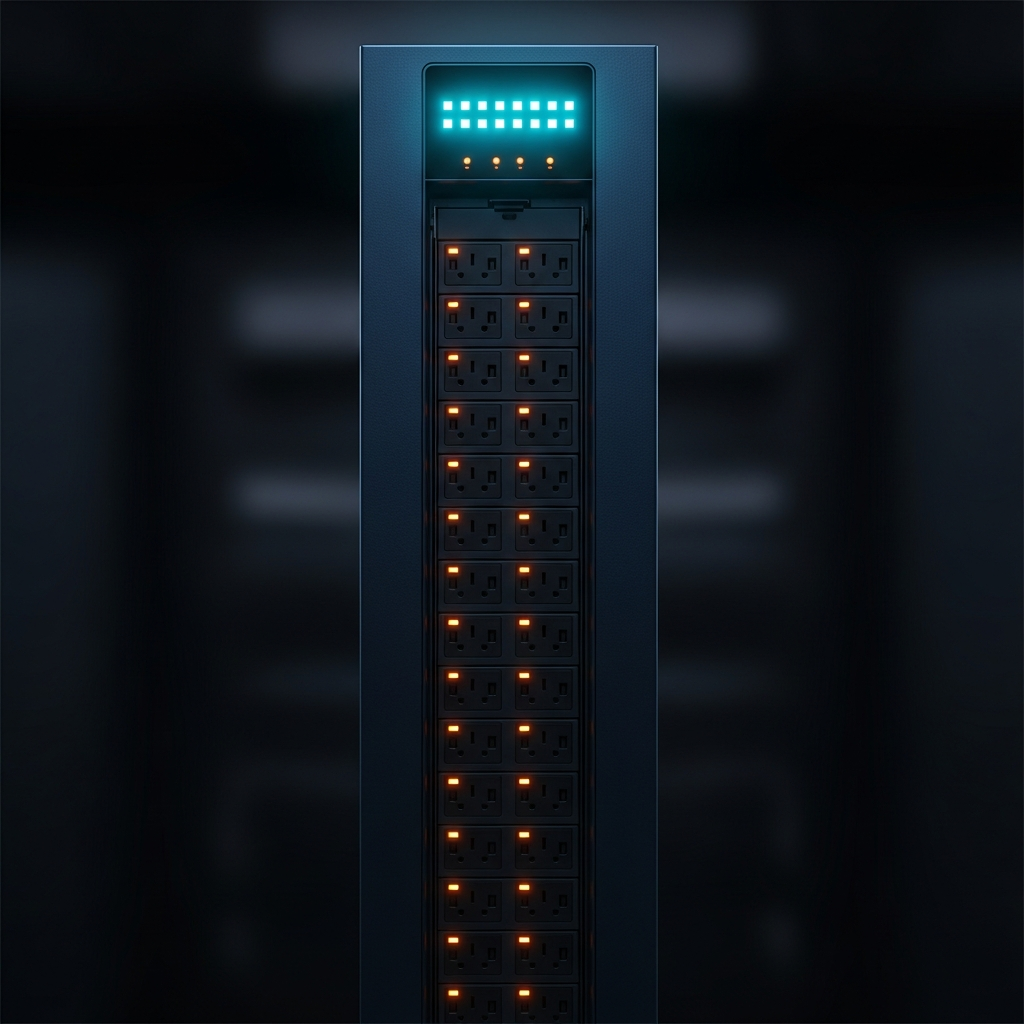
Rack PDU Buyer's Guide
Basic vs metered vs monitored vs switched - and when each one earns its place in the rack.
Key takeaways
- Basic PDU is fine if you only need outlets. Add features when you can name what they do for you.
- Metered PDU adds a real-time amp display - cheapest way to catch overloaded branches before they trip.
- Monitored PDU adds network telemetry - per-PDU current, voltage, kWh logging via SNMP / Modbus / REST.
- Switched PDU adds per-outlet on/off control - remote reboot, scheduled power cycling, automated startup sequencing.
- Dual-cord (A/B feed) PDUs are mandatory for 2N redundancy - paired with dual-PSU servers.
In this guide
PDU types: basic to switched
| Type | Outlets | Per-outlet metering | Whole-PDU metering | Network mgmt | Per-outlet switching | Typical cost |
|---|---|---|---|---|---|---|
| Basic | Always-on | No | No | No | No | $80-$250 |
| Metered | Always-on | No | Yes (local display) | No | No | $200-$500 |
| Monitored | Always-on | Optional | Yes | SNMP/HTTPS/Modbus | No | $400-$900 |
| Switched | Per-outlet on/off | Optional | Yes | SNMP/HTTPS/Modbus | Yes | $700-$1800 |
| Switched + outlet metering | Per-outlet on/off | Yes | Yes | Full | Yes | $1200-$3000 |
Which one do you need?
- Basic: single-tenant rack, low criticality, no remote management needed. Fine for surveillance racks, telephone closets.
- Metered: when you need to verify load balance across branches but don't want network exposure. Good for branch IT.
- Monitored: when you want kWh / amp / voltage data into DCIM or SNMP, but not the security exposure of remote switching. Datacenter standard for non-critical.
- Switched: when remote reboot saves a truck roll. Mandatory for colo cages, mid-tier datacenter, any unattended remote site.
- Switched + per-outlet metering: when chargeback or per-customer billing applies. Standard in colocation.
Plug and receptacle reference
The PDU's input plug must match the branch circuit receptacle, and the output receptacles must match your server / switch cords. Mismatches are the most common spec error.
| Receptacle | Voltage | Amps | Phases | Used for |
|---|---|---|---|---|
| NEMA 5-15 | 120V | 15A | Single | Office, light IT, small UPS output |
| NEMA 5-20 | 120V | 20A | Single | Workstations, network closets |
| NEMA L5-30 | 120V | 30A | Single | Larger 120V racks (uncommon in datacenter) |
| NEMA L6-20 | 208/240V | 20A | Single | Server racks, common in older datacenter |
| NEMA L6-30 | 208/240V | 30A | Single | Mid-density server rack, standard PDU input |
| NEMA L15-30 | 3-phase 208V | 30A | Three | High-density rack, 3-phase 30A drop |
| NEMA L21-30 | 3-phase 208V (with neutral) | 30A | Three | Three-phase with neutral - 4-pole + ground |
| NEMA L22-30 / L22-60 | 3-phase 480V | 30/60A | Three | Industrial / hyperscale; less common in IT |
| IEC 60309 (red) | 208/415V | 30/60/100A | Single or three | European and modern US datacenter |
| IEC C13 / C14 | 250V | 10/15A | Single | Server cord, switch cord (output side) |
| IEC C19 / C20 | 250V | 16/20A | Single | High-power servers, blade chassis output |
Single-phase vs three-phase
Single-phase
- Simpler wiring, lower install cost
- 30A single-phase 208V delivers ~5 kW usable
- Works for racks up to 10-15 kW with parallel circuits
Three-phase
- Three independent legs, 208V phase-to-phase (or 415V in modern designs)
- 30A three-phase 208V delivers ~8.6 kW usable (single drop)
- 60A three-phase 208V delivers ~17 kW; 100A delivers ~28 kW
- 415V three-phase doubles the kW per amp - the standard for hyperscale
- Required for AI cluster racks (30-100+ kW per rack)
Dual-cord / A+B redundancy
2N redundancy at the rack means each server has two PSUs, each fed from an independent PDU on an independent branch circuit. Either feed alone keeps the server running.
Rules
- A and B feeds must be on separate breakers, separate panels, ideally separate UPS systems.
- PDUs must be from separate physical paths (don't run both cords up the same conduit).
- Each PSU should be able to carry full load alone - check the server's PSU rating vs full draw.
- Load balance: when both feeds are live, distribute server load so neither feed exceeds 40-50%. That leaves 80% capacity headroom if one feed fails.
Brand comparison
| Brand / line | PDU types | Management | Notable features |
|---|---|---|---|
| Vertiv Geist rPDU | Basic, metered, monitored, switched | SNMPv3, HTTPS, Modbus, BACnet | Hot-swap intelligent network module, color-coded outlets, U-Lock |
| APC Rack PDU AP-series | All types | SNMP, EcoStruxure, NMC card | Mature DCIM integration, broad model variety |
| Eaton ePDU G3 | All types | SNMP, BACnet, Modbus, IPM software | Color-coded zones, daisy-chainable network, gigabit interface |
| Tripp Lite PDU3 / PDUMV / PDUMH | Basic, metered, monitored, switched | SNMP/HTTPS via NetCommander card | Strong value, broad config range |
| Ubiquiti USP-PDU-Pro | Smart, with PoE in some variants | UniFi Controller | Mid-density, UniFi ecosystem integration, value pricing |
| Server Technology Sentry | Switched, metered, all | SNMP, REST API, Per Inlet Monitoring | Hyperscale standard, modular outlet types, branch-level metering |
Buyer checklist
- Input plug. What does the branch circuit drop look like? L6-30, L21-30, IEC 60309?
- Phase. Single or three-phase? Match the building electrical.
- Amperage. 20, 30, 60, 100A? Continuous-load derate is 80%.
- Outlet count and types. C13 only? C13+C19 mix? Locking outlets? Count actual loads, not theoretical.
- Form factor. Zero-U vertical (skinny side rail) or 1U horizontal (eats rack space)? Vertical preferred for high-density racks.
- Management level. Basic, metered, monitored, switched - chosen based on real operational need.
- Network management. SNMPv3 minimum for monitored/switched. Verify TLS for HTTPS.
- Redundancy. Single-cord, dual-cord, or ATS-fed?
- Future expansion. Buy 24-outlet now or 36-outlet for future racks?
FAQ
Why are switched PDUs so much more expensive than basic?
Per-outlet relays are real hardware - each switchable outlet adds a relay, snubber, optoisolator, and microcontroller signal. A 24-outlet switched PDU has 24 of those circuits plus a network management module. The price reflects bill of materials, not margin gouging.
Can I daisy-chain PDUs?
Plugging one PDU into another (cascade) is technically possible but a bad idea - amperage limits compound, and you bypass the second PDU's input metering. What you can do safely: daisy-chain the network management interface (Eaton ePDU, Geist) so one IP address manages multiple PDUs.
What's the difference between "monitored" and "metered" PDUs?
Metered shows current draw locally (LCD on the PDU) and that's it. Monitored adds network connectivity - the data is logged, alerted, integrated into DCIM. Metered is a tool for the technician at the rack; monitored is a tool for the NOC.
Do PDUs themselves need a UPS feed?
If you want the gear in the rack to survive an outage, yes - the PDU's input must come from a UPS-protected source. The PDU itself draws negligible power; what matters is the cumulative draw of everything plugged into it.
How long do PDUs last?
Basic PDUs are essentially passive - they last as long as the connectors hold. Metered, monitored, and switched PDUs have electronics that age. Plan to refresh management cards every 7-10 years; the chassis itself can run 15+ years.
Should I get 24, 36, or 42 outlets per PDU?
Count actual devices, then add 25% headroom. For dual-feed 2N racks, you need outlets on both A and B sides for every dual-PSU device - count carefully. Higher outlet count rarely wastes much money and saves a future field swap.
Rack power that scales from edge to AI
Channel-direct sourcing on Vertiv Geist, APC, Eaton ePDU, Tripp Lite, Ubiquiti. Trained Installer on the phone.
Browse Power & UPS UPS Sizing Guide PoE Planning