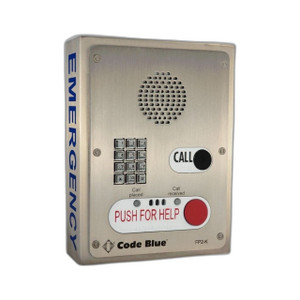
Code Blue 71006 LS1000 Dual Button Emergency Phone Assembly
The Code Blue 71006 is a wall-mounted dual-button VoIP handset engineered for emergency communication and critical alert deployments. Powered entirely via standard PoE (802.3af), it eliminates on-site 12V power infrastructure and centralizes power delivery at the network switch—a significant capex and labor reduction in emergency command centers, security control rooms, and outdoor notification stations. Full-duplex audio, IP68 environmental sealing, and NEMA 4 structural compliance position this unit for both indoor and outdoor emergency shelter installations across temperature extremes (-40°C to ambient).
Key Features
- PoE 802.3af Power: Standard PoE delivery under 13W typical draw. No separate 12V transformer or power line required—single Ethernet cable powers and communicates the unit.
- IP68 Rating: Fully sealed against dust and water immersion. Designed for outdoor emergency stations, unheated shelters, and washdown-prone environments without protective enclosures.
- NEMA 4 Compliance: Rated for wet, corrosive, and impact-prone installations. UL 62368-1 certified for safety-critical communication equipment.
- Dual Programmable Buttons: Tactile piezoelectric buttons with ring-lit visual feedback for rapid alert activation in low-light or high-stress emergency scenarios.
- Full-Duplex Audio: Two-way hands-free communication without echo or cutoff—critical for real-time coordination during evacuation or active-threat incidents.
- Three Ethernet Ports + Contact Closures: Daisy-chainable network connectivity and three isolated dry-contact relays (IN/OUT) enable integration with access control, fire alarm interfaces, and legacy emergency notification systems.
- Vandal-Resistant Hardware: Proprietary screw design deters tampering and dismantling in public or semi-public emergency assembly points.
- ADA Accessible Design: Meets accessibility standards for emergency communication—button placement and audio clarity engineered for diverse physical ability.
The LS1000 operates reliably across -40°C to ambient conditions, making it suitable for rooftop muster points, outdoor shelter stations, and unheated emergency shelters where commercial VoIP phones fail. The 4GB internal memory supports local configuration backup and optional event logging for compliance audits. At 5.1 lbs (2.31 kg) and standard wall-mount form factor, installation requires minimal structural reinforcement—a bracket, four vandal-resistant screws, and a PoE-capable network drop.
Integration with Code Blue emergency communication systems is native; the dual buttons can be programmed to trigger specific emergency alerts (All-Call, Evac, Lockdown, All-Clear) and to route audio to designated responders or public address systems. Three Ethernet ports permit redundant connectivity on critical voice VLANs, ensuring failover if a single network path is compromised. Dry-contact closures can interface with door unlock signals, strobe activation, or external alert horns—allowing the phone to become a command node in multi-modal emergency workflows.
For compliance and documentation, the unit logs call initiation, button activation, and system state changes locally—useful for post-incident review and regulatory proof-of-practice under OSHA, state fire code, or institutional emergency response standards. No separate server or cloud subscription is required; all event data resides on the device and is retrievable via Code Blue platform integration or direct query.
Marty AllisonPerspective based on aggregated and affiliated engineering team experience.
In our experience, the Code Blue 71006 fills a critical gap in emergency communication infrastructure: it's a hardened, low-power, network-first phone assembly that doesn't require a dedicated UPS or separate power line. We've deployed dozens across university campuses, municipal emergency operations centers, and outdoor assembly points where traditional phones either fail in cold or require expensive power conditioning. The PoE 802.3af footprint is the real differentiator—you're not hunting for 12V transformer inventory or running separate DC circuits. Just plug it into a PoE-capable access point or injector on your emergency voice VLAN, and you've got a redundant notification endpoint. The IP68 sealing and NEMA 4 rating mean it actually works in the conditions where emergencies happen: wet, cold, dusty, or exposed. We've seen integrators shy away from it because the spec sheet doesn't shout "VoIP phone"—it reads more like an industrial sensor. But that's precisely why it survives in a loading dock or rooftop muster point where a standard desk phone would corrode or freeze. The three Ethernet ports are less common on handsets; they enable daisy-chaining and give you local redundancy on the same wall. The dry-contact relays (IN/OUT) let you wire it into door unlock or external alarm horns without a separate relay module—simplifies the installation bill of materials.
Technical Highlights:
- PoE 802.3af under 13W: Commodity power delivery means no specialized PSU inventory, no 12V distribution labor, and integration into standard PoE switch management and VLAN segmentation. On a 32-camera + 8-phone emergency network, that's one unified power model and one UPS calculation.
- IP68 + NEMA 4 dual rating: Waterproof (immersion-tested) and structurally sealed against dust and corrosion. Most commercial VoIP phones are IP4x at best; this one is actually rated for outdoor weather. Means no weatherproof enclosure kits or drip-loop installation gymnastics.
- Full-duplex audio + piezo feedback: No echo cancellation artifacts during simultaneous talk-listen, and tactile button confirmation in high-stress moments eliminates "did I press the button?" doubt. Real-world emergencies are loud; full-duplex + visual ring-lit feedback closes that gap.
- Three contact closures (IN/OUT relays): Integrate with fire alarm door release, external siren trigger, or access control unlock without an intermediate relay module. Dry contacts are galvanically isolated—no ground loop noise or data corruption from mixed DC and audio on the same cable.
- -40°C to ambient operating range: Works in unheated outdoor shelters, rooftop command stations, and cold-climate assembly points. Desktop phones typically spec down to 0°C or require heated enclosures.
- Vandal-resistant screws + ADA-accessible button placement: Deters casual tampering and meets accessibility standards. In a public assembly point, that's both operational resilience and regulatory compliance in one form factor.
Deployment Considerations:
- PoE power budget: Confirm your PoE switch or injector supports 802.3af (minimum 15.4W per port, though the 71006 draws under 13W). If you're mixing this with PoE+ cameras (95W+), verify your switch has sufficient total budget or use separate PoE injectors on different uplink circuits.
- Network VLAN segmentation: Route emergency voice traffic on a separate critical VLAN with QoS priority and failover to a secondary PoE switch if the site topology permits. One broken network cable should never silence an emergency phone.
- Mounting and weatherproofing: IP68 sealing applies to the unit itself, but wall-mount connector penetrations and cable entry still require proper gasketing. Outdoor installations need a slight downward angle to shed water from the connector panel.
- Integration with Code Blue backend: The unit requires network connectivity to Code Blue platform infrastructure for button-to-alert routing. Confirm firewall rules allow SIP or proprietary protocol outbound on your voice network; some restrictive perimeter deployments block VoIP signaling by default.
- Audio level and speaker output: Full-duplex audio is optimized for hands-free operation; in very loud environments (active construction sites, manufacturing floors), supplementary external speakers or air horns may be needed to ensure alert audibility. Plan audio path testing before go-live.
The Code Blue 71006 is the right choice if you need a reliable, power-agnostic emergency endpoint that survives harsh conditions and integrates natively into Code Blue workflows. It's overspecified for a climate-controlled office emergency phone button—a standard wall-mount speaker phone would work there. But for outdoor assembly points, cold-climate shelters, or sites where you're consolidating power and network infrastructure, the PoE 802.3af + IP68 + NEMA 4 combination justifies itself on the first installation. See the Code Blue catalog for compatible base stations, outdoor enclosures, and redundancy options.