


Product images are provided for reference and may not represent the exact model, configuration, or included
components.
Overview
SKU:
NHR-8A-L
Condition:
New
Availability:
Usually ships in 24 hours
Warranty
2-Year Warranty
Aiphone NHR-8A-L Bedside Call Cord with Locking Switch
Aiphone NHR-8A-L Bedside Call Cord with Locking Switch Overview The Aiphone NHR-8A-L is a bedside call cord assembly with integrated locking switch d…

Aiphone NHR-8A-L Bedside Call Cord with Locking Switch
$60.99
Your recommended setup
Review items below — quantities update pricing automatically.
Item
Qty
Status
Price
Optional Add-Ons recommended
Services optional
Bundle Summary
Bundle Subtotal:
$0.00
Optional Add-Ons:
$0.00
Services:
$0.00
Total:
$0.00
Overview
SKU:
NHR-8A-L
Condition:
New
Availability:
Usually ships in 24 hours
Warranty
2-Year Warranty
Description
Aiphone NHR-8A-L Bedside Call Cord with Locking Switch
Overview
The Aiphone NHR-8A-L is a bedside call cord assembly with integrated locking switch designed for patient communication systems in healthcare facilities. This component functions as a patient-initiated call station endpoint, connecting to Aiphone's modular nursing call infrastructure. One NHR-8A-L unit is required per substation jack to enable two-tier call signaling: routine calls via button activation and urgent calls via cord-out activation. The latching call button design ensures calls must be reset at the patient station, preventing accidental dismissal and maintaining accountability in critical care environments.
Key Features
- Dual Call Modes: Button activation triggers routine call at master station; cord-out activation triggers urgent call at master station for priority alert signaling
- Latching Button Design: Call must be manually reset at patient station, preventing passive call clearing and ensuring staff acknowledgment
- Single-Unit Deployment: One bedside cord required per substation jack for flexible, scalable system expansion
- Modular Compatibility: Compatible with NH-1SA/A single-jack bedside audio substation, NH-2SA/A dual-jack bedside audio substation, and NHR-3TS dual corridor light substation
- Healthcare-Grade Design: Engineered for 24/7 nursing communication with reliable call initiation and reset mechanics
- Integrated Cord Switch: Dedicated cord-out switch mechanism for urgent call activation without requiring additional hardware
Integration & Compatibility
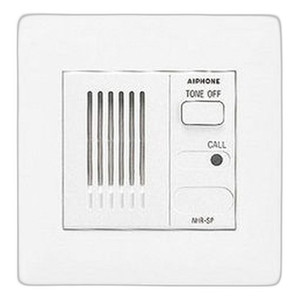
The NHR-8A-L integrates with Aiphone's master station units, including the NHX-50M 50-call audio master station with handset, which supports 3 call levels and manages incoming calls from multiple bedside cord units. System expansion is supported through add-on components such as the NHR-30K 30-call add-on PC board for 51–80 station configurations and the NHX-80X central control unit for larger deployments. The bedside cord pairs with substation architectures (single or dual-jack configurations) and corridor light substations (NHR-3TS) to create comprehensive patient communication networks across multiple patient care areas. Duty stations, such as the NHR-SP audio duty station, receive and manage incoming calls from all bedside cord units in the system.
System Architecture Considerations
Deployment of the NHR-8A-L requires selection of compatible substation units. Healthcare facilities typically mount substations at bedside with the call cord positioned for patient accessibility. The latching mechanism requires staff training to understand reset procedures and to prevent call signal loss during patient care transitions. Multi-station systems benefit from centralized master station placement in nursing stations or control areas, allowing staff to respond to routine and urgent calls with appropriate prioritization. The modular design permits incremental system growth without full-system replacement, supporting facility expansion and care unit reconfiguration.
Specifications
Power Type:
PoE+ (802.3at)
Form Factor:
Bedside Call Cord
Mount Type:
Wall; Rack
Resolution:
4K (8 MP)
Focal Length:
2-41 mm
IR Distance:
850nm
Have Questions?
Ask an Expert.
RELATED PRODUCTS



System Design, Deployment & Technical Support
Support services and planning resources for commercial surveillance, access control, and infrastructure deployments.
Fixed scope • Fixed price
System Design Assistance
- Get help validating product compatibility
- Coverage requirements
- Storage planning and deployment architecture before you buy.
Deployment & Configuration Support
- Access fixed-scope support for rollout planning
- User setup guidance
- Migration and system standardization across single-site or multi-site deployments
Guides, Tools & Calculators
- PoE requirements
- Storage retention
- Camera selection and deployment methodology