


Overview
SKU:
UF-SPLITTER-8
Condition:
New
Availability:
Usually ships in 24 hours
Warranty
Manufacturer Warranty
Ubiquiti UF-SPLITTER-8 UFiber Splitter
Ubiquiti UF-SPLITTER-8 Passive Optical Splitter Overview The Ubiquiti UF-SPLITTER-8 is a passive optical splitter designed for fiber-based network de…
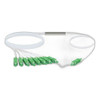
Ubiquiti UF-SPLITTER-8 UFiber Splitter
$15.99
Your recommended setup
Review items below — quantities update pricing automatically.
Item
Qty
Status
Price
Optional Add-Ons recommended
Services optional
Bundle Summary
Bundle Subtotal:
$0.00
Optional Add-Ons:
$0.00
Services:
$0.00
Total:
$0.00
Overview
SKU:
UF-SPLITTER-8
Condition:
New
Availability:
Usually ships in 24 hours
Warranty
Manufacturer Warranty
Description

Ubiquiti UF-SPLITTER-8 Passive Optical Splitter
Overview
The Ubiquiti UF-SPLITTER-8 is a passive optical splitter designed for fiber-based network deployments within the UISP accessory ecosystem. This component functions as a distribution point in fiber optic installations, enabling a single fiber run to be split into eight distinct paths without requiring external power or active management. The UF-SPLITTER-8 operates as a transparent optical element, making it suitable for applications where signal distribution must occur at the physical layer without introducing latency or requiring network administration overhead.
Key Features
As a passive optical splitter, the UF-SPLITTER-8 requires no power supply, management interface, or configuration—characteristics that simplify deployment in remote or infrastructure-constrained environments. The eight-port configuration provides flexible distribution capacity for medium-scale fiber networks. Manufactured in China and weighing only 0.150 lb, the unit is compact and straightforward to integrate into existing fiber conduit and cabinet layouts. The device maintains compatibility with UISP-based network designs, positioning it as a standard component in Ubiquiti fiber infrastructure projects.
Deployment Scenarios
The UF-SPLITTER-8 serves applications requiring passive signal distribution across multiple service delivery points. Typical use cases include fiber-to-the-premise (FTTP) networks where a single feeder fiber must reach multiple subscriber locations, distributed antenna system (DAS) backhaul where signal needs to reach multiple remote units, and campus or multi-building fiber networks requiring cost-effective distribution without powered equipment at intermediate nodes. The passive nature eliminates concerns about power redundancy and cooling at split points, reducing operational complexity in field deployments.
Network Integration
Integration of the UF-SPLITTER-8 into UISP fiber architectures follows standard optical splitter placement practices. The device sits between source and destination fiber runs, creating a passive junction that maintains signal integrity across all eight output ports. Proper fiber management—including strain relief, protective conditioning, and organized routing—ensures optimal performance. The MPN UF-SPLITTER-8 should be specified during network design to ensure adequate splitter capacity and to confirm compatibility with optical power budgets in the overall system design.
Installation Notes
Installation requires standard fiber termination practices and awareness of optical loss characteristics inherent to passive splitters. The lightweight form factor (0.150 lb) permits wall, rack, or conduit mounting with minimal structural consideration. Fiber entries should be protected from mechanical stress, moisture ingress, and sharp bends that exceed the manufacturer's bend radius specifications. Testing insertion loss across all eight ports using optical power meters validates proper installation and confirms system performance meets design specifications. Documentation of splitter location and port assignments supports future maintenance and troubleshooting.
Marty Allison, Infrastructure Architect
"The UF-SPLITTER-8 remains a foundational component in passive fiber distribution. Its zero-power operation and eight-port capacity make it economical for medium-scale FTTP and enterprise fiber builds. When specifying the UF-SPLITTER-8, ensure your optical budget calculations account for the inherent ~10-11 dB loss per port typical of passive optical splitters—this directly impacts transceiver selection and maximum link distances. In UISP deployments, the UF-SPLITTER-8 pairs effectively with UFiber transceivers, provided your source power levels accommodate the split. The passive architecture is its strength: no management overhead, no single points of failure at the splitter itself, and reliable performance across temperature variations."
Specifications
Form Factor:
Passive Optical Splitter
Management:
None (Passive)
Ports:
8
Product Family:
UISP Accessory Tech
Country of Origin:
CN
Weight:
0.150 lb
Have Questions?
Ask an Expert.
RELATED PRODUCTS



System Design, Deployment & Technical Support
Support services and planning resources for commercial surveillance, access control, and infrastructure deployments.
Fixed scope • Fixed price
System Design Assistance
- Get help validating product compatibility
- Coverage requirements
- Storage planning and deployment architecture before you buy.
Deployment & Configuration Support
- Access fixed-scope support for rollout planning
- User setup guidance
- Migration and system standardization across single-site or multi-site deployments
Guides, Tools & Calculators
- PoE requirements
- Storage retention
- Camera selection and deployment methodology