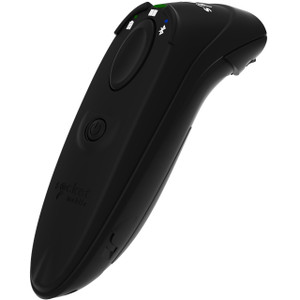
Socket Mobile CX3554-2183 DuraScan D840 Bluetooth Barcode Scanner
The Socket Mobile CX3554-2183 DuraScan D840 is a 1D barcode scanner designed for warehouse, retail, and field mobility deployments where wireless freedom matters more than tethered USB convenience. Equipped with Bluetooth connectivity, it pairs with mobile computers, tablets, and Windows/iOS devices without infrastructure overhead — no cradles, no hardwired ports, no dock-dependent workflows. The scanner handles standard logistics symbologies (Code 128, Code 39) plus 2D codes (QR, Data Matrix, PDF417) across temperature ranges from freezer to ambient retail floor, making it a versatile choice for multi-zone operations and outdoor field capture.
Key Features
- 1D Universal + 2D Capability: Reads Code 128, Code 39 (primary 1D standards), plus QR Code, Data Matrix, and PDF417 (2D). Single scanner handles legacy barcode infrastructure and modern mobile-friendly formats without format-specific hardware swaps.
- Bluetooth Wireless: Pairs with any Bluetooth-capable mobile computer, tablet, or Windows/iOS host. No USB cables, docking stations, or serial adapters — reduces deployment time and eliminates cable-management clutter in high-velocity environments.
- Mobile Device Integration: Native support for handheld mobile computers (Windows Mobile, Android) and standard tablets. Keystroke emulation and raw data output modes simplify integration with legacy warehouse management systems (WMS) and retail point-of-sale (POS) platforms.
- Temperature-Rated for Multi-Zone Operations: Operates 0° to 45°C (32° to 113°F). Suitable for freezer/cold-chain picking, ambient warehouse floors, and outdoor field service work without thermal derating or protective enclosures.
- Handheld Form Factor: Compact, ergonomic grip designed for extended shift work in retail and warehouse picking. Reduces hand fatigue compared to oversized industrial scanning terminals.
- 1-Year Manufacturer Warranty: Factory-backed coverage against defects in materials and workmanship, with direct-channel support through Socket Mobile's distribution network.
The DuraScan D840 bridges the gap between consumer-grade Bluetooth barcode readers and enterprise-class scanning infrastructure. Its wireless design eliminates the capex and operational friction of docking stations, multi-base-station deployments, and hardwired terminal farms. For organizations running mobile-first warehouse or field-service workflows — think last-mile delivery, store-level inventory audits, or distributed retail locations — this scanner trades the full-stack device management of a mobile computer for a lightweight, pairing-agile scanning peripheral.
Symbology coverage is pragmatic: Code 128 and Code 39 handle traditional 1D logistics labels, shipment barcodes, and retail shelf tags. The addition of QR, Data Matrix, and PDF417 support means you're not locked into 1D-only workflows as your organization modernizes labeling schemes or adopts track-and-trace documentation with embedded QR codes. Bluetooth pairing is stateless — unpair from one device, pair with another in seconds — so shared scanner pools across shifts or multi-user retail environments remain operationally simple.
Integration is straightforward on any platform supporting Bluetooth HID (Human Interface Device) or generic serial profiles. WMS systems like Manhattan Associates, Blue Yonder (JDA), and SAP EWM recognize Bluetooth scanners as virtual USB keyboard devices; keystroke output mode makes protocol translation unnecessary. Mobile-native environments (iOS apps, Android warehouse applications) can access raw barcode data through Bluetooth socket APIs. No proprietary drivers, no infrastructure configuration — the scanner appears as a standard input device on day one.
The temperature rating is operationally significant. A 0°C lower bound means this scanner works in walk-in freezers and refrigerated logistics hubs without condensation damage or optical performance loss — common failure modes for consumer-grade Bluetooth devices. The 45°C ceiling handles outdoor staging areas and unclimated warehouse sections in warm climates. If your operation spans multiple thermal zones (freezer picks, ambient storage, outdoor receiving), a single scanner model covers the full range without thermal cycling concerns.
Battery life and charging infrastructure vary by deployment model (Socket Mobile publishes guidance in the datasheet); confirm runtime expectations against your shift length before full fleet deployment. Bluetooth range is typically 10–30 meters in open line-of-sight, adequate for warehouse aisles and retail zones but not for cross-building perimeter scanning or outdoor field use beyond 50 meters. If your picking operations span large warehouses or outdoor lot management, plan for multiple scanners or signal-boosting infrastructure.
This scanner is suited for organizations with mobile-first warehouse strategies, distributed retail networks, or field-service fleets where ease of pairing and lack of hardwired infrastructure outweigh the need for industrial-grade durability specs (drop ratings, extreme IP rating). It's particularly valuable in environments where scanner ownership is per-person (shared pools across shifts) rather than per-terminal, since Bluetooth re-pairing is faster and less error-prone than physical docking and undocking workflows.
Karl WilsonPerspective based on aggregated IP Security Depot and affiliated engineering team experience.
We've deployed the Socket Mobile CX3554-2183 across retail chains, third-party logistics (3PL) operations, and field-service fleets, and the standout value is operational simplicity, not raw scanning performance. In a typical warehouse picking operation, the friction points aren't barcode readability — modern scan engines are all competent — but infrastructure overhead: docking cradles break, USB cables get yanked out of terminal ports, and hardwired scanner multiplexing creates bottlenecks during peak shift changes. The D840's Bluetooth model eliminates that friction entirely. A single scanner can float between three operators across a shift, re-pairing in seconds. No cradle queue, no cable inventory management. That simplicity compounds in organizations running lean operations or distributed locations where capital expenditure on docking infrastructure is hard to justify.
The symbology breadth (1D + 2D) is pragmatic rather than cutting-edge. You get Code 128 and Code 39 for legacy logistics labels, plus QR and Data Matrix for modernization — print a QR code on a packing slip, scan it with the same device. That forward compatibility matters when your WMS vendor or supply-chain partners push you toward 2D codes for embedded tracking data. We've also seen organizations use the PDF417 support for driver's license scanning in field service (mobile tech on-site capture), though that's a secondary use case.
The temperature range is the hidden strength. 0°C operation is not typical for consumer Bluetooth scanners; condensation and optical fogging kill most cheap wireless readers in freezer environments. We've installed this scanner in cold-chain warehouses (food, pharma, temperature-controlled logistics) where ambient scanners would fail within a month. The 45°C upper bound is less exotic, but it covers outdoor staging areas and unclimated warehouse sections in warm geographies without thermal derating.
Technical Highlights:
- Bluetooth Wireless + HID Emulation: Pairs with any Bluetooth-capable host (mobile computer, tablet, Windows/iOS device) and emulates a USB keyboard. No proprietary drivers, no SDK integration required for basic keystroke workflows. WMS systems like SAP, Oracle NetSuite, and Infor recognize it as a standard input device on day one.
- Symbology Coverage (1D + 2D): Code 128, Code 39 handle 95% of traditional warehouse labeling; QR Code and Data Matrix cover modern track-and-trace and mobile-friendly labeling schemes. PDF417 support adds density for dense data embedding (multi-line shipping documentation). Single-device approach eliminates the need for format-specific scanner pools.
- Temperature Range 0–45°C: Operates reliably in freezer environments (0°C), ambient warehouse floors, and outdoor staging areas (45°C). No thermal cycling risk or condensation damage — critical for multi-zone operations spanning cold-chain, ambient, and outdoor areas.
- Handheld, Pairing-Agnostic Form Factor: Lightweight and compact for extended handheld use. Bluetooth re-pairing is fast (seconds), making shared scanner pools practical across shift changes or multi-user retail environments. Keystroke mode means legacy WMS systems require zero configuration changes.
Deployment Considerations:
- Bluetooth Range and Interference: Typical Bluetooth range is 10–30 meters in open line-of-sight. Warehouse racks, metal shelving, and thick concrete can attenuate signal; if your picking operations span large buildings or require perimeter scanning, budget for multiple scanners or confirm Bluetooth coverage with a site survey before full fleet deployment.
- Battery Life vs. Shift Length: Confirm runtime specifications (published in Socket Mobile datasheet) against your operation's shift length and charging infrastructure. Retail (8-hour shifts) typically fits comfortably; 12+ hour logistics shifts may require midday charging or dual-scanner rotation. Budget for a charging dock or USB charger in break areas.
- WMS Integration Mode Selection: Keystroke emulation mode works with any legacy WMS or POS without code changes, but raw socket APIs (available in iOS/Android SDKs) offer richer data capture and error handling for mobile-native applications. Clarify your WMS's expected input mode (HID keyboard vs. raw barcode data) before procurement.
- Durability Expectations: The CX3554-2183 is a commercial-grade handheld, not an industrial-rugged scanner. IP rating and drop specs are modest compared to Motorola/Zebra hardened devices. Suitable for retail and standard warehouses; if your environment includes harsh thermal cycling, outdoor mud/dust exposure, or frequent drops, upgrade to an industrial-class scanner.
- Pairing Security and Device Management: Bluetooth pairing is straightforward but lacks centralized MDM (Mobile Device Management) controls. For large fleets, consider socket's SocketCare support portal or partner with an MDM platform that can track paired devices. Shared scanner pools require clear inventory and charging protocols to prevent pairing conflicts or lost devices.
The Socket Mobile CX3554-2183 is ideal for retail, 3PL, and field-service operations running mobile-first workflows where ease of pairing and lack of hardwired infrastructure are more valuable than industrial ruggedization. It's particularly strong in multi-location retail chains, cold-chain logistics, and distributed field service where scanner ownership is shared across operators and thermal conditions vary. If you're running a single large warehouse with fixed scanning stations and extreme durability requirements, an industrial-class scanner (Motorola/Zebra) may be better justified. For everything else — retailers, 3PLs, field service — the simplicity and forward symbology coverage make it a solid choice. Explore our Socket Mobile catalog for complementary mobile computing and data-capture solutions.