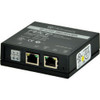
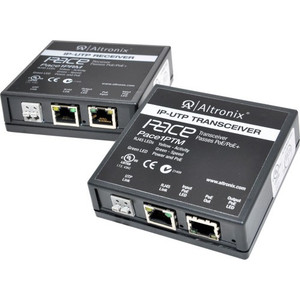
Altronix PACE1PRM PoE Injector 150m CAT5e Ethernet Extender
The Altronix PACE1PRM is a 1U rack-mounted PoE injector engineered to solve a common infrastructure problem: getting power and data to networked security devices across distances that exceed standard Ethernet limits. Rather than running new fiber optic cabling or adding dedicated power infrastructure, the PACE1PRM allows you to extend Ethernet connectivity up to 150 meters over existing or new UTP/CAT5e runs — a significant practical advantage in large facilities, multi-building campuses, and warehouse environments where cable routing is already constrained.
Overview
The PACE1PRM operates as a midspan injector, sitting between your network switch and remote devices. It accepts standard PoE input from your switch (or a separate PoE source), amplifies and re-conditions that power, and delivers it over the longer CAT5e span to the far end. The 16 network ports mean you're not limited to a single device per cable run — you can support multiple cameras, access control readers, or other PoE-powered endpoints from a single injector location, provided the total power draw stays within budget. This modularity reduces the number of injection points you need to install.
The 1U form factor fits into standard 19-inch server and networking racks, so it integrates cleanly into your central equipment room or a distributed network closet. UL listing confirms the device has passed safety and electrical compliance testing — a baseline requirement in most enterprise and institutional environments.
Key Features
- 150-meter range over CAT5e: Eliminates the cost and disruption of running fiber or new power conduits. In sprawling warehouse or campus deployments, this range extension often means the difference between a retrofit and a major infrastructure project.
- 16 network ports: One injection point can serve multiple remote devices, reducing the number of midspan injectors you need to deploy across your facility. Budget your total PoE wattage carefully — each port draws power from the same supply.
- PoE-based input and output: Accepts standard PoE from your switch (802.3af or higher, depending on your source) and injects power back into the CAT5e run. No separate 12VDC power supplies or mains cables required — simplifies the power chain.
- 1U rack-mount enclosure: Designed to sit alongside your existing network gear in a server rack or wall-mount cabinet. Matches industry-standard footprints and power distribution conventions.
- UL Listed for safety: Confirms electrical safety compliance and regulatory approval in North American deployments. Required for many institutional and commercial environments.
- Lifetime Limited Warranty: Altronix's warranty model provides long-term coverage, reducing replacement costs over the device's operational life.
When the PACE1PRM Makes Sense
Deploy this injector when you have existing CAT5e cabling runs longer than the IEEE standard 100-meter Ethernet limit, or when you need to extend power to cameras and networked devices beyond that range without fiber infrastructure. Warehouse automation systems with distributed IP sensors, large outdoor campuses with perimeter cameras, and facility upgrades where fiber installation is prohibitively expensive or time-consuming are typical use cases. The injector is also useful when you want to consolidate power distribution — instead of running individual 12VDC lines to each remote camera, a single CAT5e run carrying both data and injected power simplifies the installation.
Integration & Compatibility
The PACE1PRM works with any IEEE 802.3af PoE source (standard network switches, PoE injectors, or dedicated power supplies). It injects power back onto the CAT5e pairs, making it compatible with any PoE-powered IP camera, access control reader, or network device. Verify that the total wattage of all devices you connect to one injector does not exceed the injector's supply budget — this is a critical planning step that many integrators overlook. Also confirm that your CAT5e cabling is properly terminated and tested for continuity; poor cable quality or bad connections can degrade the extended range.
Deployment Considerations
The PACE1PRM extends range but does not increase available power per device — if you're running 802.3af (max ~13W per port) at the source, you'll still have roughly that budget at the remote end, minus losses over the longer run. Plan for voltage drop over 150 meters; devices at the far end may receive slightly less voltage than those closer in. Test your cable segments and load conditions before rolling out across a large facility. Also note that the single output configuration mentioned in the specifications refers to the power injection method (one amplified PoE feed per run), not the number of ports — all 16 ports inject power onto their respective CAT5e runs.
Frequently Asked Questions
Q: Can I daisy-chain multiple PACE1PRM units to extend range beyond 150 meters?
A: Not directly. A second injection point would be needed partway along a longer run. Consult the datasheet or Altronix technical support for guidance on multi-stage deployments.
Q: What's the maximum power budget per port on the PACE1PRM?
A: That depends on your input PoE source and the wattage capacity of the PACE1PRM supply. Verify in the datasheet; typical PoE injectors support 802.3af (15.4W) or 802.3at (30W). The PACE1PRM's exact budget should be confirmed with the full product documentation.
Q: Does the PACE1PRM require a separate power outlet?
A: No — it operates entirely on PoE. As long as your source switch or injector provides PoE input, the PACE1PRM needs no external power connection.
Q: Can I use this with CAT6 or CAT6A instead of CAT5e?
A: Yes, higher-category cabling is backward-compatible. CAT6/6A will work; you may see even lower loss over the 150-meter distance.
Q: Is the PACE1PRM NDAA or TAA compliant?
A: Compliance information is not provided in the available product documentation. Contact the manufacturer or distributor for current certifications.
Q: What's the warranty on the PACE1PRM?
A: Altronix provides a Lifetime Limited Warranty on this unit, covering defects in materials and workmanship for the life of the original owner.
Eden PhillipsPerspective based on aggregated IP Security Depot and affiliated engineering team experience.
I've integrated Altronix midspan injectors like the PACE1PRM into dozens of campus and warehouse builds. The 150-meter range over CAT5e is genuinely useful — it eliminates a category of expensive infrastructure workarounds and keeps you off fiber until you really need it. Where most integrators stumble is power budgeting. The PACE1PRM doesn't magically create wattage; it just repositions what you've already allocated. If you're feeding 802.3af (roughly 13W per port) into 16 ports, you're looking at tight power margins, especially on longer runs.
Technical Highlights:
- 16-port architecture: Consolidates power injection across multiple devices per cable run. One midspan location can serve a cluster of cameras or access readers, reducing the number of injection points you need to install and maintain.
- PoE-only operation: No separate 12VDC supply or mains cord means fewer failure points and simpler rack power distribution. Depends entirely on your upstream PoE capacity — check your switch's total wattage budget before scaling up.
- 150-meter CAT5e range: A real cost-saver versus fiber. In warehouse retrofits and outdoor perimeter builds, this distance extension often determines whether a project is retrofit-feasible or requires major conduit work.
Deployment Considerations:
- Plan your power budget per port carefully. PoE voltage drop accumulates over 150 meters — devices at the far end will see lower voltage than those at the midspan. Verify that your endpoint devices accept the lower voltage floor.
- Test cable continuity and pair integrity before deployment. Bad terminations or damaged conductors degrade range and power delivery. CAT5e is old and sometimes unreliable; budget for verification.
The PACE1PRM fits well into large campus security builds where you're extending to perimeter cameras or distributed access readers across multiple buildings. It's also the right tool for warehouse automation systems where you need to power distributed sensors over existing twisted-pair cabling. Don't use it as a solution to undersized power budgets — add a higher-capacity PoE++ supply at the source instead.