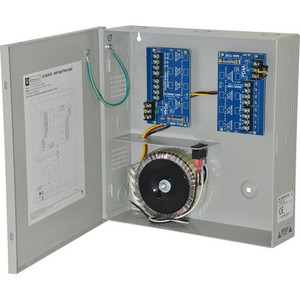
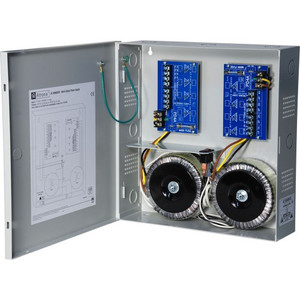
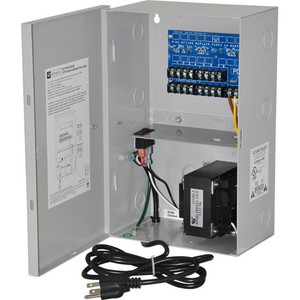
Altronix AL168175CB 8-Output 16VAC Power Supply
Overview
The Altronix AL168175CB is a regulated 16VAC power supply designed to distribute power across multiple security and access control loads with independent circuit protection. Configured with 8 individually protected outputs and housed in a BC100M enclosure, this unit delivers up to 10 amps total capacity at 16VAC from standard 115VAC input. Security integrators and system designers choose this unit when circuit isolation and individual output supervision are priorities—each output shuts down independently if a fault occurs, preventing cascading failures that could disable an entire branch of the security system.
Key Features
- Input Power (115VAC, Single-Phase): Standard utility AC power—no special wiring or three-phase infrastructure required, simplifying installation in small-to-medium commercial and institutional sites.
- Output Voltage (16VAC Regulated): Consistent voltage output regardless of input line fluctuations within normal utility ranges. This stability protects connected devices like door locks, intercoms, and auxiliary sensors from brownout-induced faults and extends device service life.
- Maximum Output Current (10 Amps Total): 10A aggregate capacity allows flexible load allocation across the 8 outputs. A balanced load averages 1.25A per circuit, but individual outputs can handle higher current as long as total system draw stays below 10A—useful for deployments where one or two outputs feed high-draw devices (e.g., electric strike locks) while others support lighter loads (e.g., magnetic contacts).
- 8 Individually Protected Outputs: Each output incorporates PTC (Positive Temperature Coefficient) thermistor protection, a passive self-resetting mechanism that automatically shuts down that circuit if current exceeds safe limits. When one output faults, the remaining 7 continue operating, ensuring critical devices stay powered. No replaceable fuses or manual breaker resets needed—automatic recovery when the fault clears reduces maintenance overhead and on-site service calls.
- PTC Thermistor Protection (Auto-Reset): As current rises, the thermistor's electrical resistance increases automatically, limiting current flow without breaking the circuit. This self-resetting behavior eliminates the operational blind spot of fuses (which require replacement) or manual breakers (which require technician intervention). For integrators managing multiple remote sites, this translates to lower service call density and faster fault recovery.
- BC100M Enclosure: Compact form factor suitable for wall mounting or integration into electrical distribution cabinets. Standard dimensions support seamless integration into custom power distribution schemes typical of mid-sized security and access control deployments.
Integration & Compatibility
The AL168175CB operates as a standalone power distribution unit within hybrid and legacy security architectures. Its 16VAC output is compatible with conventional access control panels, door lock controllers, intercom systems, and auxiliary device power requirements common in analog and hybrid installations. The modular 8-output design integrates into custom power schemes where per-circuit supervision and independent load control are required—common in warehouse automation, facility access control, and multi-tenant commercial buildings where different security branches (entry points, emergency systems, backup intercoms) must remain isolated from one another.
The regulated 16VAC output accommodates voltage drop conditions typical in extended wire runs to remote locks, speakers, and sensor devices. When cable runs exceed 100 feet, voltage sag can reduce output at the connected device; the AL168175CB's regulation maintains nominal output at the panel, allowing the integrator to size branch circuits based on actual device requirements rather than compensating for line loss.
Installation Context
The AL168175CB is specified for standard indoor operating environments common in commercial security installations—electrical rooms, telecom closets, and building distribution points. It does not require environmental hardening (heaters, fans, or IP-rated enclosures) for indoor use. The compact BC100M footprint allows installation alongside other control equipment in standard wall cabinets or DIN-rail setups, reducing real estate requirements in crowded equipment rooms.
Load Planning & Design
Integrators must calculate total branch current during system design. Sum the current draw of all connected devices (door locks: typically 0.5–1.5A; intercoms: 0.3–0.8A; magnetic contacts: under 0.1A) and confirm the total stays below 10A. The 8-output flexibility means high-draw devices can be assigned dedicated or dual outputs if needed, as long as the total system current remains within the 10A envelope. Undersizing the load on the AL168175CB ensures headroom for future device additions or upgrades without a power supply swap.
Frequently Asked Questions
Q: What is the difference between the AL168175CB and a simple 16VAC transformer?
A: A basic transformer lacks individual output protection and regulation. If one connected device shorts, it can pull the entire 16VAC line down, affecting all other devices. The AL168175CB's 8 protected outputs isolate each circuit—a fault on one output does not affect the others. Additionally, the regulated output maintains consistent voltage despite input line fluctuations, protecting sensitive devices from brownout conditions.
Q: Can I mix high-current and low-current devices on the same AL168175CB?
A: Yes. The 10A total capacity can be distributed across the 8 outputs as needed. For example, you could allocate 3A to one output feeding an electric strike lock, 1.5A to another powering a door controller, and share the remaining 5.5A across the other 6 outputs for sensors and intercoms. Total system draw must remain below 10A.
Q: What happens if a door lock draws more current than expected?
A: The PTC thermistor on that output will increase resistance and limit current, protecting the power supply and connected wiring. The output will shut down momentarily, then automatically recover once the fault clears. This is preferable to a blown fuse, which would leave you without power until a technician replaces it.
Q: Is the AL168175CB suitable for outdoor or wet environments?
A: No. The BC100M enclosure is rated for standard indoor use only. For outdoor or damp locations, the power supply must be installed indoors with outdoor-rated cables and connectors used for the branch circuits. If the power supply itself must be exposed to weather, a different weatherproof enclosure and supply model is required.
Q: What is the typical lifespan of the PTC thermistors?
A: PTC thermistors are passive solid-state components with no moving parts, so they do not degrade from normal fault cycling. Lifespan is effectively the life of the power supply itself (typically 10+ years under normal operating conditions). However, they will eventually age if subjected to sustained elevated temperatures; keeping the unit in a cool environment extends service life.
Ted PerryPerspective based on aggregated IP Security Depot and affiliated engineering team experience.
The AL168175CB solves a real problem in mid-scale security deployments: protecting multiple branch circuits from cascading failures without the maintenance overhead of replaceable fuses. If you're integrating access control, door locks, and intercom systems across a facility, this unit's 8 individually protected outputs at 10A total capacity gives you the granularity to isolate faults while keeping the rest of the system running. The PTC thermistor protection is the key differentiator—it resets automatically when a fault clears, eliminating service calls to replace blown fuses or manually reset breakers.
Technical Highlights:
- 10A Aggregate Capacity Across 8 Outputs: Provides the flexibility to support mixed loads—high-draw devices like electric strike locks (1–1.5A) on dedicated outputs, lighter sensor and intercom loads (0.3–0.8A each) sharing remaining capacity. Undersizing your load provides headroom for future expansion without a power supply swap.
- PTC Thermistor Auto-Reset (All 8 Outputs): When a short-circuit or overload occurs on any single output, that circuit's resistance automatically increases, limiting current flow and preventing damage to the power supply or wiring. Once the fault clears, the thermistor resets automatically—no manual intervention, no fuse replacement, no service call. Reduces operational friction on multi-site deployments.
- 16VAC Regulated Output: Maintains nominal voltage despite input line sag within normal utility ranges. This is crucial for devices at the far end of long cable runs (100+ feet). A non-regulated transformer would drop voltage along the run; the AL168175CB's regulation compensates, ensuring connected devices receive proper voltage and avoiding nuisance shutdowns or performance degradation.
Deployment Considerations:
- This is a shared 10A capacity across 8 outputs—not 10A per output. Total system current must stay below 10A. Before commissioning, calculate the steady-state current draw of all connected devices and confirm headroom exists. A spreadsheet tracking each output's load is good practice for future troubleshooting and capacity planning.
- The BC100M enclosure is indoor-rated only. Do not expose the power supply itself to weather, temperature extremes, or high humidity. Install in a clean, climate-controlled electrical or telecom closet, and run outdoor-rated cables from the terminals to remote devices. Moisture or temperature cycling will degrade the internal components and PTC thermistors over time.
- When integrating with door locks or solenoid devices, be aware that inductive loads (coils) can generate voltage spikes when de-energized. If you see intermittent faults on an output driving a solenoid-based device, consider adding a surge suppressor or diode across the load terminals to protect the power supply and improve PTC reliability.
The AL168175CB is the right choice for warehouse automation hubs, multi-tenant access control installations, or facilities where access points, emergency backup systems, and operational intercoms must remain isolated from one another. If a single fault can't take down your entire security branch, this unit earns its place in the power architecture.