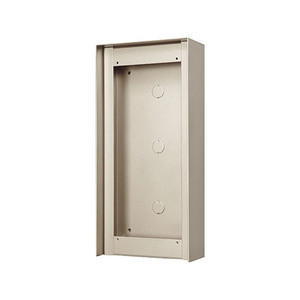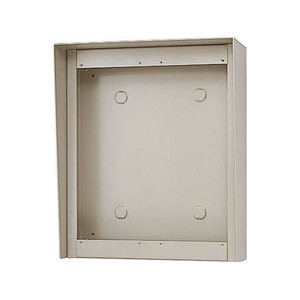

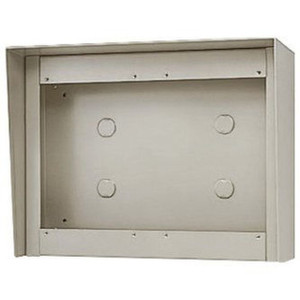
Aiphone GT-4B 4-Module Back Box
The Aiphone GT-4B is a flush-mount back box designed to consolidate up to four entrance modules into a single organized panel for the Aiphone GT Series intercom platform. It serves as the structural and wiring foundation for modular audio and video entry points—front door, secondary entrance, loading dock, or visitor call station—eliminating the need for separate cable runs and panel layouts. The back box is not a control unit; it integrates with existing GT Series tenant stations and security controllers to create a unified, professional entrance system.
Key Features
- 4-Module Capacity: Accommodates up to four entrance modules in a single enclosure. Reduces installation footprint and simplifies cabling for multi-entry deployments.
- Flush-Mount Installation: Designed for recessed wall mounting. Creates a seamless, integrated appearance at entry points without surface-mounted bulk.
- Audio and Video Support: Compatible with all GT Series audio modules (GT-DB, GT-DB-VN) and video camera modules (GT-VB). Mix and match modules based on site requirements.
- Standard Wiring Terminals: Terminal block layout follows Aiphone GT Series protocol. Supports audio loop, video loop, and power distribution via documented wiring standards.
- Panel Overlay Ready: Accepts optional GT-DBP panel overlays and security station components for label customization and system expansion.
- Lightweight Mounting: 0.9 lb form factor simplifies wall preparation and installation without requiring structural reinforcement.
The GT-4B is the wiring backbone for modular entrance configurations. When you need to combine multiple entry points at a single building facade—residential lobby, office park secondary access, warehouse dock with visitor station—the back box consolidates audio/video loops, power, and module mounting into one location. This eliminates parallel cable runs and reduces installation labor on larger properties.
Module compatibility spans the entire GT Series audio and video lineup. Audio modules (GT-DB for standard, GT-DB-VN for video-enabled) and video camera modules (GT-VB) seat directly into the back box frame. Pair the back box with tenant stations including the GT-1A, GT-1C7, GT-1C7W, or GT-1M3 to complete a functional intercom system. Optional GT-DBP panel overlays mount to the frame for tenant labeling and call-button arrangement customization. The back box also integrates with security stations equipped with NFC readers for credential-based access.
Installation follows standard Aiphone GT Series wiring protocols. Flush-mount configuration requires wall opening preparation and electrical wiring per local code. The back box accommodates both recessed and surface-mount orientations depending on architectural constraints. Terminal block assignments for power, audio loop, and video loop are documented in Aiphone's GT Series installation guides. Route all conductors to the correct terminals before inserting modules. Standard electrician hand tools suffice; no specialized mounting hardware is required.
The GT-4B carries a 2-Year Manufacturer Warranty and is sourced direct from Aiphone or authorized US distributors—no grey-market or parallel imports. It integrates seamlessly with Aiphone's complete GT Series ecosystem, from standalone two-door configurations to large multi-building campuses with NFC-enabled security stations.
Marty AllisonPerspective based on aggregated IP Security Depot and affiliated engineering team experience.
We've deployed the GT-4B on a wide range of multi-entry buildings—everything from small office parks with front and rear entrances to larger mixed-use facilities with loading docks and visitor stations. The back box is fundamentally a modular mounting chassis and wiring breakout; its value lies in consolidating hardware, reducing cable runs, and creating a professional panel layout at each entry point. On a three-entrance building, you eliminate two separate back-box installations and associated labor. The flush-mount profile matters more than you'd think—surface-mounted entry panels look institutional; recessed panels blend into architectural millwork. Audio/video mixing is straightforward: GT-DB audio modules and GT-VB video modules coexist in the same back box without interference, as long as you respect Aiphone's loop wiring discipline. We've seen installers accidentally bridge audio and video loops on the terminal block, which corrupts both signals—always verify terminal assignments against the datasheet before powering up. The four-module limit is real: if a site needs five or more entry points, you'll need two back boxes and a secondary tenant station or security controller, which adds cost and complexity. For most deployments (lobby + secondary + loading dock + visitor), one back box covers the need. Pair it with a GT-1M3 master station or GT-1A/GT-1C7 tenant stations, and you've got a robust, standards-compliant entrance system that scales cleanly.
Technical Highlights:
- 4-Module Consolidation: Reduces installation footprint and eliminates parallel cable runs. On a three-entrance site, this saves half a day of labor and simplifies maintenance troubleshooting because audio and video loops converge at one junction point.
- Flush-Mount Profile: Recessed installation into wall cavities creates a seamless appearance. Architects and building owners appreciate clean lines; from a security ops perspective, a low-profile panel is less likely to be vandalized or tampered with than a surface-mounted box.
- Audio + Video Mixing: Compatible with all GT Series modules—you're not locked into audio-only or video-only configurations. Design flexibility: front door gets video (GT-VB), secondary entrance uses audio-only (GT-DB) for cost efficiency, loading dock adds video-enabled audio (GT-DB-VN).
- Standard Wiring Protocol: Follows Aiphone's documented terminal block layout. No proprietary connectors or special breakout boards—clean, auditable wiring that any licensed integrator can troubleshoot or extend.
Deployment Considerations:
- Four-module limit is firm. If your site needs more than four entry points, budget for a second back box and a secondary tenant station or security controller to manage the additional loops.
- Flush-mount installation requires accurate wall cavity preparation and electrical rough-in before the back box arrives. Don't assume a generic 4-gang box opening will work—verify dimensions against the datasheet. Oversized cavities require shimming; undersized cavities require wall modification.
- Audio and video loop wiring must be routed to separate terminals. We've seen mixed-media sites fail during commissioning because installers accidentally connected audio loop conductors to video terminals. Test each loop independently before connecting the first module.
- Panel overlays (GT-DBP) and security reader modules add depth to the installation. Verify total panel depth against your wall cavity and rough-in box before ordering. A 2-inch cavity won't accommodate a back box plus overlay plus video camera module.
- Power distribution to the back box must follow local electrical code. If your installation is in a commercial building, coordinate with the electrical contractor early—many jurisdictions require a dedicated 20A circuit for intercom systems.
The GT-4B is the right choice for integrators designing multi-entry Aiphone systems in residential buildings, small office parks, and mixed-use facilities where appearance and cable organization matter. It's not the right choice for single-entry installations (use a 1-module back box instead) or for sites requiring more than four simultaneous entry points (consider a distributed architecture with multiple back boxes and secondary controllers). For modular Aiphone deployments, explore the full Aiphone catalog.