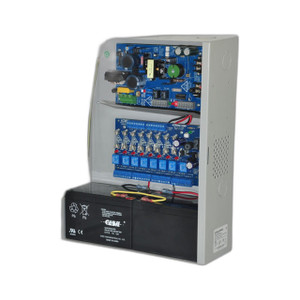
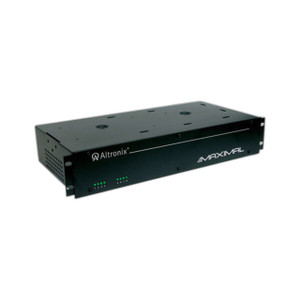
Altronix ACM8 8-Output Access Power Controller
Overview
The Altronix ACM8 is a compact relay-based power distribution board designed to convert a single 12–24 volt AC or DC input into eight independently controlled, fuse-protected relay outputs for access control devices. Each output can drive mag locks, electric strikes, push-to-exit buttons, and magnetic door holders — allowing a single power source to serve multiple access points with independent fail-safe or fail-secure logic per output. The ACM8 integrates fire alarm control panel (FACP) signaling, meaning it can cut power to specified outputs during emergency egress without manually reconfiguring the board. This is not a switching power supply; it is a relay distribution and control interface that sits between your AC/DC source and your access hardware.
Key Features
- 8 independent fused relay outputs: Each output has its own fuse protection, so a short on one lock does not cascade and kill power to the others. Simplifies troubleshooting and reduces downtime on multi-door deployments.
- 12–24 VAC or VDC operation with no setting required: The board auto-detects input voltage, eliminating a configuration step on installation and reducing field errors when retrofitting mixed-voltage sites.
- Fire alarm disconnect per output: Selectively disable power to specific doors during alarm activation — useful for egress requirements and life-safety coordination without pulling the whole board offline.
- Dry form "C" relay contacts: Outputs can be wired as normally open (NO) or normally closed (NC), giving flexibility for fail-safe and fail-secure door hardware in the same deployment.
- Dry trigger inputs (NO and open collector sink): Integrates with card readers, push-to-exit buttons, keypads, and passive infrared sensors without requiring powered inputs. Reduces wiring complexity on retrofit jobs.
- Battery backup support: The board can be powered by a separate battery source independent of the main 12/24V rail, allowing emergency exit locks to remain energized during a main power loss.
- AC Fail supervision: Built-in monitoring of AC input status, useful for alerting integrators to utility power loss on sites that do not have central UPS.
- UL294 (Access Control) and cUL General Signaling Equipment listed: Certification confirms compliance with safety and signaling standards required by most commercial and institutional access control installers and code authorities.
- Low power consumption: Draws only 0.6A @ 12V or 0.3A @ 24V with all relays energized, so even small transformer-based AC supplies or lean battery backup systems can run the board without overload calculations.
Integration and Compatibility
The ACM8 accepts trigger inputs from access control systems, card readers, keypads, push-to-exit buttons, and motion sensors via normally open (NO) dry contacts or open collector sink inputs — no powered signal required. It can be powered by a single source for both the board and lock outputs, or by two isolated sources (e.g., mains 24VDC for the board logic, backed-up battery for fail-safe locks). This dual-source flexibility is common in life-safety retrofits where some doors must remain energized on battery during mains failure.
The FACP interface allows the board to receive alarm signals from a fire alarm control panel, triggering per-output power cutoff for emergency egress compliance. Integrators typically wire this signal to the fire alarm's trouble relay or alarm output, allowing the ACM8 to de-energize selected locks without human intervention during an emergency.
When to Choose a Different Model
If you need only one or two relay outputs, a smaller single-channel relay module may reduce cost and physical footprint. If your access control system provides its own relay outputs and you are only adding supplemental monitoring or battery backup, a dedicated power backup module or UPS may be more cost-effective than a full 8-output board. For sites requiring integrated logic, timers, or inputs from multiple sensors, an access control panel with built-in relay outputs is typically a better fit than a standalone distribution board.
Deployment Considerations
Board-level products like the ACM8 require proper DIN rail mounting or enclosure placement; they do not ship pre-installed in a cabinet, so installation labor typically includes rail prep, terminal block wiring, and fuse installation. Verify that your AC/DC source can deliver sufficient current under full load — 0.6A @ 12V or 0.3A @ 24V is not demanding, but adding external relay coils, LEDs, or extended wiring runs can push consumption higher. Test fire alarm disconnect operation during commissioning to confirm per-output logic matches your site's emergency egress plan. The board's fused outputs are protection, not isolation — do not rely on the ACM8 alone for multi-source power merging or load balancing; add external diodes or a merge module if combining battery and mains sources on the same output.
Frequently Asked Questions
Q: Can the ACM8 work with both AC and DC sources at the same time?
A: The board auto-detects 12–24 VAC or VDC, but it is not rated to accept both simultaneously. Choose one input source; if you need AC mains with DC battery backup, wire the battery to a separate 24VDC supply (diode-isolated) and connect both to the board's input terminals with proper isolation or a merge module.
Q: What happens to a lock if its output fuse blows?
A: That output loses power immediately. Depending on your lock's fail-safe or fail-secure setting, the door either unlocks (fail-safe) or remains locked (fail-secure). Replace the fuse to restore power. The fuse protects only that output, so the other seven remain live.
Q: Does the ACM8 include a power supply?
A: No. The board is a distribution and control interface; you must source a 12 or 24 VDC (or VAC) power supply separately. Common choices are 24VDC transformer supplies or industrial DIN rail power supplies, sized to deliver at least 0.6A @ 12V or 0.3A @ 24V for board operation plus the amperage required by your locks and sensors.
Q: Is the ACM8 suitable for outdoor access points?
A: The board itself is not weather-sealed (no IP rating). Install it inside a weatherproof enclosure if it will be exposed to rain, humidity, or temperature extremes. The relay outputs can drive outdoor mag locks; the board logic must remain dry.
Q: Can I use the ACM8 for purposes other than access control?
A: The board is a general-purpose 8-output relay interface, so it can switch any 12/24V load — door holders, solenoids, indicator lights, or alarm sirens. However, UL294 certification applies to access control use; if you deploy it for other purposes, consult the manufacturer to confirm compliance with your application's safety and signaling standards.
Ted PerryPerspective based on aggregated IP Security Depot and affiliated engineering team experience.
The ACM8 is a workhorse for multi-door access retrofit jobs where you need to centralize lock power and fire alarm logic without replacing an entire access control system. I spec it regularly on retrofit jobs because the per-output fuse design and auto-detect voltage input eliminate two common failure modes on older sites: cascading power loss when one lock shorts, and field confusion over 12V vs. 24V jumpers.
Technical Highlights:
- Per-output fuse protection: A shorted mag lock does not kill the entire board — only that output fuses open. On a warehouse with eight loading dock doors, one mechanical failure costs you one door, not eight. Replace the fuse, test, move on.
- Auto-detect 12/24V input: No jumpers, no configuration. Plug in 24VAC or 12VDC and the board handles it. Reduces site labor and re-commissioning time on retrofit jobs where voltage standards vary building-to-building.
- Fire alarm disconnect per output: Integrate FACP signaling so emergency egress doors (e.g., stairwell strikes) de-energize on alarm without manual override logic. UL294 compliance plus life-safety alignment in one board.
- Low quiescent draw (0.3A @ 24V, 0.6A @ 12V): Even a modest 24VDC supply handles the board's own consumption easily. Leaves headroom for lock current without oversizing the power supply and adding cost.
Deployment Considerations:
- The ACM8 is relay-based distribution, not a programmable controller — no timers, no conditional logic. If you need "unlock for 3 seconds then re-lock," add an external timer or let your access control system provide the timed output.
- Mounting is DIN rail or enclosure screw-down — account for terminal block wiring labor. This is not plug-and-play; expect 2–4 hours for a typical 8-door board installation including power supply, fuse installation, and test.
- Verify your AC/DC source can deliver peak lock current. Most mag locks draw 0.8–1.5A @ 24V; the board itself is light, but eight locks in parallel mean 6–12A depending on hardware. Oversizing the supply avoids voltage sag issues.
- Test fire alarm disconnect during commissioning — confirm that your FACP alarm output triggers the ACM8's FACP input and that the correct doors de-energize. Misplaced wiring here creates code failures at inspection.
Deploy the ACM8 on retrofit multi-door sites where you cannot replace the access control system but need to add fused power distribution, battery backup, and emergency egress compliance. It is particularly strong for warehouses, data centers, and industrial facilities where door hardware varies and you need centralized, fault-isolated power management.