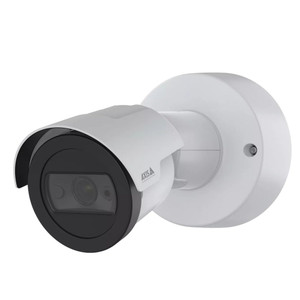
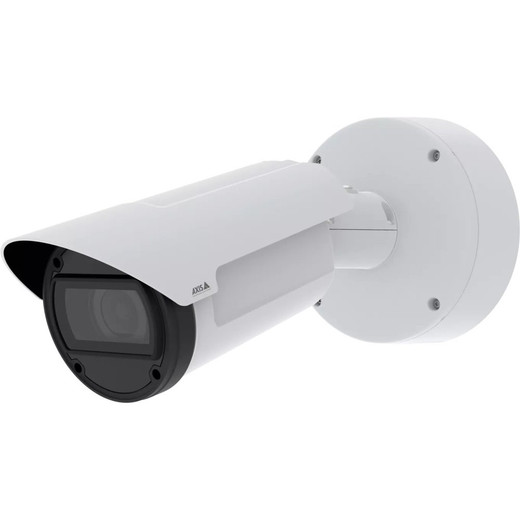
Axis Communications Q1809-LE Bullet Camera Overview
The Axis Q1809-LE is a high-resolution network bullet camera designed for professional surveillance deployments requiring exceptional detail capture and low-light performance. Built on a 4/3 progressive scan RGB CMOS sensor with 41MP resolution, the Q1809-LE features dual ARTPEC-8 system-on-chip processors and supports both H.264 and H.265 video compression with Zipstream technology for optimized bandwidth utilization. Available in two varifocal lens configurations—24mm (F2.0–3.0) and 150mm (F4.0)—this camera serves demanding security integration applications where pixel density and adaptive zoom capability are critical.
Axis Q1809-LE Key Features
- 41MP Native Resolution with 4/3 aspect ratio (7424Ă—5568) and dual 16:9 (7680Ă—4320) and 21:9 (7680Ă—3240) video outputs, enabling detailed forensic review and wide-area coverage from a single camera position.
- Dual ARTPEC-8 Processors deliver on-camera Deep Learning Processing Unit (DLPU) capability for intelligent edge analytics and reduced server-side processing load.
- Varifocal Lens Options: 24mm lens provides 90° to 44° horizontal FOV with 1.5m minimum focus distance; 150mm lens offers 21° to 7° horizontal FOV with 5m minimum focus distance. Both support remote zoom and focus plus P-Iris control for precise exposure management.
- 8K Video Frame Rate Support at up to 30 fps (50/60 Hz) in native 4:3 resolution, with 41MP mode capable of 15 fps, meeting high-frame-rate surveillance requirements.
- Exceptional Low-Light Sensitivity: 24mm lens achieves 0.12 lux in color (50 IRE, F2.0) and 0.02 lux in B/W (F2.0); 150mm lens reaches 0.2 lux color (F4.0) and 0.04 lux B/W. Full IR illumination support enables 0 lux operation in complete darkness.
- Advanced Video Compression with H.264 Baseline/Main/High Profiles, H.265 Main Profile 1, and Motion JPEG. H.265 is recommended for this high-resolution sensor. Zipstream technology in both H.264 and H.265 reduces bandwidth and storage by up to 80% while maintaining forensic quality.
- Dynamic WDR and Adjustable Shutter Control: 4:3 mode supports 1/10500s to 2s shutter range; 16:9 mode 1/15500s to 2s, with dynamic contrast WDR for high-contrast lighting scenarios.
- Flexible Video Streaming supports up to 20 unique, configurable video streams per camera with VBR/ABR/MBR rate control, low-latency mode, and stream reusability via multicast or unicast transport (Axis recommends maximum 3 unique streams per camera for optimal network and storage performance).
- 4GB RAM and 8GB Flash Memory per ARTPEC-8 processor (8GB RAM, 16GB Flash total) for robust edge processing and local buffering capabilities.
- microSD/microSDHC/microSDXC Edge Storage Support for local backup and redundant recording independent of network connectivity.
- Motorized Pan/Tilt/Roll Adjustment: Pan ±180°, tilt 0° to -90°, roll -90° to 270° for precise mounting alignment and field-of-view customization post-installation.
- Day/Night Imaging with automatically removable IR-cut filter in day mode and IR-pass filter (800–900nm) in night mode for seamless color-to-B/W transition and optimal spectral response.
- High Signal-to-Noise Ratio exceeding 55dB for clean image quality across varying lighting conditions.
Axis Q1809-LE Integration & Compatibility
The Q1809-LE integrates with ONVIF-compliant video management systems and supports Axis Camera Station and third-party platforms via standardized IP video protocols. Dual gigabit Ethernet connectivity (10Base-T/100Base-TX/1000Base-T) ensures compatibility with modern network infrastructure. Deep Learning Processing Unit (DLPU) enables on-device analytics—including object detection and metadata extraction—reducing bandwidth demands for centralized VMS platforms. The camera's extensive video streaming configuration options allow deployment in complex multi-system environments with stream reuse capability for efficient multicast delivery. Mounting flexibility (pan/tilt/roll adjustment at installation) accommodates diverse bullet-camera deployment scenarios on building facades, corner mounts, and pole applications. Remote zoom and focus control via network interface simplifies focus-pulling post-deployment without physical camera access.