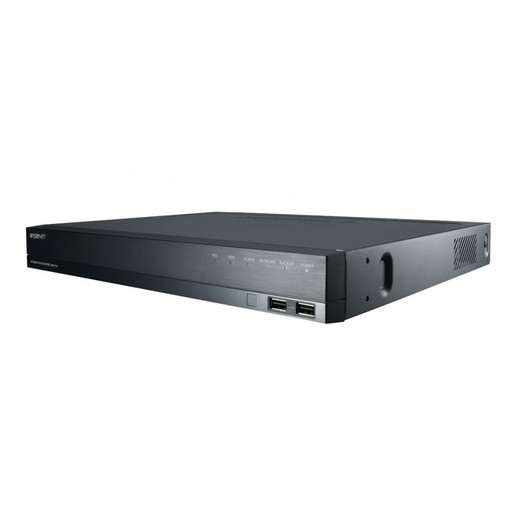
Hanwha XRN-820S Overview
The Hanwha XRN-820S is an 8-channel embedded Linux network video recorder engineered for enterprise surveillance deployments requiring high-resolution capture and efficient storage management. This Intel-based NVR delivers 120 Mbps recording bandwidth with support for 32-megapixel camera resolution, making it suitable for large-area monitoring and detail-critical applications. The XRN-820S combines native H.265 codec support with WiseStream technology to optimize bandwidth and storage utilization without sacrificing image quality.
Hanwha XRN-820S Key Features
- 32 MP Camera Support with Multiple Compression Formats: Accommodates network cameras up to 32 megapixels in resolution while supporting H.265, H.264, and MJPEG compression codecs. H.265 encoding delivers superior compression efficiency, reducing bandwidth and storage requirements compared to H.264 at equivalent quality levels.
- High-Bandwidth Recording: Maximum 120 Mbps recording bandwidth enables simultaneous multi-camera recording at high frame rates and resolutions, supporting normal, dual-stream, schedule-based (continuous/event), and event-triggered (pre/post) recording modes.
- Dual Monitor Display with Flexible Resolution Output: Native HDMI and VGA dual-monitor support with FHD clone mode (up to 16 divisions) or expand mode (up to 9 divisions). Single HDMI port supports UHD output for higher-resolution local playback. Web interface supports 1/2H/2V/3V/4/6/8/9 multi-screen layouts.
- WiseStream Technology: Hanwha's intelligent codec optimization reduces bandwidth and storage consumption by adapting compression based on scene content and motion detection, extending recording duration on fixed storage pools.
- 8 PoE/PoE+ Integrated Ports with 100W Budget: Built-in Power over Ethernet delivery supports connected cameras directly from the NVR, eliminating external injectors for smaller deployments. PoE+ (802.3at) capability enables power delivery to mid-range PoE+ cameras.
- Internal Storage Expansion: Two fixed internal SATA HDD bays support maximum 12TB total capacity (6TB per drive), providing on-site recording storage with ARB (Automatic Recovery Backup) and N+1 failover redundancy for continuous operation during drive failure or maintenance.
- Local Recording Playback Performance: FHD clone mode supports 32 MP at 15 fps (H.265 only), 12 MP at 30 fps (H.265 only), 8.3 MP at 50 fps, 1080p at 240 fps, or D1 at 480 fps. UHD single-monitor mode supports equivalent resolutions with D1 playback at 270 fps. FHD expand mode supports 32 MP at 12 fps and 1080p at 90 fps, accommodating variable quality/performance requirements.
- Network Playback with Multiple Simultaneous Users: Maximum 32 Mbps playback bandwidth supports 4 simultaneous users (1 local, 3 remote) with up to 32 channels of simultaneous playback per remote user (8 channels local, 8 channels per remote user). Enables distributed forensic review and evidence gathering across multiple analyst stations.
- Fisheye Dewarping on Web and CMS: Native dewarping support for 180° and 360° fisheye camera feeds across web UI 2.0 and compatible VMS platforms, eliminating the need for external dewarping software and improving usability for panoramic camera deployments.
- Comprehensive Event Triggering and Actions: Records on alarm input, video loss, camera events (sensor, motion detection, video analytics, defocus detection, audio), dynamic events, and user-defined events. Automated responses include email notification, event push alerts, PTZ preset commands, alarm output relay, audible buzzer, monitor output switching, FTP upload, and SUNAPI command execution.
- Wisenet AI Integration and Smart Search: Native support for Wisenet AI-capable cameras with metadata search functionality enables object-type filtering (person, vehicle) and behavioral analytics queries directly from the NVR interface without external VMS dependency.
Hanwha XRN-820S Integration and Compatibility
The XRN-820S implements SUNAPI and ONVIF protocols for VMS interoperability and third-party camera integration. Web UI 2.0 operates plugin-free in modern browsers, eliminating Java or ActiveX dependencies. Network discovery and QR code-based camera addition streamline initial setup and commissioning workflows. The embedded Linux operating system provides a stable, purpose-built foundation for continuous surveillance recording without consumer OS overhead.