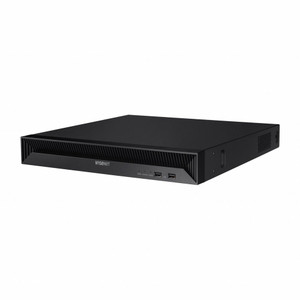
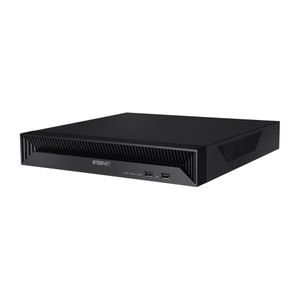
Hanwha QRN-830S Overview
The Hanwha QRN-830S is a purpose-built 8-channel network video recorder designed for small-to-medium IP surveillance deployments requiring unified PoE power delivery and cost-effective local storage. This compact NVR consolidates video recording, display, and edge backup functions in a single unit, making it ideal for integrators deploying Hanwha 8MP cameras or third-party ONVIF-compliant cameras across mixed environments.
Hanwha QRN-830S Key Features
- 8-Channel 8MP Recording Capability – Supports up to 8 network cameras at full 8MP resolution, down to CIF, with maximum 80Mbps aggregate recording bandwidth for efficient storage utilization.
- Integrated 8-Port PoE Power Delivery – Embedded 802.3af PoE ports with 65W total budget eliminate the need for external injectors or separate PoE switches in small installations, reducing BOM complexity and deployment footprint.
- Triple Codec Support (H.265, H.264, MJPEG) – Flexible compression standards ensure compatibility with diverse camera manufacturers and enable bitrate optimization via H.265 or dual-stream recording for efficient bandwidth management.
- Dual-Stream Recording Mode – Simultaneous recording at different resolutions and bitrates on a single camera feed allows high-quality local archival while minimizing storage consumption, or selective stream recording for event-triggered backup.
- 4K Local Display Output – Dual HDMI outputs provide granular monitoring flexibility: HDMI1 supports 3840×2160 (4K) at 30Hz for high-resolution live view, while HDMI2 delivers 1920×1080 at 60Hz for secondary displays or control room integration.
- 6TB Single-Drive Storage Architecture – One fixed internal SATA HDD slot (maximum 6TB) provides built-in recording capacity; capacity-constrained design favors simplicity and reliability over expandability, suitable for retention periods under 30–60 days at typical bitrates.
- 32Mbps Playback Bandwidth with Multi-User Access – Supports up to 4 simultaneous users (1 local + 3 remote) with maximum 32-channel playback (8 local, 8 per remote user), enabling distributed review without server congestion.
- Comprehensive Event Recording & Alerting – Alarm inputs, video loss detection, camera-level events (sensor, motion, defocus, audio), dynamic events, and user-triggered events integrate with e-mail, push notifications, PTZ presets, FTP uploads, and SUNAPI commands for proactive monitoring.
- P2P Connectivity & Mobile Access – QR code-based peer-to-peer pairing simplifies remote configuration without port forwarding; native Wisenet Mobile App (iOS/Android) and free Wisenet Viewer software enable remote playback, live view, and backup retrieval from any network.
- Automatic Recovery Backup (ARB/Edge Recording Retrieval) – Network interruption or recorder downtime automatically triggers edge recording on compatible cameras; the NVR retrieves buffered video on reconnection, eliminating footage loss during WAN outages—critical for geographically distributed sites.
- ONVIF Protocol & Industry Standards Support – SUNAPI and ONVIF compliance ensure interoperability with third-party cameras, VMS platforms, and integrations without vendor lock-in, facilitating future system expansion.
- NDAA & FCC Compliance – Pre-certified for U.S. federal procurement and commercial use, simplifying compliance validation in government, critical infrastructure, and regulated verticals.
Hanwha QRN-830S Integration & Compatibility
The QRN-830S integrates via SUNAPI and ONVIF protocols, enabling connectivity with third-party IP cameras from Dahua, Hikvision, Bosch, Axis, and other standards-compliant manufacturers. Embedded Linux OS provides stable, long-term support with automatic firmware updates. P2P service and Wisenet Mobile App deliver out-of-the-box remote access without complex networking; integrators can deploy multi-site systems using QR code enrollment. Local playback supports calendar-based date/time search, event list filtering, text search, and smart search; dynamic multi-monitor layouts (1/2H/2V/3V/4/6/8/9) on a single HDMI output allow flexible control room configurations. The 4-user architecture (1 local, 3 remote) suits small corporate or retail installations; larger deployments may require a dedicated VMS backbone. Fisheye dewarping support via CMS enables panoramic camera integration when paired with compatible front-end software.