
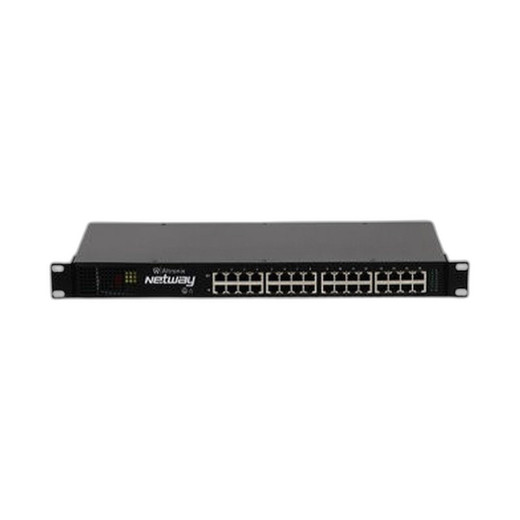

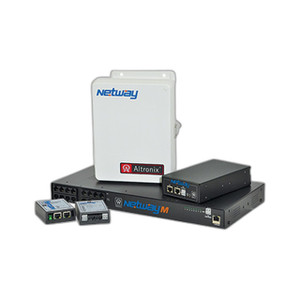

Overview
SKU:
NETWAY16G
Condition:
New
Availability:
Usually ships in 24 hours
Warranty
Lifetime Limited Warranty
Altronix NETWAY16G 16-Port Managed PoE Midspan
Altronix NETWAY16G Network Managed PoE MidspanOverviewThe Altronix NETWAY16G is a 16-port managed Power over Ethernet (PoE) midspan designed for secur…
Altronix NETWAY16G 16-Port Managed PoE Midspan
$1,262.99
Your recommended setup
Review items below — quantities update pricing automatically.
Item
Qty
Status
Price
Optional Add-Ons recommended
Services optional
Bundle Summary
Bundle Subtotal:
$0.00
Optional Add-Ons:
$0.00
Services:
$0.00
Total:
$0.00
Overview
SKU:
NETWAY16G
Condition:
New
Availability:
Usually ships in 24 hours
Warranty
Lifetime Limited Warranty
Description

Altronix NETWAY16G Network Managed PoE Midspan
Overview
The Altronix NETWAY16G is a 16-port managed Power over Ethernet (PoE) midspan designed for security integrators and telecom installers who require flexible power distribution across existing network infrastructure. As a midspan device, the NETWAY16G operates between a standard non-PoE network switch and PoE-powered endpoints, delivering managed power to 16 ports simultaneously without replacing core switching equipment. This topology simplifies retrofits in legacy installations while providing 480W total power budget distributed across all ports at 30W per port maximum.
Key Features
- 16 PoE Ports: Full managed control across all 16 Gigabit Ethernet ports with independent per-port configuration and monitoring
- 30W Per Port: Delivers maximum 30W per port, supporting high-power PoE+ applications including pan-tilt-zoom cameras, multi-sensor devices, and access control systems
- 480W Total Power Budget: Aggregate power capacity supports dense deployments with simultaneous high-draw endpoint activation
- 10/100/1000 Gigabit Ethernet: Full Gigabit throughput on all ports for high-bandwidth video and data applications
- Dual Input Voltage: Accepts both 115VAC and 230VAC input, accommodating regional power standards and reducing configuration complexity in mixed-voltage facilities
- Network Managed Architecture: SNMP and web-based management interfaces enable remote port control, power scheduling, and real-time consumption monitoring from a central NMS
- Battery Charging Support: Integrated battery charging capability allows connection to external UPS or battery backup systems for continued operation during AC loss
- Port-Level Supervision: Individual port status reporting, load monitoring, and fault detection for rapid troubleshooting and capacity planning
Deployment Flexibility
The NETWAY16G addresses common integration challenges in large-scale security and access control deployments. When core network infrastructure lacks integrated PoE capability, the midspan approach preserves existing switch investments while adding managed power distribution. The dual 115/230VAC input specification eliminates region-specific power supply variations, allowing a single SKU across North American and international installations. Per-port 30W capacity meets IEEE 802.3bt PoE+ and proprietary high-power protocols, supporting turret and PTZ camera systems that demand sustained draw beyond standard PoE budgets.
Battery charging integration is critical for security-critical applications. Integrators can wire the NETWAY16G to 24VDC battery banks or uninterruptible power supplies, ensuring access control readers, intercoms, and priority surveillance cameras remain powered during mains failure. This topology is preferable to individual endpoint batteries in large deployments, centralizing backup capacity and simplifying maintenance cycles.
Management and Integration
Web-based management and SNMP support enable integration with monitoring platforms already deployed in telecom and security operations centers. Port scheduling features reduce phantom power draw during off-peak hours, and per-port power metering provides visibility into endpoint health and current consumption trends. The managed architecture supports automatic port shutdown on fault detection, protecting against short circuits and overload conditions without manual intervention.
Ted Perry
I've specified the NETWAY16G in several large-scale access control and surveillance deployments where legacy network infrastructure lacked integrated PoE. The midspan approach proved invaluable—it preserved existing Cisco and Juniper switches while adding managed power distribution without major capex. The 30W per-port capacity covered all our endpoints, including Axis PTZ and Hikvision turret cameras running at sustained 25W draw.
Technical Highlights:
- Managed Power Distribution: SNMP and web management allow granular per-port control and real-time consumption monitoring, eliminating guesswork in capacity planning
- Dual Voltage Input (115/230VAC): Single SKU covers both North American and international sites, reducing logistics complexity and spare-parts inventory
- 480W Aggregate Budget: Sufficient for 16 concurrent high-power devices or mixed load profiles with typical utilization at 25-28W per port
- Battery Charging Integration: Direct wiring to external 24VDC UPS ensures access control and priority cameras remain powered during mains loss
Deployment Considerations:
- Confirm upstream switch port capacity and cable quality (Cat5e minimum, Cat6 recommended for full Gigabit throughput under load)
- Plan battery backup sizing based on expected runtime; 24VDC systems typically support 2-4 hours runtime at 480W sustained draw
- Schedule port power-cycling during maintenance windows to avoid access control or camera dropout; managed scheduling features minimize user impact
The NETWAY16G delivers transparent managed PoE retrofit capabilities without the cost and complexity of complete switch replacement. For security integrators managing large installations, the per-port power control and battery charging support justify the midspan investment.
Specifications
Input Voltage:
115VAC / 230VAC
Number of Outputs:
16
Battery_Backup:
Battery charging capable
PoE_Budget:
480W total, 30W per port
Supervision:
Per-port monitoring and control
Warranty:
Lifetime Limited Warranty
Have Questions?
Ask an Expert.
RELATED PRODUCTS

System Design, Deployment & Technical Support
Support services and planning resources for commercial surveillance, access control, and infrastructure deployments.
Fixed scope • Fixed price
System Design Assistance
- Get help validating product compatibility
- Coverage requirements
- Storage planning and deployment architecture before you buy.
Deployment & Configuration Support
- Access fixed-scope support for rollout planning
- User setup guidance
- Migration and system standardization across single-site or multi-site deployments
Guides, Tools & Calculators
- PoE requirements
- Storage retention
- Camera selection and deployment methodology