


Overview
SKU:
EFLOW6NA8DV
Condition:
New
Availability:
Usually ships in 24 hours
Warranty
Lifetime Limited Warranty
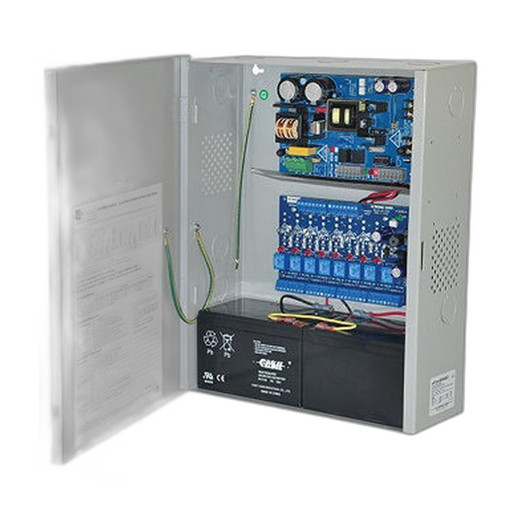
Altronix EFLOW6NA8DV 8-Output Access Power Controller
Altronix EFLOW6NA8DV Access Power Controller Overview The Altronix EFLOW6NA8DV is a dedicated access control power management solution designed for se…

Altronix EFLOW6NA8DV 8-Output Access Power Controller
$448.99
Your recommended setup
Review items below — quantities update pricing automatically.
Item
Qty
Status
Price
Optional Add-Ons recommended
Services optional
Bundle Summary
Bundle Subtotal:
$0.00
Optional Add-Ons:
$0.00
Services:
$0.00
Total:
$0.00
Overview
SKU:
EFLOW6NA8DV
Condition:
New
Availability:
Usually ships in 24 hours
Warranty
Lifetime Limited Warranty
Description

Altronix EFLOW6NA8DV Access Power Controller
Overview
The Altronix EFLOW6NA8DV is a dedicated access control power management solution designed for security integrators and installers managing multi-output access applications. This unit combines a regulated power supply with integrated battery charger functionality, delivering reliable 12VDC and 24VDC output to support door locks, magnetic locks, and relay-controlled access hardware in both small and mid-scale deployments. The EFLOW6NA8DV consolidates power distribution and backup charging into a single enclosure, reducing installation complexity and panel real estate requirements.
Key Features
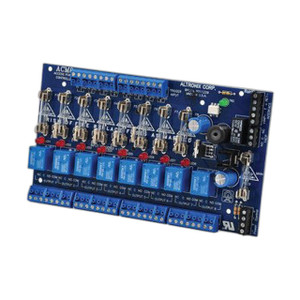
- 8 PTC Class 2 Relay Outputs: Eight independent relay outputs provide discrete control of access devices with built-in protection against overcurrent conditions.
- Dual Voltage Output: Selectable 12VDC and 24VDC outputs accommodate different lock voltages and control devices without requiring separate supplies.
- 6A Maximum Current Rating: Sufficient capacity for multi-door access control installations with concurrent lock and solenoid actuation.
- Auxiliary Output: Additional output terminal for extended control or signaling functions beyond primary relay channels.
- Integrated Battery Charger: Built-in charging circuit supports lead-acid battery backup for fail-safe access control during power loss events.
- FAI (Fault Alert Input): Supervisory fault detection enables integration with central monitoring and alarm reporting systems.
- 220VAC Input: Operates on standard commercial AC mains for reliable operation across North American and international installations.
- UL Listed & CE Marked: Meets UL and CE safety certifications for North American and European deployments.
- BC400 Enclosure: Compact DIN rail-mount form factor fits standard electrical panels and access control cabinets.
Technical Specifications
The EFLOW6NA8DV operates from 220VAC input and delivers output at 12VDC with 4A maximum current per the primary output rating. The unit supports both 12VDC and 24VDC output configurations to match field hardware requirements. Eight PTC-protected relay outputs provide independent load switching, with an additional auxiliary output for extended functionality. Battery backup charging is integral to the design, allowing the EFLOW6NA8DV to support uninterruptible access control during AC power interruptions. All outputs are Class 2 rated, meeting safety standards for low-voltage control circuits in access applications.
Integration & Compatibility
The EFLOW6NA8DV integrates into both legacy and modern access control systems through its relay outputs and auxiliary connections. FAI supervision capability enables real-time fault reporting to networked access control panels and monitoring stations. The unit's DIN rail mount design simplifies integration into standardized electrical enclosures used by security integrators. Battery backup output supports lead-acid batteries commonly specified in access control designs, ensuring code compliance for fail-safe locking during power loss.
Jerry Tildsen
I've specified the EFLOW6NA8DV in multi-tenant office access systems where distributed power and battery backup are required across several entry points. The combination of eight relay outputs and integrated charger function eliminates the need for separate battery charging modules, which streamlines procurement and reduces panel footprint during integration.
Technical Highlights:
- Eight Independent Relay Outputs: Each PTC-protected output can switch access devices independently, allowing fine-grained control across multiple doors without additional relay expansion modules.
- Integrated Battery Charger: The EFLOW6NA8DV includes charger logic in a single unit, reducing BOM complexity and support burden during deployments requiring UPS functionality.
- Dual Voltage Capability: Field-selectable 12VDC and 24VDC outputs adapt to different lock types and control device requirements without stock-keeping multiple SKUs.
- FAI Supervision: Fault reporting enables proactive monitoring and integration with central station systems, critical for mission-critical access installations.
Deployment Considerations:
- Confirm battery voltage and amp-hour rating against the unit's charger specifications before connecting backup batteries to ensure proper float charging and longevity.
- Size AC input conductors and circuit protection per local electrical code; 220VAC input current should be calculated based on connected load to avoid nuisance trips.
- Validate output load on each relay—eight outputs sharing the same supply means aggregate current must remain below the 6A rating to prevent thermal shutdown.
- Test FAI line supervision during commissioning to confirm fault reporting is reaching your monitoring panel or central station receiver.
The EFLOW6NA8DV is a solid choice for integrators standardizing on centralized power distribution for mid-scale access control projects. The integrated charger and PTC protection reduce field callbacks, and the compact BC400 enclosure makes it a natural fit for panel-mounted access control cabinets.
Specifications
Product Type:
Access Power Controller
Approvals:
UL Listed, CE
Output Voltage:
12VDC / 12VDC
Max Current:
4A @ 12VDC / 10A @ 12VDC / 10A @ 24VDC
Input Voltage:
220VAC
Number of Outputs:
8 PTC Class 2 Relay Outputs + Auxiliary Output
Battery_Backup:
Integrated Battery Charger
Supervision:
FAI (Fault Alert Input)
Warranty:
Lifetime Limited Warranty
Have Questions?
Ask an Expert.
RELATED PRODUCTS


System Design, Deployment & Technical Support
Support services and planning resources for commercial surveillance, access control, and infrastructure deployments.
Fixed scope • Fixed price
System Design Assistance
- Get help validating product compatibility
- Coverage requirements
- Storage planning and deployment architecture before you buy.
Deployment & Configuration Support
- Access fixed-scope support for rollout planning
- User setup guidance
- Migration and system standardization across single-site or multi-site deployments
Guides, Tools & Calculators
- PoE requirements
- Storage retention
- Camera selection and deployment methodology