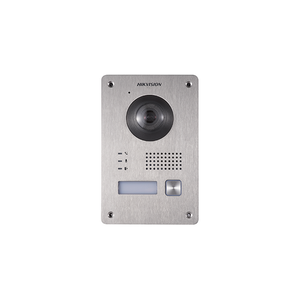
Hikvision DS-KAD706Y-SP Two-Wire IP Distributor
The Hikvision DS-KAD706Y-SP is a network signal distribution device designed to simplify multi-endpoint IP security and communication system deployments. Rather than running individual cables to each connected device, the DS-KAD706Y-SP converts a single IP network signal into a two-wire protocol, allowing you to daisy-chain multiple devices while reducing the infrastructure footprint and installation labor. This approach is particularly valuable in retrofit projects or cost-constrained deployments where minimizing cabling complexity matters.
Key Features
- Two-wire multi-device support: Connects up to 8 devices (6 unpowered endpoints + 2 cascading ports) over a single two-wire protocol, eliminating the need for dedicated cables to each device and cutting installation time on mid-to-large system expansions.
- Single RJ45 network input: One centralized connection point to your IP network means less cable routing complexity and fewer potential single points of failure in the distribution backbone.
- 24 VDC power supply: Provides stable, regulated power to the distributor and its connected endpoints, reducing dependency on localized power solutions and simplifying UPS considerations in security-critical installations.
- Eight independent signal indicators: LED status lights for each connected device enable rapid visual diagnostics without requiring a terminal connection or software tool—especially useful during commissioning and troubleshooting in field conditions.
- Cascading capability: The two dedicated cascading ports allow daisy-chain expansion, letting you add more endpoint groups without requiring additional backbone cabling or network switches—a genuine asset for phased system growth.
- Wide operating temperature range (-10°C to 55°C): Supports both indoor and semi-protected outdoor installations (parking structures, loading docks, climate-controlled vaults), eliminating the need for separate indoor/outdoor SKUs in many deployments.
- Humidity tolerance (10% to 90%): The broad environmental envelope reduces the risk of condensation-related failures in transitional spaces like mechanical rooms or loading bays where temperature and humidity fluctuate.
- Manual reset function: A physical reset button on the device allows field troubleshooting without requiring network access or removal of the unit, reducing on-site downtime during commissioning or after power cycling.
Integration and Deployment Context
The DS-KAD706Y-SP integrates into Hikvision IP ecosystems where multiple door controllers, intercoms, or access devices must be networked across larger facilities. The two-wire protocol reduces the cabling footprint compared to traditional point-to-point architectures—a meaningful cost lever in buildings with distributed security zones or complex conduit runs. Cascading support means you can segment a large facility into logical endpoint clusters without requiring a secondary network switch or additional backbone capacity.
For system designers and integrators, the key tradeoff is simplicity versus active signal conditioning. The DS-KAD706Y-SP appears to function primarily as a passive signal distributor rather than an amplifier or repeater. This is suitable for well-designed network topologies with reasonable distance runs, but you'll need to validate cable lengths and signal integrity if deploying across longer horizontal distances or through electrically noisy environments.
Frequently Asked Questions
Q: What is the maximum cable distance I can run from the DS-KAD706Y-SP to each connected device?
A: The evidence provided does not specify maximum two-wire cable run distances. Consult the manufacturer datasheet or contact technical support with your specific topology (cable gauge, environment, run length) before finalizing conduit routing in large facilities.
Q: Can the DS-KAD706Y-SP power connected devices directly, or do endpoints require separate power?
A: The DS-KAD706Y-SP supplies 24 VDC to power the distribution protocol and can support unpowered endpoints over the two-wire bus. Confirm your specific devices' power requirements with the manufacturer, as some endpoints may draw more current than the distributor's power budget allows.
Q: Does the DS-KAD706Y-SP work with non-Hikvision IP devices?
A: The device is designed for Hikvision IP ecosystems. Two-wire protocol compatibility is vendor-specific. Verify interoperability with any third-party endpoints before deployment.
Q: What happens if one of the eight connected devices fails?
A: The LED indicators will show a loss of signal on the failed device's port. The remaining seven devices should continue operating normally. The two-wire protocol isolates faults to individual endpoints without cascading disruption across the entire group.
Q: Can I use the cascading ports to extend the system to more than 8 devices?
A: Yes. The two cascading ports enable daisy-chain topology, allowing you to connect a second DS-KAD706Y-SP (or compatible distributor) to expand capacity. Plan your cascading topology during design phase to avoid signal degradation over long cascaded chains.
Q: Is the DS-KAD706Y-SP suitable for outdoor installations?
A: The device operates from -10°C to 55°C and tolerates 10–90% humidity, making it suitable for semi-protected outdoor environments (covered loading docks, vented equipment rooms) but not for direct weather exposure. Enclose in a weatherproof cabinet or use an outdoor-rated junction box if mounting outside a protected space.
Ted PerryPerspective based on aggregated IP Security Depot and affiliated engineering team experience.
The DS-KAD706Y-SP addresses a specific cabling problem: how to connect multiple IP endpoints (controllers, intercoms, readers) across a facility without running dedicated network runs to every device. By using a two-wire protocol over a single RJ45 backbone, this distributor eliminates the complexity of point-to-point wiring while maintaining signal integrity for most well-designed network topologies. It's particularly useful in retrofit scenarios where adding new cable trays or expanding conduit isn't practical.
Technical Highlights:
- Eight independent signal indicators: Provides immediate visual feedback on endpoint status without requiring software access. During commissioning and troubleshooting, you can diagnose connection issues at a glance—critical in facilities without nearby network monitoring stations.
- 24 VDC regulated supply: Powers the distribution logic and can supply unpowered endpoints over the two-wire bus, reducing the number of localized 12V or 24V supplies you need to install and manage. This centralizes power provisioning and simplifies UPS considerations.
- Cascading ports (2 of 8 connections): The dedicated cascade ports enable multi-distributor daisy-chain topologies, allowing phased system expansion without requiring additional network infrastructure or switch port capacity. Plan cascade depth during design to manage signal attenuation.
- Operating range -10°C to 55°C: Broad enough for semi-outdoor deployments (covered loading docks, climate-controlled vaults, mechanical rooms), but not for direct sunlight or weather exposure. Enclose in a weatherproof housing if mounting outside.
Deployment Considerations:
- Signal distribution vs. amplification: The DS-KAD706Y-SP appears to function as a passive protocol converter rather than an active repeater. Validate cable lengths and signal quality in your specific environment—electrically noisy areas (motor rooms, high-current equipment) may require additional shielding or conduit separation.
- Cascading depth penalty: Each cascaded distributor adds latency and potential signal degradation. Document your cascade topology and test end-to-end performance before commissioning to avoid communication dropouts during peak traffic periods.
Best suited for mid-to-large facilities (office parks, hospitality, institutional campuses) deploying distributed access control or IP intercom systems where Hikvision endpoints dominate the bill of materials and cabling simplicity is a cost driver. Not recommended for single-building or sparse deployments where the two-wire protocol adds unnecessary complexity.