
Retention Math That Doesn’t Lie: Bitrate, Motion, and the Storage Traps That Break Deployments
Storage planning is where “looks good on paper” deployments go to die. Most retention misses aren’t caused by the NVR brand or the hard drives — they’re caused by assumptions: a default bitrate, a best-case scene, and forgetting overhead.
- Megapixels and frame rate don’t determine storage. Real bitrate does.
- Motion complexity (trees, traffic, crowds) can double or triple bitrate.
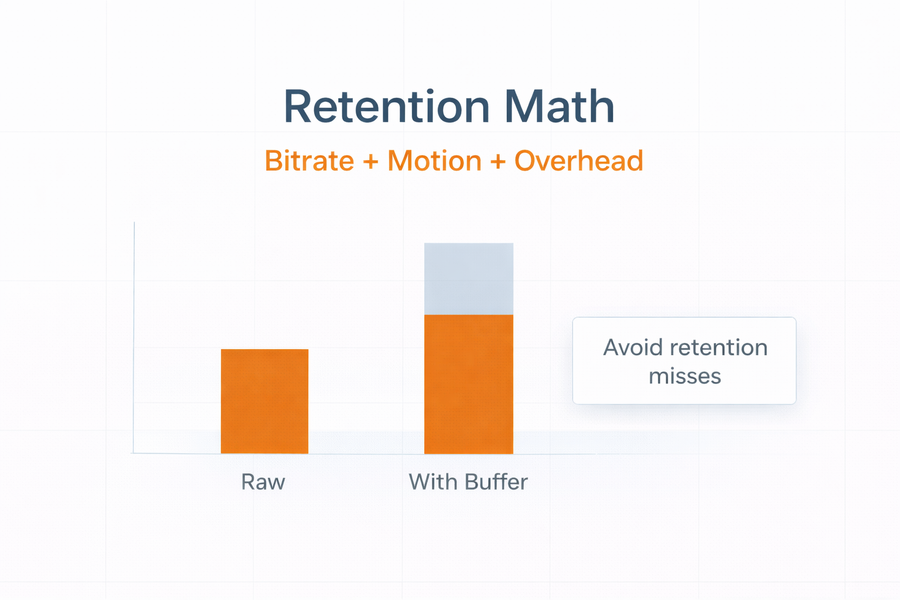
- Always include overhead: VMS, RAID, metadata, audio, and safety buffer.
Why “Default Bitrate” Retention Plans Fail
Camera spec sheets often provide a bitrate range, but the number you actually get depends on:
- Scene motion (busy parking lot vs. quiet hallway)
- Compression settings (H.264 vs H.265, GOP length, profile)
- Frame rate and shutter behavior (especially in low light)
- WDR and noise (night scenes can inflate bitrate dramatically)
- Analytics overlays, metadata, and secondary streams
If you size storage using “best case” bitrate, the site works until it gets real — then retention collapses quietly.
The Practical Inputs That Matter Most
1) Bitrate (Mbps) per camera
If you can pull a real measured bitrate from a test camera or an existing site, do it. If not, use a conservative planning bitrate for the environment and keep a buffer.
2) Recording hours per day
Continuous recording (24/7) is the easiest to size, but it’s also the fastest way to blow retention targets. Many deployments use continuous for critical zones and motion-based recording elsewhere.
3) Retention days
Most organizations have a retention requirement. The trick is meeting it reliably in the worst 30% of real-world conditions.
4) Overhead and safety buffer
Even if the raw math says you’re good, add buffer for real operations: VMS overhead, RAID overhead, index/metadata growth, and “we added two cameras later.”
Fast Storage Calculator (Quick Sizing)
Use this quick estimator to get a reality-check number. This is not a replacement for full engineering, but it prevents the most common retention misses.
Three Storage Traps We See All the Time
1) Nighttime noise inflation
Low light introduces noise. Noise looks like “motion” to compression and can inflate bitrate significantly. This is why some sites meet retention in the day and fail at night.
2) Mixed retention expectations across zones
Not every camera needs the same retention. If you apply a universal retention target to every camera, you pay for storage where it doesn’t increase security outcomes. A better model is tiered retention:
- Tier 1: entrances/choke points (highest value, longest retention)
- Tier 2: interior general coverage (moderate retention)
- Tier 3: context/perimeter (shorter retention or motion-based)
3) Ignoring overhead
Storage math is not just raw video. Add buffer for the real world: RAID parity, VMS overhead, index growth, metadata, and operational change.
How We Validate Retention Before You Buy
If you share camera count, target retention days, and the environment (busy/medium/low motion, day/night conditions), we can help you validate storage requirements and confirm a recording architecture that holds up in the real world.
- Confirm conservative bitrate assumptions per camera zone
- Recommend tiered retention approaches when appropriate
- Validate VMS/NVR platform fit and storage architecture
- Confirm switch PoE budgeting for the camera set
Tell us your platform + site count and retention target — we’ll recommend best-fit models and a deployment-ready recording approach.
Get RecommendationsRelated Resources
- Retention Modeling and Storage Planning
- VMS Selection and Architecture Guide
- Video Recording Platforms Guide
- IP Camera Selection and Deployment Guide
Where This Fits in a Deployment Program
- Commercial Surveillance Solutions
- Data Center Security Systems
- Corporate Office Security Systems
- Education and Campus Security Systems
- Healthcare and Clinics Security Systems
If you want, send your target retention days and an estimated “busy vs quiet” breakdown by camera zone. We’ll sanity-check your storage plan and point out where retention risk is hiding.