



SKU:
D2123-VE
Condition:
New
Warranty:
5-Year Warranty
Industry Leading Prices
Quantity Discounts
Available
Certified Experts
Pre and Post-sales
Support Available
Free Shipping on Orders Over $499
Same Day Shipping on
Most Orders

Axis AXIS D2123-VE Radar 270° AI Perimeter Detection
Add to Cart for Sale Price!
$4,364.99
Description
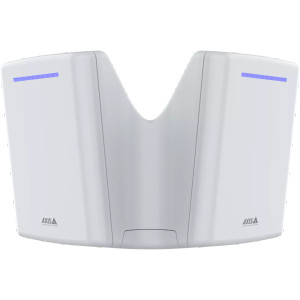
Axis AXIS D2123-VE Radar
Axis AXIS D2123-VE Radar Overview
The AXIS D2123-VE Radar is a 24 GHz FMCW radar sensor engineered for wide-area outdoor perimeter detection with a 270 degree horizontal field of detection. Built on ARTPEC-9 with a deep learning processing unit, it delivers AI-powered classification of humans, vehicles, and unknown objects across large coverage zones, operating 24/7 independent of lighting conditions. In the area monitoring profile, coverage is specified at up to 30,000 m2 for persons and 59,000 m2 for vehicles, with recognition up to 140 m for persons and detection up to 200 m for vehicles when measured at 5 m mounting height. This is a long-range “detect and classify” layer designed to operate standalone or integrate tightly with selected ARTPEC-9 PTZ cameras for radar autotracking and radar-video fusion.
Lens and Coverage Geometry – What Actually Matters
This is not a camera-based detection system; geometry is defined by radar propagation. The 270 degree horizontal field of detection dramatically reduces blind zones compared to 180 degree models and enables broad arc coverage from a single mounting position. Recommended mounting height is 4 to 10 m, and mounting height directly affects detection range and tracking performance. Spatial differentiation is specified at 3 m minimum distance between moving objects, meaning tightly grouped targets closer than 3 m may not be tracked as separate objects. Distance accuracy is rated at 0.9 m, angle accuracy under 0.5 degrees, and speed accuracy at +/- 2 km/h, with radial speed support up to 80 km/h. Data refresh rate is 6.67 Hz, which is sufficient for perimeter tracking and handoff to PTZ cameras. The system uses box-shaped detection and recognition zones, simplifying coverage planning and enabling predictable zone boundaries for line crossing detection and exclusion filtering.
AI and Analytics
Object metadata includes object type classification (humans, vehicles, unknown), range, direction, and velocity. The radar supports AXIS Radar Autotracking for PTZ (slew to cue) and enables radar-video fusion workflows where radar classification is validated by AI video analytics before alarm decisions are made. Multiple detection zones, one or two line crossing rules, exclusion zones, speed filters, object type filters, configurable trigger durations, and swaying object filters are supported. Radar transmission can be controlled on or off, and installation aids include reference map calibration, tilt angle sensor, and manual GPS position entry to embed object GPS coordinates in the data stream. Dynamic LED strip functionality with RGB LEDs and predefined light patterns supports deterrence or status indication at distances up to 60 m in direct sunlight.
Image Quality and Low Light Performance
Detection performance is independent of illumination and weather-related light changes. For contextual visualization, the device supports video streaming up to 10 fps across resolutions from 1920x1080 down to 320x200 in 16:9 and 1440x1080 down to 160x120 in 4:3. Compression formats include H.264, H.265, AV1, and Motion JPEG, with Axis Zipstream in H.264 and H.265. Up to 20 unique and configurable video streams are supported. Low latency mode and controllable frame rate and bandwidth settings allow tuning for integration scenarios.
Environmental and Durability Ratings
The AXIS D2123-VE Radar is rated IP66 and IP67, NEMA 4X, and IK10, supporting deployment in harsh exterior environments. Operating temperature is -40 C to 60 C with humidity 10 to 100 percent RH non-condensing. The casing is aluminum and plastic. Environmental approvals include IEC/EN 60529 IP66/IP67 and IEC/EN 62262 IK09/IK10. Effective projected area is 0.09 m2, relevant for pole load calculations.
Infrastructure and Security Considerations
Networking uses shielded RJ45 10/100/1000BASE-T with PoE input and a second shielded RJ45 providing 1000BASE-T PoE output to power an external PoE device. Input power is IEEE 802.3bt Type 2 Class 4, typical 11.5 W and maximum 19.6 W. PoE output capability depends on upstream power class: Type 3 Class 6 output requires Type 4 Class 8 input, and Type 2 Class 4 output requires Type 3 Class 6 input. Storage supports microSD, microSDHC, and microSDXC with AES-XTS-Plain64 256bit SD card encryption and NAS recording. Cybersecurity controls include signed OS, secure boot, encrypted filesystem (AES-XTS-Plain64 256bit), secure element (CC EAL 6+ and FIPS 140-3 Level 3), IEEE 802.1X, TLS v1.2/v1.3, OAuth 2.0 support, and host-based firewall. ONVIF Profiles G, M, S, and T are supported.
When This Is the Right Choice
This radar is appropriate for wide perimeter arcs, yards, logistics sites, rail corridors, and critical infrastructure where 270 degree coverage from a single mounting location reduces device count and infrastructure cost. It is particularly effective when paired with PTZ cameras for automated slew-to-cue and layered validation.
When It Is Not the Right Choice
This device does not provide evidentiary facial or license plate detail. It is a detection and classification layer, not a high-resolution identification camera. Also, tightly packed targets under 3 m separation may not be independently tracked.
Have Questions?
Ask an Expert.
RELATED PRODUCTS


