


SKU:
D2122-VE
Condition:
New
Availability:
Usually Ships Same Business Day
Warranty:
5-Year Warranty
Industry Leading Prices
Quantity Discounts
Available
Certified Experts
Pre and Post-sales
Support Available
Free Shipping on Orders Over $499
Same Day Shipping on
Most Orders

Axis AXIS D2122-VE Radar 180° w/AI Classification
Add to Cart for Sale Price!
$3,394.99
Description
Axis AXIS D2122-VE
Axis AXIS D2122-VE Overview
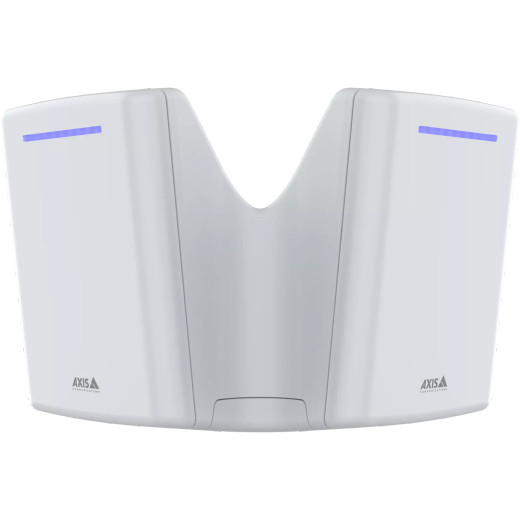
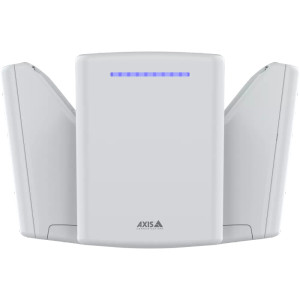
AXIS D2122-VE is an outdoor-ready FMCW radar sensor designed for wide-area perimeter awareness with a true 180 degree horizontal field of detection and AI-powered classification. It is built on ARTPEC-9 with a deep learning processing unit and is intended to run standalone as a radar layer, or to integrate with selected ARTPEC-9 PTZ cameras for radar autotracking and radar-video fusion workflows. In practical security design terms, this is a “find and hand off” sensor: radar does the long-range, all-light detection and classification, then triggers downstream actions such as PTZ slew-to-cue, dynamic LED strip behavior, notifications, or third-party workflows through open APIs and ONVIF profiles. The coverage numbers are meaningful: up to 20,000 m2 for persons and 39,000 m2 for vehicles in the area monitoring profile, with recognition out to 140 m for a person and vehicle detection out to 200 m (measured at 5 m mounting height). This is the kind of sensor you deploy to reduce false alarms and operator fatigue in large exterior zones where video analytics alone tends to get noisy.
Lens and Coverage Geometry – What Actually Matters
There is no lens here, but geometry still rules outcomes. The radar provides 180 degrees horizontal field of detection and is designed around box-shaped detection and recognition zones, which simplifies coverage planning compared to free-form polygons. Recommended mounting height is 4 to 10 m, and the mounting height directly impacts detection performance. Spatial differentiation is specified at 3 m minimum distance between moving objects, with distance accuracy of 0.9 m and angle accuracy below 0.5 degrees. Data refresh rate is 6.67 Hz, which is fast enough for reliable track continuity for typical perimeter targets, and radial speed supports up to 80 km/h. If you expect closely spaced targets (groups walking tight, vehicles tailgating), that 3 m spatial differentiation becomes the practical limiter for separate tracks. The system supports multiple detection zones, line crossing detection (one or two lines), and exclusion zones with filters for short-lived objects, object speed, and object type, which is where you tune nuisance alarms out of the design.
AI and Analytics
The radar outputs object metadata including object type classes (humans, vehicles, unknown), plus range, direction, and velocity. It supports AXIS Radar Autotracking for PTZ (slew to cue) and can participate in radar-video fusion where the radar trigger and classification are validated by a second layer of AI video analytics before an alarm decision is made. This two-stage approach is explicitly positioned to minimize false alarms and improve decision quality, especially in darkness and adverse weather where cameras struggle. Built-in installation aids include reference map calibration, a tilt angle sensor, and GPS position support (manual entry required to obtain objects’ GPS position in the data stream).
Image Quality and Low Light Performance
Radar performance is inherently 24/7 and not dependent on illumination. For operators who still need visual confirmation, the device includes video streaming capability up to 10 fps across resolutions from 1920x1080 down to 320x200 (16:9) and supports H.264, H.265, AV1, and Motion JPEG, with Axis Zipstream in H.264/H.265 and up to 20 unique and configurable video streams. Low latency mode is supported. The video layer is not the detection engine; it is there for context and workflows such as pairing and verification.
Environmental and Durability Ratings
This is an exterior-grade device: IP66/IP67 and NEMA 4X, with IK10-rated casing (general section) and approvals listing IEC/EN 62262 IK09/IK10. Operating temperature is -40 C to 60 C with 10 to 100% RH non-condensing. The casing is aluminum and plastic. For harsh coastal or industrial atmospheres, corrosion resistance is indicated by ISO 12944-6 C5 and NEMA Type 4X alignment, making it appropriate for exposed perimeter poles and walls.
Infrastructure and Security Considerations
Networking includes shielded RJ45 for 10/100/1000 with PoE, plus a second shielded RJ45 providing PoE output to power an external PoE device. Input power is IEEE 802.3bt Type 2 Class 4 with typical 9 W and max 15 W. If you need PoE output, budgeting changes: PoE output Type 3 Class 6 requires the radar be powered by Type 4 Class 8 with max 66 W, and PoE output Type 2 Class 4 requires the radar be powered by Type 3 Class 6 with max 40.5 W. Storage supports microSD with SD card encryption (AES-XTS-Plain64 256bit) and NAS recording. Cybersecurity includes signed OS, brute force delay protection, digest authentication, OAuth 2.0 flows, and Axis Edge Vault with secure element (CC EAL 6+ and FIPS 140-3 Level 3), secure boot, and encrypted filesystem (AES-XTS-Plain64 256bit). IEEE 802.1X is supported, along with TLS v1.2/v1.3 and related controls.
When This Is the Right Choice
AXIS D2122-VE is the right choice when you need long-range, wide-area detection and classification across large outdoor zones, and you want dependable performance independent of lighting, with the option to drive PTZ autotracking and multi-device automation. It is ideal for perimeter lines, yards, lots, and approaches where video-only analytics struggle with weather, headlight glare, or low contrast.
When It Is Not the Right Choice
This is not a replacement for a high-detail identification camera. If your primary requirement is facial or license plate evidentiary detail, you still need properly designed camera coverage. Also, if you need 360 degree coverage from a single point, this is a 180 degree sensor and must be positioned accordingly.
Have Questions?
Ask an Expert.
RELATED PRODUCTS


