
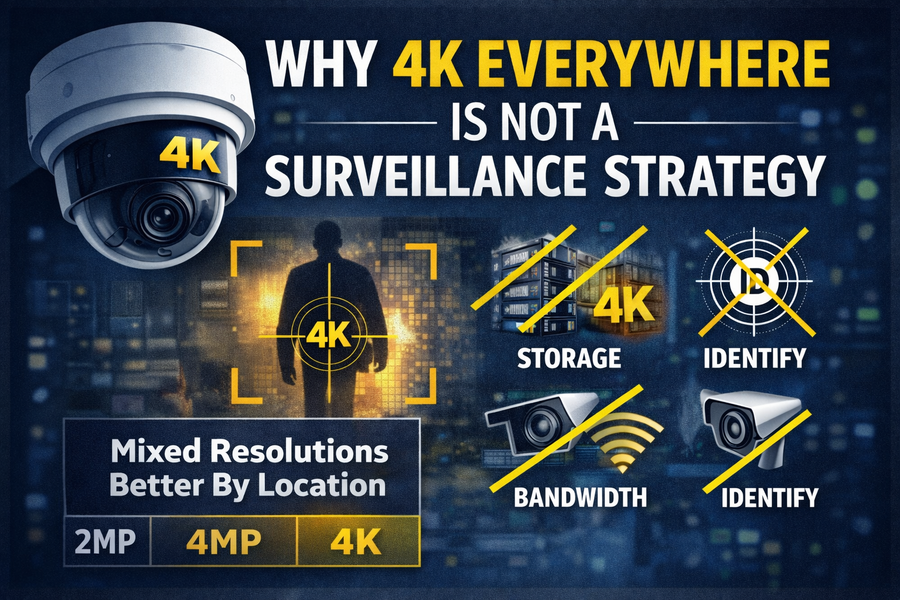
Why 4K Everywhere Is Not a Surveillance Strategy
A lot of surveillance projects fail for a predictable reason: the camera plan was built around resolution instead of evidence outcomes. “Let’s just do 4K everywhere” sounds safe, and it looks great in a demo. But in real deployments, that mindset creates unstable recording, shortened retention, overloaded networks, and a system that still fails at identification when it matters.
The core issue is simple. Resolution is only one variable in a surveillance system. Identification performance is the result of capture geometry, pixels on target, exposure discipline, bitrate behavior, retention policy, and export workflow. If those are not engineered, 4K becomes an expensive way to generate more unusable footage.
The Resolution Myth: More Pixels Does Not Equal More Evidence
4K increases total pixels in a frame. It does not guarantee that the pixels you need are on the target you care about. Most identification failures happen because the subject is too small in the frame, the shutter is wrong for motion, the scene is backlit, or compression destroys fine detail under motion.
If a camera is watching a wide area and the subject occupies 3 percent of the image width, increasing the resolution can help, but it is often the wrong first move. A tighter lens, a better angle, or a dedicated capture point usually produces a bigger improvement than doubling or quadrupling resolution.
- Wide view + distant subjects = low pixels on target, even in 4K
- High motion scenes = compression and shutter discipline matter more than raw pixels
- Backlight or glare = exposure strategy and placement dominate resolution
What Actually Matters: Pixels on Target and Evidence Intent
The correct way to plan cameras is to define evidence intent first. Most zones fall into four practical categories:
- Overview: general situational awareness, low detail requirements
- Detection: reliably noticing presence or movement
- Recognition: confirming “it is probably that person/vehicle”
- Identification: face or plate-grade detail where evidence must hold up under scrutiny
A system built around identification outcomes will almost never be “4K everywhere.” It will be a mixed-resolution design with dedicated identification cameras in specific capture points and lower-resolution cameras for coverage and context.
If you have not defined evidence intent by zone, start with the camera planning guide: IP Camera Selection & Deployment Guide.
4K Has a Cost: Bandwidth, Storage, and Retention Pressure
The fastest way to break a surveillance system is to over-spec resolution without modeling retention and bitrate behavior. The platform may record fine in a demo, but it fails under real scene conditions: multi-user exports, retention requirements, and high-motion periods that force bitrates to spike.
If you move from 4MP to 4K across many cameras, you are not just increasing storage. You are increasing:
- network throughput requirements and switch uplink pressure
- PoE budget density in edge closets
- recording server/NVR write load
- retention volatility under motion
- export time and evidence workflow friction
If retention is a real requirement (and in most commercial environments it is), model it before you pick “features”: Retention Modeling & Storage Guide.
If you have not stabilized the network and PoE plan, 4K is usually a premature decision: Network & PoE Planning Guide.
Lens Geometry Still Determines Identification
This is where most buyers get surprised. Even with high resolution, a wide-angle lens can make the subject too small for identification. Cameras do not identify because they are “4K.” They identify because the subject occupies enough of the sensor with stable exposure and adequate shutter for motion.
A clean design usually looks like this:
- wide coverage cameras for context and movement awareness
- dedicated identification cameras at chokepoints, doors, counters, lanes, or aisle ends
- exposure strategy aligned to lighting and motion
If your plan is “one camera does everything,” you will usually end up with an expensive overview camera and still miss identification when it matters.
When 4K Is the Right Choice
4K can be the correct choice, but it should be used intentionally. 4K typically makes sense when:
- you need digital zoom after the fact and the scene is stable
- the subject is consistently within a defined distance band
- you have enough bitrate headroom to preserve detail under motion
- retention targets have been modeled and approved
- the network and recording architecture is sized for load, not demos
If you are using 4K to compensate for weak placement, wrong lens selection, or undefined evidence intent, it will not save the system.
Resolution Discipline Quick Check
Use this as a fast validator. It is not a “calculator.” It is a design discipline check to prevent the most common mis-buy.
Need Help Building a Mixed-Resolution Camera Plan?
Tell us your zones, retention requirement, and identification needs. We will outline a camera plan and recording architecture that holds up under real motion and real exports.