
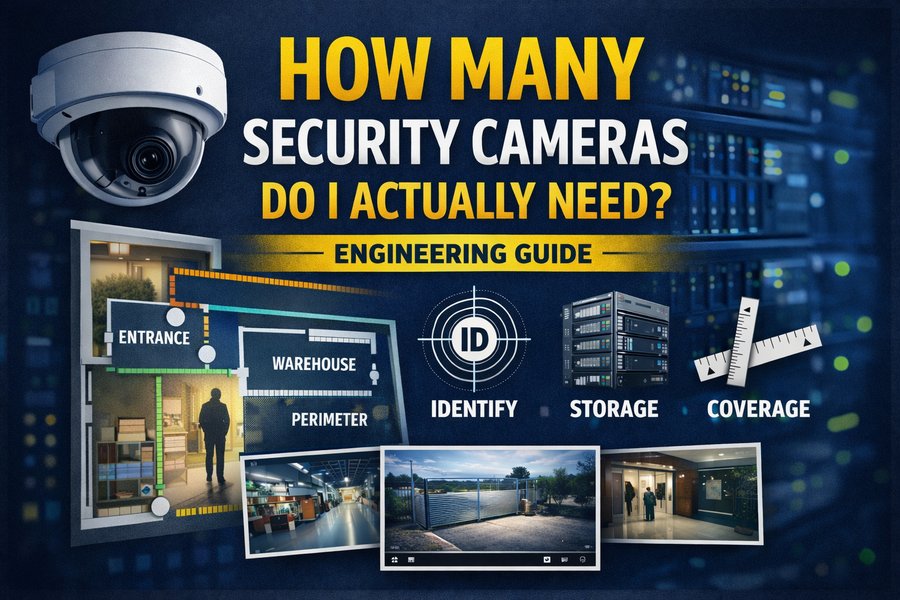
How Many Security Cameras Do I Actually Need? (A Real Engineering Answer)
One of the most common commercial surveillance questions is also one of the most misunderstood: how many cameras do I need?
The honest answer is not “one per 1,000 square feet” or any other rule of thumb you may have heard. Camera count is determined by coverage objective, identification requirements, environmental complexity, and retention policy — not square footage alone.
This guide walks through the engineering variables that actually determine camera quantity and how to model it correctly.
Step 1: Define What “Coverage” Means
There are three fundamentally different surveillance objectives:
- Detection – Something happened.
- Observation – We can see activity clearly.
- Identification – We can identify a person or object with evidentiary clarity.
Identification-grade coverage requires significantly tighter field-of-view discipline than detection. If your objective is ID at entrances, POS lanes, loading docks, or badge-controlled doors, camera count increases accordingly.
Read the Full IP Camera Deployment Guide →
Step 2: Break the Facility Into Coverage Zones
Professional deployments do not start with square footage. They start with zone mapping.
Entrances & Exits
- ID-grade camera
- Controlled lighting strategy
- Tighter field of view
Operational Floor
- Wide-area coverage
- Overlapping sight lines
- Blind spot mitigation
Exterior & Perimeter
- Environmental resilience
- Standoff detection distance
- Lighting + analytics pairing
Once zones are mapped, camera count becomes a geometry exercise rather than a guess.
Step 3: Field of View Determines Quantity
Wider lenses reduce camera count but also reduce identification quality. Narrower lenses increase identification fidelity but increase camera quantity.
If you are targeting identification at 20 feet, your usable field width is dramatically smaller than if you are targeting general detection.
Use the Coverage Planning Tool →
Step 4: Retention Policy Impacts Design
Camera count directly affects storage modeling.
- Resolution
- Frame rate
- Bitrate control
- Recording schedule
- Retention window (30, 60, 90 days)
Want an Engineering-Based Camera Count?
Tell us your facility type, square footage, identification objectives, and retention target. We will outline a practical coverage map before recommending hardware.