
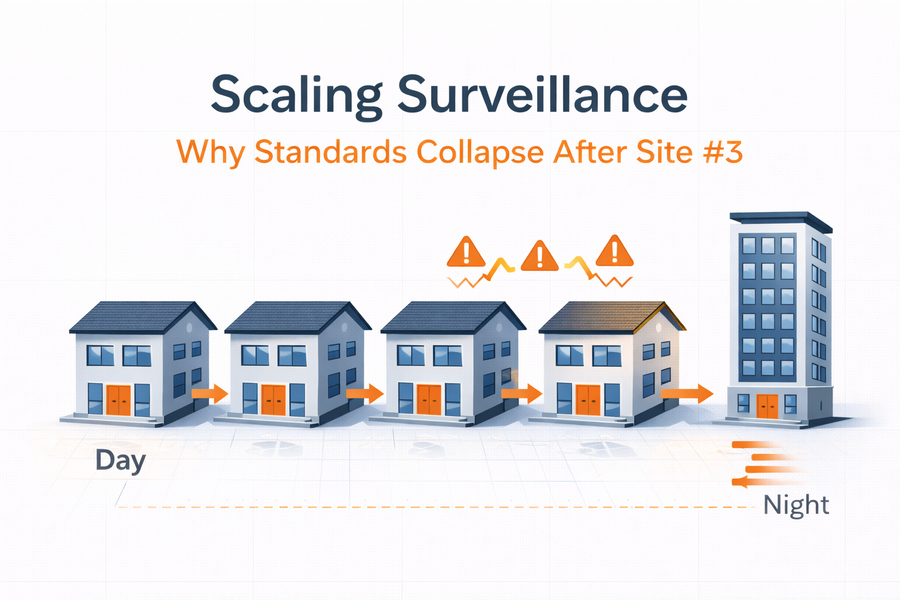
Why Surveillance Standards Collapse After the Third Location
Most surveillance programs scale like this:
- Location 1: Designed carefully.
- Location 2: Minor adjustments.
- Location 3: “Just copy the last one.”
- Location 4+: Everything starts drifting.
By location five, you don’t have a standard anymore. You have variations.
- A model list is not a standard.
- Standards must define coverage intent, not just part numbers.
- Storage, power, and retention assumptions must scale with volume.
- Governance matters more than hardware consistency.
The Hidden Drift Problem
Multi-site deployments fail quietly. Not catastrophically — gradually.
Common drift patterns:
- Different mounting heights per installer
- Inconsistent lens selection
- Varying bitrate or FPS settings
- PoE switches swapped due to availability
- Retention periods altered due to storage pressure
By the time leadership reviews footage, identification quality varies wildly by site.
A Real Standard Defines Outcomes
Strong surveillance standards define:
- Identification zones (pixel density targets)
- Shutter settings for motion areas
- Low-light expectations
- Nighttime bitrate assumptions
- PoE class requirements
- Retention targets (worst-case planning)
If your standard is “Use Model X,” it will fail at scale.
The 5-Layer Repeatability Framework
1. Coverage Layer
Define pixel density and DORI-based intent per zone type. Not per camera model.
2. Performance Layer
Set minimum shutter speed, max FPS, and acceptable bitrate ranges. Avoid per-site improvisation.
3. Storage Layer
Retention must be modeled for worst-case nighttime bitrate — not average load.
4. Power Layer
Specify PoE class and watt buffer. Do not allow switch substitutions without watt verification.
5. Governance Layer
Document configuration baselines. Require installer signoff. Audit quarterly.
Where Multi-Site Programs Usually Break
- Procurement substitutes hardware mid-program
- Different VMS versions across sites
- IT enforces bandwidth caps without adjusting settings
- Local contractors improvise mounting decisions
Consistency requires authority. Authority requires documentation. Documentation requires intent.
How This Connects to the Full Stack
- Pixel density defines coverage intent
- Frame rate impacts identification reliability
- Noise increases storage requirements
- PoE constraints shape infrastructure choices
- Governance protects long-term consistency
Share your current spec sheet. We’ll identify drift risks and help you build a repeatable deployment standard.
Request Standard ReviewStrong surveillance programs don’t rely on hardware consistency alone. They rely on architectural consistency.