
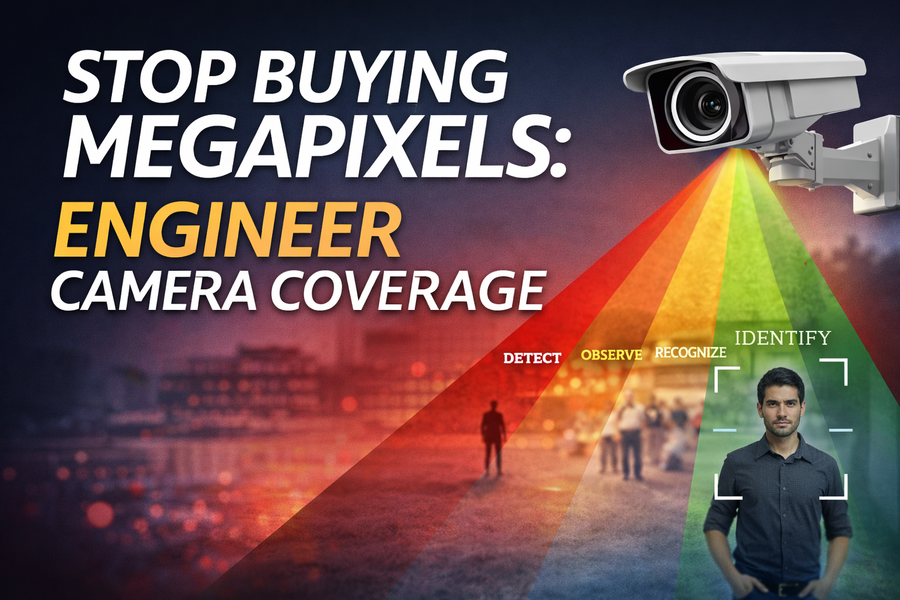
Stop Buying Megapixels: How to Actually Engineer Camera Coverage
Most surveillance systems do not fail because of hardware defects. They fail because of design mistakes.
The most common one?
Buying cameras based on megapixels instead of coverage geometry.
A 12MP camera mounted at the wrong height with the wrong lens is worse than a 4MP camera engineered correctly. Resolution alone does not determine identification capability. Pixel density and scene geometry do.
If you are responsible for specifying, installing, or approving surveillance systems, this matters.
Megapixels Do Not Equal Identification
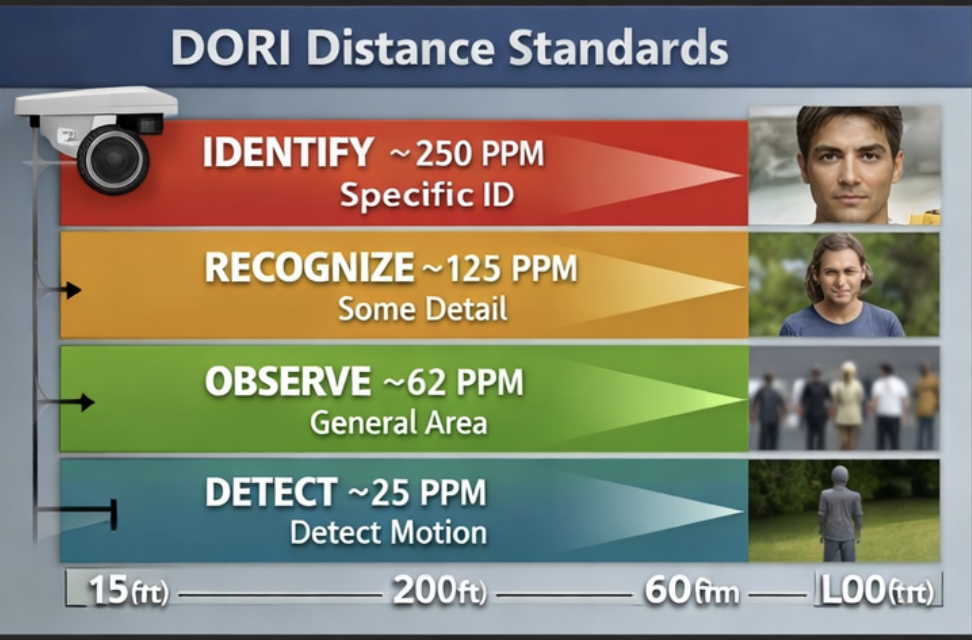
Megapixels determine total image resolution. They do not determine usable pixel density at a specific distance.
What matters is pixels per foot or pixels per meter.
- Identification typically requires around 250 pixels per meter.
- Recognition is around 125 pixels per meter.
- Observation is lower.
- Detection is lower still.
This is the basis of DORI: Detection, Observation, Recognition, Identification.
When manufacturers list DORI distances, they are assuming ideal mounting height, ideal lighting, and correct lens selection. Real-world performance depends on how you deploy the camera.
Link: enterprise IP cameras engineered for identification
Field of View vs Pixel Density
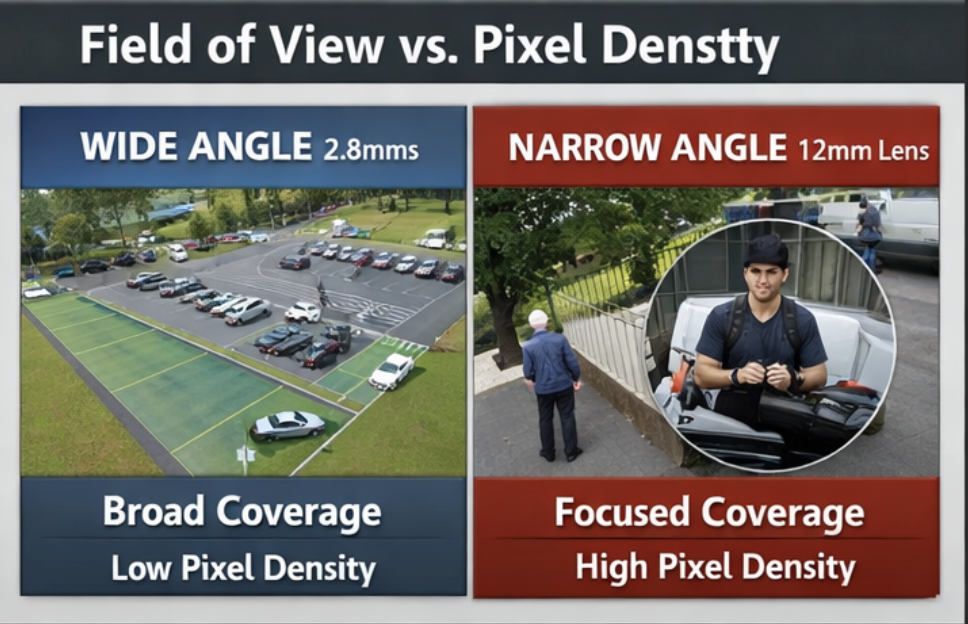
Every camera lens is a tradeoff between coverage width and pixel density.
Wider field of view:
- Covers more area
- Reduces pixel density at distance
- Better for situational awareness
Narrower field of view:
- Increases pixel density
- Improves identification distance
- Covers less area
A common mistake is using a wide 2.8mm lens to cover a parking lot and expecting license plate identification at 150 feet. Physics does not cooperate.
If identification is the objective, you must tighten the field of view or increase resolution accordingly.
Link: license plate recognition systems
Mounting Height Is Not Neutral
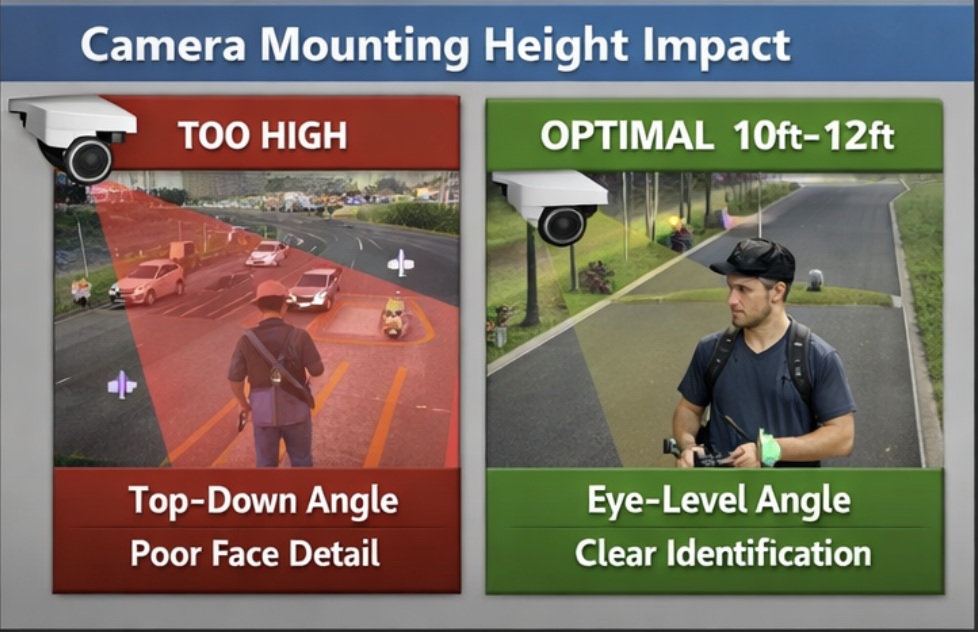
Mounting height directly impacts facial identification performance.
Too high:
- Faces become top-down
- Hats obscure facial features
- Pixel density spreads vertically
Too low:
- Increased vandal risk
- Limited coverage footprint
For entry identification, mounting between 8 and 12 feet is typically ideal. For perimeter coverage, higher mounts are acceptable when identification is not the objective.
Link: Outdoor IP Cameras
AI Analytics Do Not Fix Bad Geometry
AI analytics such as human detection, vehicle detection, line crossing, or intrusion detection can reduce false alerts. They cannot restore pixel density that was never there.
If the image lacks detail at the required distance, analytics cannot compensate.
AI improves efficiency. It does not override physics.
Link: PTZ IP Cameras
Low Light Performance Is Not Just IR Distance
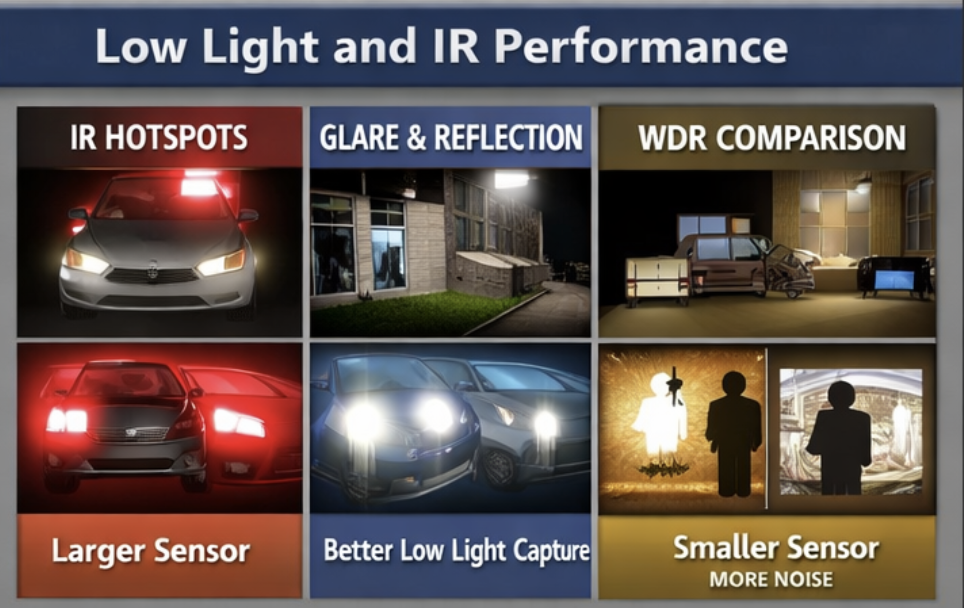
IR distance numbers assume optimal reflectivity. Real-world IR performance depends on:
- Scene reflectivity
- Mounting angle
- Fog, rain, and snow
- Lens quality
- Sensor size
A 4MP camera with a larger sensor and better dynamic range will often outperform a higher megapixel unit in mixed lighting environments.
Always evaluate:
- Sensor size
- WDR rating
- Minimum illumination
- IR uniformity
Link: Thermal IP Cameras
Design First, Hardware Second
When specifying a surveillance system, define the objective first:
- Is this camera meant to detect movement?
- Recognize a known employee?
- Identify an unknown individual?
- Capture license plates?
- Provide situational awareness?
Once the objective is defined, calculate pixel density at the required distance. Then choose resolution and lens.
Not the other way around.
Don't Forget
Over-specifying resolution wastes budget. Under-engineering coverage creates liability.
Surveillance is not about buying cameras. It is about engineering outcomes.
At IP Security Depot, we approach systems design from geometry, pixel density, and deployment constraints, not marketing labels.
If you are unsure whether your design supports true identification at the required distance, start with the math before adding more megapixels.
Contact us Today to get started with a system design consultation