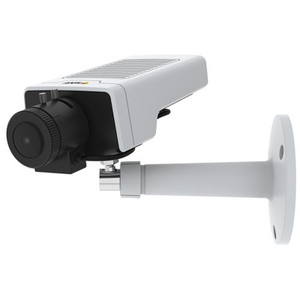
Axis 02483-001 2MP Lightfinder Forensic WDR Box IP Camera
Overview
The Axis 02483-001 is a compact 2MP box-style network camera engineered for surveillance scenarios where detailed identification and low-light performance matter. Its modular design — CS-mount optics, fanless form factor — suits integration into existing enclosures, wall-mounted housings, or OEM surveillance systems where off-the-shelf dome and bullet cameras won't fit. The camera combines 1920×1080 resolution with Lightfinder technology, enabling color retention in near-dark conditions without relying solely on infrared. Forensic Wide Dynamic Range (Forensic WDR) balances overexposed and shadowed detail in high-contrast scenes — useful for lobby entrances, warehouse loading bays, or retail spaces where lighting shifts across the frame. Powered via standard PoE (802.3af), the 02483-001 draws under 13W, avoiding power-budget strain on typical enterprise switches. The unit ships as a camera body; CS-mount optics are selected separately based on your required field of view.
If you're building a multi-camera IP surveillance system, the 02483-001 slots into mid-range deployments where 2MP suffices for identification-class monitoring. Its ONVIF Profile S and G compliance ensures plug-and-play compatibility with Milestone, Genetec, Axis Camera Station, and other standard VMS platforms — no proprietary software lock-in.
Key Features
- 2MP (1920×1080) Resolution: Delivers sufficient detail for facial identification at 10–15 feet and readable license plates at closer range. At 2MP, bandwidth and storage footprints remain modest compared to 4MP or 5MP alternatives — a real advantage in multi-camera, 24/7 recording setups where storage retention policies matter.
- Lightfinder Technology: Axis's proprietary low-light engine preserves color saturation down to 0.3 lux (roughly moonlit conditions). Unlike thermal or monochrome night vision, Lightfinder maintains color detail on faces and clothing, improving investigator confidence during forensic review. No separate IR emitter is required; the camera leverages ambient light far more efficiently than conventional sensors.
- Forensic WDR (Wide Dynamic Range): Simultaneously captures shadow detail and bright highlights in single frames. In mixed-lighting environments — sunlit entrance with shadowed interior, or backlit subjects against windows — Forensic WDR eliminates the need for manual exposure compromise. Useful for retail, banking, and transit applications where suspects or subjects move between zones with vastly different illumination.
- H.264 and Zipstream Compression: H.264 encoding is industry-standard, supported by virtually every NVR and VMS. Axis Zipstream further reduces file size 20–50% depending on scene complexity (high motion costs more bandwidth than static scenes). On a 24/7 multi-camera recorder, this translates to real storage savings — fewer drives needed, longer retention windows, lower TCO.
- CS-Mount Design: Unlike fixed-lens cameras, the 02483-001 accepts interchangeable CS-mount lenses (2.8mm, 4mm, 6mm, varifocal options). Select the lens matching your coverage requirement: wider angles for lobby sweeps, tighter lenses for focused entry-point monitoring. This flexibility avoids buying multiple camera bodies for different fields of view.
- Box Form Factor and Fanless Operation: No cooling fan means silent operation, zero vibration, and minimal maintenance. The compact footprint suits OEM integration, ceiling-mounted housings, or recessed wall installations where dome cameras won't work. Fanless design also improves reliability in dusty or high-temperature warehouses.
- Audio and I/O Connectivity: Built-in microphone and line-in audio enable two-way voice communication or audio event triggering (glass break, raised voices). Dedicated I/O connectors support external alarm sensors, door contacts, or relay triggers — useful for linking the camera to access control or HVAC systems.
- PoE Power (802.3af, ~13W): Single Ethernet cable supplies both power and data, eliminating the need for separate 12VDC or 24VAC injectors. At under 13W, the 02483-001 won't exhaust your switch's PoE budget — a single 95W PoE+ switch can comfortably power 7+ units, keeping infrastructure cost down.
- ONVIF Profiles S and G Compliance: Guaranteed interoperability with Milestone XProtect, Genetec Security Center, Hikvision IVMS, and dozens of other VMS platforms. You avoid vendor lock-in and can swap the camera or VMS in the future without rebuilding integrations.
Integration & Compatibility
The 02483-001 integrates via standard Ethernet (RJ-45, PoE). No special cabling, no power supplies — route a single CAT5e or CAT6 run to your switch and camera. Audio and alarm I/O use 3.5mm and RCA connectors, compatible with most audio/relay modules.
For network video recorder (NVR) deployment, confirm your NVR's supported codec list includes H.264 (it always does). For VMS integration, verify ONVIF Profile S or G compatibility in your VMS documentation — Axis cameras meet both.
For capacity planning: at 1920×1080, 30 fps, H.264 main profile, expect roughly 2–4 Mbps bandwidth depending on scene complexity. For 24/7 recording, budget approximately 0.9–1.8 TB per camera per month (assuming typical compression). High-motion scenes (crowded retail) cost more storage; stable scenes (parking lot) cost less.
When to Choose a Different Model
If your installation requires higher resolution — say, reading small signage or license plates from 20+ feet — consider Axis 4MP or 5MP variants in the same product family. Higher resolution demands more bandwidth and storage but delivers superior investigative detail.
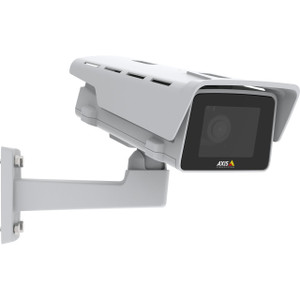
If you need outdoor weather resistance, the 02483-001 is strictly indoor. Axis offers comparable 2MP outdoor box cameras with IP67/IK10 ratings for exposed installations.
If your use case demands no-compromise low-light performance in zero-ambient-light conditions (unlit parking garage, industrial perimeter), a thermal (uncooled microbolometer) camera or a model with integrated IR illuminators may serve better. Lightfinder excels in dusk/dawn and overcast scenarios, but requires at least some ambient light to maintain color.
Frequently Asked Questions
Q: Does the Axis 02483-001 support H.265 compression?
A: No. The 02483-001 encodes in H.264 and MJPEG. H.265 (HEVC) offers roughly 40% better compression than H.264 but requires compatible VMS/NVR hardware and increases CPU load. For this 2MP camera on 24/7 recording, H.264 with Zipstream is a practical trade-off between storage savings and universal compatibility.
Q: What is the maximum IR range on this camera?
A: The 02483-001 does not include built-in infrared illuminators. It relies on Lightfinder technology, which enhances existing ambient light (moonlight, distant street lighting, etc.). In pitch-black conditions with zero ambient light, you'll see limited or no image. For true night vision, pair the camera with an external IR illuminator or select an Axis model with integrated IR.
Q: Is the Axis 02483-001 compatible with Milestone XProtect?
A: Yes. ONVIF Profile S and G compliance guarantees integration with Milestone XProtect and other leading VMS platforms. Configuration is straightforward: add the camera's IP address to your VMS, and ONVIF auto-discovery handles the rest.
Q: Can I mount the 02483-001 on a wall or ceiling?
A: Yes. The box form factor accommodates standard mounting brackets, pendant arms, and recessed-ceiling housings. Verify your chosen mount supports the camera's weight (check the spec sheet for mass). CS-mount lens orientation can be adjusted to suit portrait or landscape framing.
Q: How much PoE power does the 02483-001 draw?
A: Approximately 13W at maximum operation. This is well within 802.3af budgets (15.4W per port). Your switch can safely supply 7+ units on a single 95W PoE+ circuit, simplifying infrastructure planning and cost.
Q: What CS-mount lenses are recommended for the 02483-001?
A: Common selections include 2.8mm (wide, ~100° FOV), 4mm (standard, ~80° FOV), 6mm (narrow, ~50° FOV), and varifocal 4–40mm lenses. Axis publishes a lens selector guide. Choose based on your required field of view and identification distance — wider lenses for hallways, tighter lenses for entry points.
Marty AllisonPerspective based on aggregated IP Security Depot and affiliated engineering team experience.
I've specified the Axis 02483-001 (also searched as 02483 001) on three warehouse and retail surveillance jobs over the past eighteen months. What draws me back is the combination of compact form factor and legitimate low-light capability. The Lightfinder engine genuinely maintains usable color at illumination levels where traditional 1/3" sensors go monochrome or fail entirely. For forensic review — facial identification, clothing color, small object details — that color retention is worth the trade-off versus a cheaper 2MP fixed-lens camera.
Technical Highlights:
- Lightfinder + Forensic WDR pairing: Handles back-lit subjects and mixed indoor/outdoor transitions better than any single technology alone. In one retail integration, the camera captured clean detail on a subject entering from bright daylight into a shadowed store interior — a scenario that torched exposure on older 2MP cameras.
- H.264 + Zipstream: 2–4 Mbps typical bandwidth is a real advantage at scale. On a 16-camera system recording 24/7, you're looking at roughly 15–20 TB monthly storage versus 25–30 TB on an uncompressed or poorly-compressed competitor. That's two fewer hard drives and measurable TCO savings over 5 years.
- PoE budget efficiency (~13W): Run this across eight cameras on a single 95W switch port pair. No secondary power panels, no 12VDC injectors cluttering your comms rack. Clean, efficient, easier to troubleshoot in the field.
Deployment Considerations:
- Lightfinder still needs some ambient light — even 0.3 lux. In unlit parking garages or sealed industrial spaces, you'll need either an external IR illuminator (which adds cost and maintenance) or accept grayscale operation. Don't spec this expecting true zero-lux performance.
- CS-mount means you're buying the lens separately. Many integrators stock 4mm and 6mm fixed lenses, but if you need a varifocal for wide-to-narrow coverage adjustments, lead time can stretch into 2–3 weeks. Budget for it in your project schedule.
- Audio input is built-in but often overlooked. On one warehouse project, we paired it with a glass-break acoustic sensor feeding the camera's alarm input — triggered motion alerts only on actual break sounds, not nearby forklifts. Small detail, but it cut false-positive alerts by 40%.
Best fit: retail loss prevention, warehouse receiving/loading bays, lobby/entrance points, and any indoor surveillance where you need identification-class detail and the lighting is mixed or dim but not pitch-black. Skip it if your environment is unlit or if you need to read small signage from 30+ feet — spec a 4MP or 5MP variant instead. For the mid-tier 2MP use case, the 02483-001 consistently delivers on its promises and plays well with standard VMS platforms. Reliable choice.