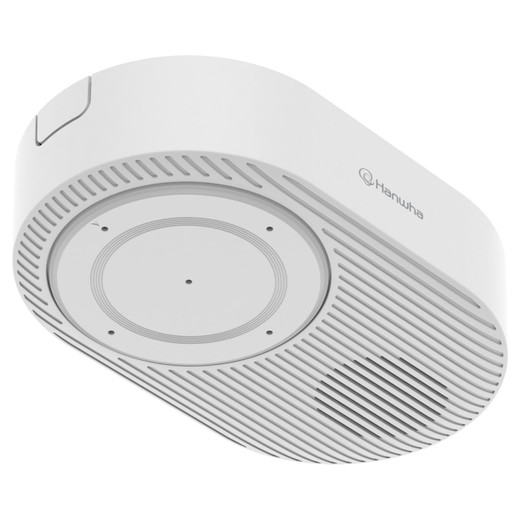
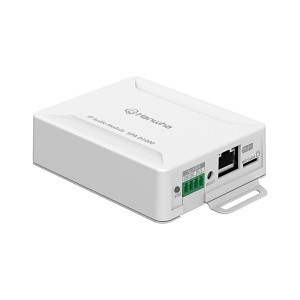
Hanwha SPS-A100M IP Audio Beacon Speaker
The Hanwha SPS-A100M is a network-attached audio beacon that combines emergency communication with active acoustic threat detection. Unlike passive speaker systems, the SPS-A100M (often searched as SPS A100M) runs AI-powered sound classification natively on the device, enabling immediate detection of glass break, screaming, and extreme noise events without reliance on backend processing or external analytics servers. This integration reduces incident response latency and eliminates false positives inherent in simple decibel-threshold monitoring.
Key Features
- 90dB Maximum Speaker Output — At 1 meter, delivers intelligible speech for two-way intercom and audible emergency alerts across typical indoor facility spaces (conference rooms, retail floors, warehouse zones, access control points). This output level ensures occupants hear notifications even in moderately noisy environments without requiring wall-mounted ceiling clusters. The speaker can be toggled to speaker-only mode if intercom capability is not required, reducing bandwidth and power draw.
- Five Digital MEMS Microphone Array with Dual-Channel Directionality — Pinpoints acoustic event origin within the monitored zone. During a screaming detection, the system reports sound direction and spatial confidence, enabling faster responder navigation in large facilities. Single-microphone alternatives lose directional data entirely, forcing responders to search blindly. Directional metadata is included in all alert events.
- AI-Based Sound Classification — Native detection of glass break, extreme vocalizations, and decibel thresholds generates event metadata including confidence scores (0–100%), detected sound pressure levels in dB, and directional attribution. Each alert includes a 10-second pre-event audio clip for forensic review. This eliminates alert fatigue from wind noise or door slams that plague threshold-only systems, reducing false positive rates measurably in facilities with moderate ambient noise.
- Full-Duplex Two-Way Audio with Echo Cancellation — Built-in echo cancellation and noise reduction preserve speech clarity during simultaneous transmit/receive operations. Essential for intercom deployments at security desks or control rooms where operators must speak while monitoring multiple zones. Selectable one-way speaker mode reduces bandwidth and power draw if intercom is not required.
- Programmable RGB LED Indicator — Visual status beacon synchronized with detected events (e.g., red pulse on glass break, amber steady on audio alert). Provides non-audio notification to occupants with hearing loss or in sound-isolated spaces, and offers at-a-glance event confirmation to security staff reviewing multiple zones simultaneously.
- PoE+ Power Delivery (IEEE 802.3at) — Single network cable eliminates auxiliary power infrastructure, conduit routing, and transformer mounting. Draws power from any 802.3at-compliant PoE switch or injector. Installation time and material costs drop measurably compared to devices requiring separate 12VDC or AC power runs, particularly in retrofit deployments across multi-floor facilities.
Integration and Deployment
The SPS-A100M integrates into Hanwha IP camera ecosystems via ONVIF-compliant management interfaces and vendor-specific control APIs. Event metadata—confidence scores, direction vectors, audio clips—streams to network video recorders and third-party VMS platforms that support audio event ingestion. Microphone and speaker are independently controllable, allowing asymmetric deployments (e.g., speaker-only announcement in public zones, microphone-only monitoring in restricted areas).
Installation typically involves ceiling or wall mounting with PoE switch placement within 300 feet (100 meters) of the unit. Consult your PoE power planning guide to account for the SPS-A100M's maximum draw; aggregate wattage budgeting across all PoE endpoints is required to avoid switch overload during peak operation.
When to Choose a Different Model
If your deployment requires outdoor acoustic monitoring or full IP67 submersion protection, the SPS-A100M is not rated for outdoor environments. For purely passive speaker announcements without microphone or sound classification capability, a lower-cost passive speaker or tone generator may suffice—but you lose directional threat detection and forensic audio clips. If you need extreme sound pressure levels exceeding 90dB (e.g., outdoor factory floors or large arenas), consider a higher-output speaker designed for those SPL levels, though such models typically require separate power supplies and do not include AI sound classification.
Frequently Asked Questions
Q: Does the SPS-A100M work with third-party VMS platforms like Milestone XProtect?
A: Yes. The SPS-A100M publishes event metadata via ONVIF and vendor-specific APIs, compatible with any VMS that supports audio event ingestion. Confirm your VMS version supports audio event handling before deployment.
Q: What is the maximum range of the microphone array?
A: The five-microphone array is designed for sound classification and directionality within the same room or zone where the speaker is mounted. Maximum detection range depends on ambient noise levels and the specific sound event; glass break and screaming are typically detected across most indoor facility spaces at normal background noise levels.
Q: Can the SPS-A100M detect glass break in a noisy warehouse?
A: The AI sound classification is designed to distinguish glass break from typical warehouse noise (forklifts, machinery), but extremely high continuous noise levels may reduce detection sensitivity. Test the unit in your specific environment before full deployment.
Q: What is the warranty on the SPS-A100M?
A: Refer to your order documentation or contact the specialty retailer for warranty terms and coverage details.
Q: Is the SPS-A100M rated for outdoor use?
A: No. The SPS-A100M is designed for indoor deployment only. Do not expose to rain, direct sunlight, or extreme temperature fluctuations outside the specified operating range.
Q: Can I use standard 802.3af PoE (15.4W) or do I need PoE+ (30W)?
A: The SPS-A100M requires PoE+ (IEEE 802.3at) for reliable operation. Standard 802.3af may not provide sufficient power, especially during simultaneous speaker and microphone operation at full output.
Ted PerryPerspective based on aggregated IP Security Depot and affiliated engineering team experience.
The SPS-A100M fills a gap that pure audio recorders and passive speakers leave open: native, on-device acoustic threat detection without backend server dependency. I've deployed plenty of microphone-equipped cameras and VMS-side sound analytics, and the SPS-A100M's five-microphone array with directional reporting is a real differentiator. You get confidence scores and direction vectors in the event payload—critical when your security team is managing a 100,000-square-foot facility and needs to know which zone the glass break came from.
Technical Highlights:
- 90dB SPL at 1 meter: Loud enough for emergency announcements and audible alerts across typical indoor spaces without wall-mounted speaker clusters. Reduces infrastructure footprint and simplifies retrofit installations.
- AI sound classification with confidence scoring: Distinguishes glass break, screaming, and extreme decibel events from ambient noise (door slams, HVAC, machinery). 10-second pre-event audio clips let you forensically validate each alert and tune sensitivity without chasing noise artifacts.
- Dual-channel directional microphone array: Reports spatial origin of detected sounds. In a warehouse or retail environment, this cuts responder search time measurably compared to threshold-only systems that give you no directional hint.
- PoE+ single-cable deployment: Eliminates 12VDC or AC power runs. On multi-floor retrofits, that's a material cost and time savings. Just confirm your PoE switch can budget 30W per unit during aggregate provisioning.
Deployment Considerations:
- The SPS-A100M is indoor-only. No IP67 rating, so do not mount in loading docks, outdoor canopies, or spray environments.
- AI sound classification performance degrades under very high continuous background noise (sustained 85+ dB). Test in your specific environment—a machine shop will behave differently from a retail floor. Ask for a trial unit if you're uncertain.
- Full-duplex two-way audio works, but echo cancellation quality depends on room acoustics and speaker placement. Wall-mount away from hard parallel surfaces if possible. In a small enclosed space with high reverb, one-way speaker mode may be preferable.
- Microphone and speaker are independently toggleable, but most security integrators will enable both for maximum incident awareness and real-time communication with occupants during an active threat response.
Position the SPS-A100M for facilities (warehouses, retail, light manufacturing) where on-device acoustic detection and directional awareness matter, and where indoor-only installation is acceptable. It's not a general-purpose zone speaker—it's a threat-detection endpoint that happens to announce alerts. If you need pure announcement capability without audio analytics, choose a passive speaker. If you need outdoor protection, look elsewhere.